 Add to Chrome
 Add to Firefox
 Add to Edge
Why Thinking Hurts? Diagnosing and Rectifying the Reasoning Shift in Foundation Recommender Models
Feb 18, 2026
Integrating Chain-of-Thought (CoT) reasoning into Semantic ID-based recommendation foundation models (such as OpenOneRec) often paradoxically degrades recommendation performance. We identify the root cause as textual inertia from the General Subspace, where verbose reasoning dominates inference and causes the model to neglect critical Semantic ID. To address this, we propose a training-free Inference-Time Subspace Alignment framework. By compressing reasoning chains and applying bias-subtracted contrastive decoding, our approach mitigates ungrounded textual drift. Experiments show this effectively calibrates inference, allowing foundation models to leverage reasoning without sacrificing ID-grounded accuracy.

The Next Paradigm Is User-Centric Agent, Not Platform-Centric Service
Feb 17, 2026Modern digital services have evolved into indispensable tools, driving the present large-scale information systems. Yet, the prevailing platform-centric model, where services are optimized for platform-driven metrics such as engagement and conversion, often fails to align with users' true needs. While platform technologies have advanced significantly-especially with the integration of large language models (LLMs)-we argue that improvements in platform service quality do not necessarily translate to genuine user benefit. Instead, platform-centric services prioritize provider objectives over user welfare, resulting in conflicts against user interests. This paper argues that the future of digital services should shift from a platform-centric to a user-centric agent. These user-centric agents prioritize privacy, align with user-defined goals, and grant users control over their preferences and actions. With advancements in LLMs and on-device intelligence, the realization of this vision is now feasible. This paper explores the opportunities and challenges in transitioning to user-centric intelligence, presents a practical device-cloud pipeline for its implementation, and discusses the necessary governance and ecosystem structures for its adoption.
Can Recommender Systems Teach Themselves? A Recursive Self-Improving Framework with Fidelity Control
Feb 17, 2026The scarcity of high-quality training data presents a fundamental bottleneck to scaling machine learning models. This challenge is particularly acute in recommendation systems, where extreme sparsity in user interactions leads to rugged optimization landscapes and poor generalization. We propose the Recursive Self-Improving Recommendation (RSIR) framework, a paradigm in which a model bootstraps its own performance without reliance on external data or teacher models. RSIR operates in a closed loop: the current model generates plausible user interaction sequences, a fidelity-based quality control mechanism filters them for consistency with user's approximate preference manifold, and a successor model is augmented on the enriched dataset. Our theoretical analysis shows that RSIR acts as a data-driven implicit regularizer, smoothing the optimization landscape and guiding models toward more robust solutions. Empirically, RSIR yields consistent, cumulative gains across multiple benchmarks and architectures. Notably, even smaller models benefit, and weak models can generate effective training curricula for stronger ones. These results demonstrate that recursive self-improvement is a general, model-agnostic approach to overcoming data sparsity, suggesting a scalable path forward for recommender systems and beyond. Our anonymized code is available at https://anonymous.4open.science/r/RSIR-7C5B .
Multi-modal and Multi-view Fundus Image Fusion for Retinopathy Diagnosis via Multi-scale Cross-attention and Shifted Window Self-attention
Apr 12, 2025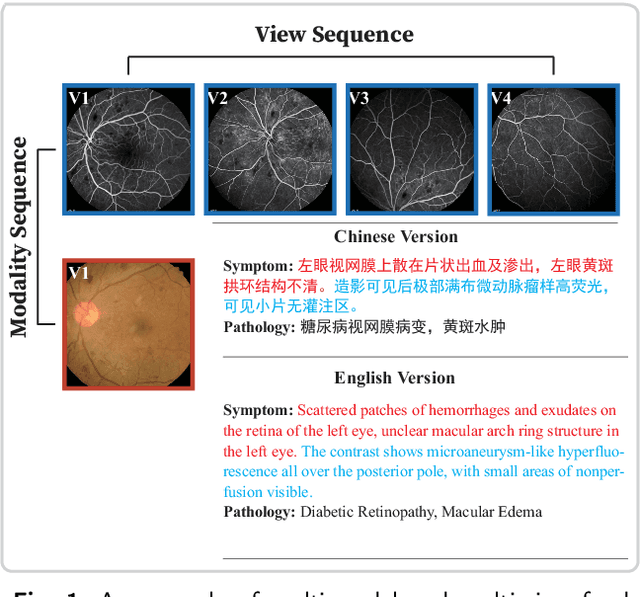

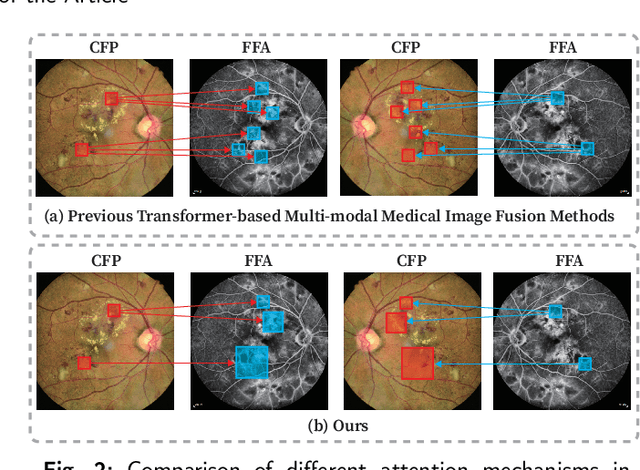
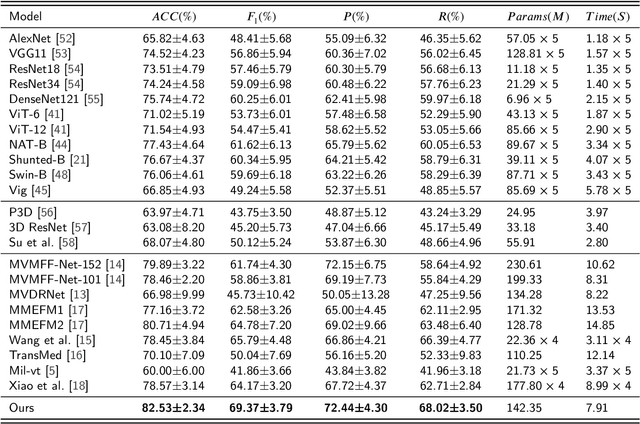
The joint interpretation of multi-modal and multi-view fundus images is critical for retinopathy prevention, as different views can show the complete 3D eyeball field and different modalities can provide complementary lesion areas. Compared with single images, the sequence relationships in multi-modal and multi-view fundus images contain long-range dependencies in lesion features. By modeling the long-range dependencies in these sequences, lesion areas can be more comprehensively mined, and modality-specific lesions can be detected. To learn the long-range dependency relationship and fuse complementary multi-scale lesion features between different fundus modalities, we design a multi-modal fundus image fusion method based on multi-scale cross-attention, which solves the static receptive field problem in previous multi-modal medical fusion methods based on attention. To capture multi-view relative positional relationships between different views and fuse comprehensive lesion features between different views, we design a multi-view fundus image fusion method based on shifted window self-attention, which also solves the computational complexity of the multi-view fundus fusion method based on self-attention is quadratic to the size and number of multi-view fundus images. Finally, we design a multi-task retinopathy diagnosis framework to help ophthalmologists reduce workload and improve diagnostic accuracy by combining the proposed two fusion methods. The experimental results of retinopathy classification and report generation tasks indicate our method's potential to improve the efficiency and reliability of retinopathy diagnosis in clinical practice, achieving a classification accuracy of 82.53\% and a report generation BlEU-1 of 0.543.
Multi-Modal Brain Tumor Segmentation via 3D Multi-Scale Self-attention and Cross-attention
Apr 12, 2025Due to the success of CNN-based and Transformer-based models in various computer vision tasks, recent works study the applicability of CNN-Transformer hybrid architecture models in 3D multi-modality medical segmentation tasks. Introducing Transformer brings long-range dependent information modeling ability in 3D medical images to hybrid models via the self-attention mechanism. However, these models usually employ fixed receptive fields of 3D volumetric features within each self-attention layer, ignoring the multi-scale volumetric lesion features. To address this issue, we propose a CNN-Transformer hybrid 3D medical image segmentation model, named TMA-TransBTS, based on an encoder-decoder structure. TMA-TransBTS realizes simultaneous extraction of multi-scale 3D features and modeling of long-distance dependencies by multi-scale division and aggregation of 3D tokens in a self-attention layer. Furthermore, TMA-TransBTS proposes a 3D multi-scale cross-attention module to establish a link between the encoder and the decoder for extracting rich volume representations by exploiting the mutual attention mechanism of cross-attention and multi-scale aggregation of 3D tokens. Extensive experimental results on three public 3D medical segmentation datasets show that TMA-TransBTS achieves higher averaged segmentation results than previous state-of-the-art CNN-based 3D methods and CNN-Transform hybrid 3D methods for the segmentation of 3D multi-modality brain tumors.