 Add to Chrome
 Add to Firefox
 Add to Edge
Shedding the Facades, Connecting the Domains: Detecting Shifting Multimodal Hate Video with Test-Time Adaptation
Jan 28, 2026
Hate Video Detection (HVD) is crucial for online ecosystems. Existing methods assume identical distributions between training (source) and inference (target) data. However, hateful content often evolves into irregular and ambiguous forms to evade censorship, resulting in substantial semantic drift and rendering previously trained models ineffective. Test-Time Adaptation (TTA) offers a solution by adapting models during inference to narrow the cross-domain gap, while conventional TTA methods target mild distribution shifts and struggle with the severe semantic drift in HVD. To tackle these challenges, we propose SCANNER, the first TTA framework tailored for HVD. Motivated by the insight that, despite the evolving nature of hateful manifestations, their underlying cores remain largely invariant (i.e., targeting is still based on characteristics like gender, race, etc), we leverage these stable cores as a bridge to connect the source and target domains. Specifically, SCANNER initially reveals the stable cores from the ambiguous layout in evolving hateful content via a principled centroid-guided alignment mechanism. To alleviate the impact of outlier-like samples that are weakly correlated with centroids during the alignment process, SCANNER enhances the prior by incorporating a sample-level adaptive centroid alignment strategy, promoting more stable adaptation. Furthermore, to mitigate semantic collapse from overly uniform outputs within clusters, SCANNER introduces an intra-cluster diversity regularization that encourages the cluster-wise semantic richness. Experiments show that SCANNER outperforms all baselines, with an average gain of 4.69% in Macro-F1 over the best.

From Shallow Humor to Metaphor: Towards Label-Free Harmful Meme Detection via LMM Agent Self-Improvement
Dec 25, 2025The proliferation of harmful memes on online media poses significant risks to public health and stability. Existing detection methods heavily rely on large-scale labeled data for training, which necessitates substantial manual annotation efforts and limits their adaptability to the continually evolving nature of harmful content. To address these challenges, we present ALARM, the first lAbeL-free hARmful Meme detection framework powered by Large Multimodal Model (LMM) agent self-improvement. The core innovation of ALARM lies in exploiting the expressive information from "shallow" memes to iteratively enhance its ability to tackle more complex and subtle ones. ALARM consists of a novel Confidence-based Explicit Meme Identification mechanism that isolates the explicit memes from the original dataset and assigns them pseudo-labels. Besides, a new Pairwise Learning Guided Agent Self-Improvement paradigm is introduced, where the explicit memes are reorganized into contrastive pairs (positive vs. negative) to refine a learner LMM agent. This agent autonomously derives high-level detection cues from these pairs, which in turn empower the agent itself to handle complex and challenging memes effectively. Experiments on three diverse datasets demonstrate the superior performance and strong adaptability of ALARM to newly evolved memes. Notably, our method even outperforms label-driven methods. These results highlight the potential of label-free frameworks as a scalable and promising solution for adapting to novel forms and topics of harmful memes in dynamic online environments.
Multi-modal and Multi-view Fundus Image Fusion for Retinopathy Diagnosis via Multi-scale Cross-attention and Shifted Window Self-attention
Apr 12, 2025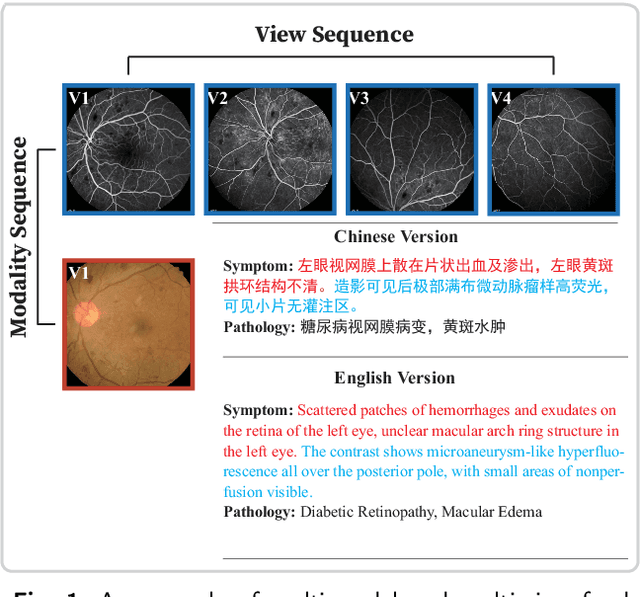

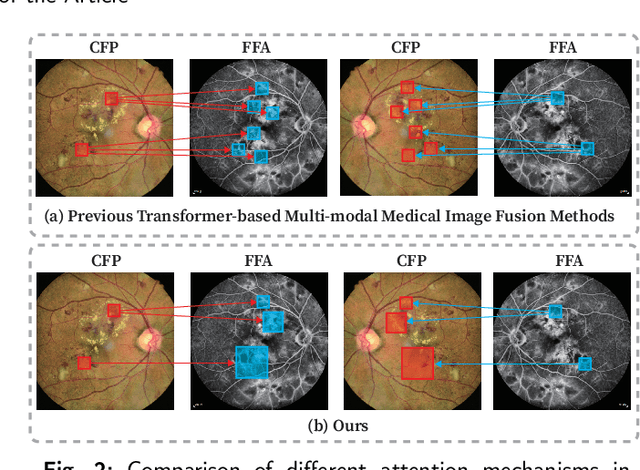
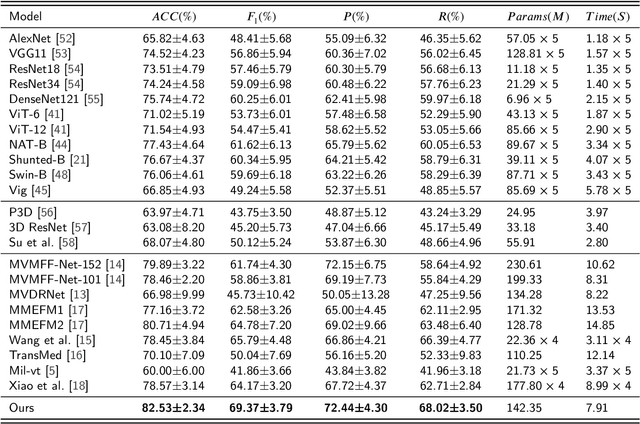
The joint interpretation of multi-modal and multi-view fundus images is critical for retinopathy prevention, as different views can show the complete 3D eyeball field and different modalities can provide complementary lesion areas. Compared with single images, the sequence relationships in multi-modal and multi-view fundus images contain long-range dependencies in lesion features. By modeling the long-range dependencies in these sequences, lesion areas can be more comprehensively mined, and modality-specific lesions can be detected. To learn the long-range dependency relationship and fuse complementary multi-scale lesion features between different fundus modalities, we design a multi-modal fundus image fusion method based on multi-scale cross-attention, which solves the static receptive field problem in previous multi-modal medical fusion methods based on attention. To capture multi-view relative positional relationships between different views and fuse comprehensive lesion features between different views, we design a multi-view fundus image fusion method based on shifted window self-attention, which also solves the computational complexity of the multi-view fundus fusion method based on self-attention is quadratic to the size and number of multi-view fundus images. Finally, we design a multi-task retinopathy diagnosis framework to help ophthalmologists reduce workload and improve diagnostic accuracy by combining the proposed two fusion methods. The experimental results of retinopathy classification and report generation tasks indicate our method's potential to improve the efficiency and reliability of retinopathy diagnosis in clinical practice, achieving a classification accuracy of 82.53\% and a report generation BlEU-1 of 0.543.
Multi-Modal Brain Tumor Segmentation via 3D Multi-Scale Self-attention and Cross-attention
Apr 12, 2025Due to the success of CNN-based and Transformer-based models in various computer vision tasks, recent works study the applicability of CNN-Transformer hybrid architecture models in 3D multi-modality medical segmentation tasks. Introducing Transformer brings long-range dependent information modeling ability in 3D medical images to hybrid models via the self-attention mechanism. However, these models usually employ fixed receptive fields of 3D volumetric features within each self-attention layer, ignoring the multi-scale volumetric lesion features. To address this issue, we propose a CNN-Transformer hybrid 3D medical image segmentation model, named TMA-TransBTS, based on an encoder-decoder structure. TMA-TransBTS realizes simultaneous extraction of multi-scale 3D features and modeling of long-distance dependencies by multi-scale division and aggregation of 3D tokens in a self-attention layer. Furthermore, TMA-TransBTS proposes a 3D multi-scale cross-attention module to establish a link between the encoder and the decoder for extracting rich volume representations by exploiting the mutual attention mechanism of cross-attention and multi-scale aggregation of 3D tokens. Extensive experimental results on three public 3D medical segmentation datasets show that TMA-TransBTS achieves higher averaged segmentation results than previous state-of-the-art CNN-based 3D methods and CNN-Transform hybrid 3D methods for the segmentation of 3D multi-modality brain tumors.