 Add to Chrome
 Add to Firefox
 Add to Edge
Synergizing Efficiency and Reliability for Continuous Mobile Manipulation
Apr 07, 2026
Humans seamlessly fuse anticipatory planning with immediate feedback to perform successive mobile manipulation tasks without stopping, achieving both high efficiency and reliability. Replicating this fluid and reliable behavior in robots remains fundamentally challenging, not only due to conflicts between long-horizon planning and real-time reactivity, but also because excessively pursuing efficiency undermines reliability in uncertain environments: it impairs stable perception and the potential for compensation, while also increasing the risk of unintended contact. In this work, we present a unified framework that synergizes efficiency and reliability for continuous mobile manipulation. It features a reliability-aware trajectory planner that embeds essential elements for reliable execution into spatiotemporal optimization, generating efficient and reliability-promising global trajectories. It is coupled with a phase-dependent switching controller that seamlessly transitions between global trajectory tracking for efficiency and task-error compensation for reliability. We also investigate a hierarchical initialization that facilitates online replanning despite the complexity of long-horizon planning problems. Real-world evaluations demonstrate that our approach enables efficient and reliable completion of successive tasks under uncertainty (e.g., dynamic disturbances, perception and control errors). Moreover, the framework generalizes to tasks with diverse end-effector constraints. Compared with state-of-the-art baselines, our method consistently achieves the highest efficiency while improving the task success rate by 26.67\%--81.67\%. Comprehensive ablation studies further validate the contribution of each component. The source code will be released.

GS^3: Efficient Relighting with Triple Gaussian Splatting
Oct 15, 2024
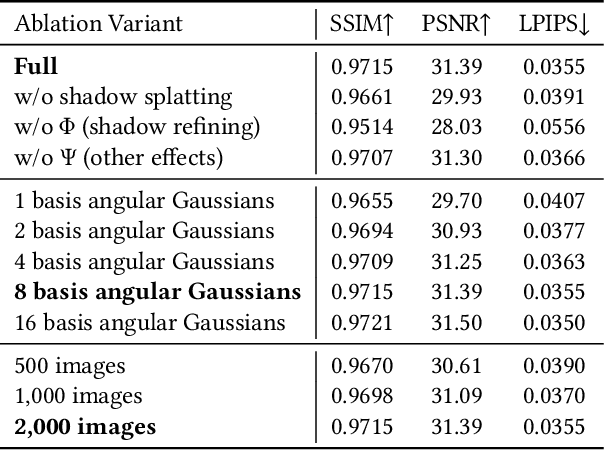

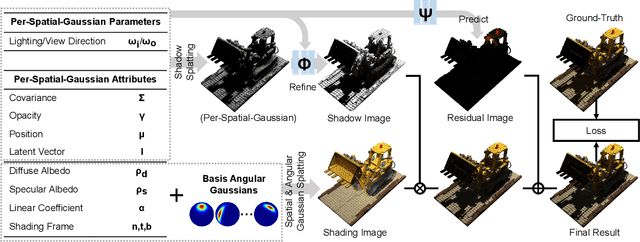
We present a spatial and angular Gaussian based representation and a triple splatting process, for real-time, high-quality novel lighting-and-view synthesis from multi-view point-lit input images. To describe complex appearance, we employ a Lambertian plus a mixture of angular Gaussians as an effective reflectance function for each spatial Gaussian. To generate self-shadow, we splat all spatial Gaussians towards the light source to obtain shadow values, which are further refined by a small multi-layer perceptron. To compensate for other effects like global illumination, another network is trained to compute and add a per-spatial-Gaussian RGB tuple. The effectiveness of our representation is demonstrated on 30 samples with a wide variation in geometry (from solid to fluffy) and appearance (from translucent to anisotropic), as well as using different forms of input data, including rendered images of synthetic/reconstructed objects, photographs captured with a handheld camera and a flash, or from a professional lightstage. We achieve a training time of 40-70 minutes and a rendering speed of 90 fps on a single commodity GPU. Our results compare favorably with state-of-the-art techniques in terms of quality/performance. Our code and data are publicly available at https://GSrelight.github.io/.
* Accepted to SIGGRAPH Asia 2024. Project page: https://gsrelight.github.io/