 Add to Chrome
 Add to Firefox
 Add to Edge
Learning with Foresight: Enhancing Neural Routing Policy via Multi-Node Lookahead Prediction
May 19, 2026
Neural policies have shown promise in solving vehicle routing problems due to their reduced reliance on handcrafted heuristics. However, current training paradigms suffer from a fundamental limitation: they primarily focus on next-node prediction for solution construction, resulting in myopic decision-making that undermines long-horizon planning capacity. To this end, we introduce Multi-node Lookahead Prediction (MnLP), a novel training strategy that extends the supervised learning paradigm to predict multiple future nodes simultaneously. We incorporate causal and discardable MnLP modules that operate exclusively during training, facilitating models to anticipate multi-step decisions while preserving inference-time efficiency. By incorporating multi-depth auxiliary supervision into the loss function, MnLP equips neural policies with the ability of long-range contextual understanding. Experimentally, MnLP outperforms existing training methods, improving the generalization capability of neural policies across various problem sizes, distributions, and real-world benchmarks. Moreover, MnLP can be seamlessly integrated into diverse neural architectures without introducing additional inference overhead.

Scheduling That Speaks: An Interpretable Programmatic Reinforcement Learning Framework
May 18, 2026Deep reinforcement learning (DRL) has recently emerged as a promising approach to solve combinatorial optimization problems such as job shop scheduling. However, the policies learned by DRL are typically represented by deep neural networks (DNNs), whose opaque neural architectures and non-interpretable policy decisions can lead to critical trust and usability concerns for human decision makers. In addition, the computational requirements of DNNs can further hinder practical deployment in resource constrained environments. In this work, we propose ProRL, a novel interpretable programmatic reinforcement learning framework that achieves high-performance scheduling with human-readable and editable programmatic policies (i.e., programs). We first introduce a domain-specific language for scheduling (DSL-S) to represent scheduling strategies as structured programs. ProRL then explores the program space defined by DSL-S using local search to identify incomplete programs, which are subsequently completed by learning their parameters via Bayesian optimization. ProRL learns which scheduling heuristic rules to select, and hence, it naturally incorporates existing heuristics already used in industrial scenarios. Experiments on widely used benchmark instances demonstrate the strong performance of ProRL against existing heuristics and DRL baselines. Furthermore, ProRL performs well under strongly constrained computational resources, such as training with only 100 episodes. Our code is available at https://github.com/HcPlu/ProRL.
DiPRL: Learning Discrete Programmatic Policies via Architecture Entropy Regularization
May 18, 2026Programmatic reinforcement learning (PRL) offers an interpretable alternative to deep reinforcement learning by representing policies as human-readable and -editable programs. While gradient-based methods have been developed to optimize continuous relaxations of programs, they face a significant performance drop when converting the continuous relaxations back into discrete programs. Post-hoc discretization can discard optimized branches and parameters in a program, which results in a collapse of policy expressivity and lowered task performance, leading in turn to a need for additional fine-tuning. To overcome these limitations, we propose Differentiable Discrete Programmatic Reinforcement Learning (DiPRL), a method that learns programmatic policies that become nearly discrete during training, avoiding a separate post-hoc fine-tuning stage. We first analyze the inherent risks of performance drop introduced by post-hoc discretization of gradient-based methods. Then, we introduce programmatic architecture entropy regularization, which enables smooth, differentiable training that encourages convergence toward a discrete program. DiPRL maintains the efficiency of gradient-based optimization while mitigating the risks of post-hoc discretization. Our experiments across multiple discrete and continuous RL tasks demonstrate that DiPRL can achieve strong performance via interpretable programmatic policies.
When does learning pay off? A study on DRL-based dynamic algorithm configuration for carbon-aware scheduling
Apr 02, 2026Deep reinforcement learning (DRL) has recently emerged as a promising tool for Dynamic Algorithm Configuration (DAC), enabling evolutionary algorithms to adapt their parameters online rather than relying on static tuned configurations. While DRL can learn effective control policies, training is computationally expensive. This cost may be justified if learned policies generalize, allowing the training effort to transfer across instance types and problem scales. Yet, for real-world optimization problems, it remains unclear whether this promise holds in practice and under which conditions the investment in learning pays off. In this work, we investigate this question in the context of the carbon-aware permutation flow-shop scheduling problem. We develop a DRL-based DAC framework and train it exclusively on small, simple instances. We then deploy the learned policy on both similar and more complex unseen instances and compare its performance against a static tuned baseline, which provides a fair point of comparison. Our findings show that the proposed method provides a strong dynamic algorithm control policy that can be effectively transferred to different unseen problem instances. Notably, on simple and cheap to compute instances, similar to those observed during training and tuning, DRL performs comparably with the statically tuned baseline. However, as instance characteristics diverge and computational complexities increase, the DRL-learned policy continuously outperforms static tuning. These results confirm that DRL can acquire robust and generalizable control policies which are effective beyond the training instance distributions. This ability to generalize across instance types makes the initial computational investment worthwhile, particularly in settings where static tuning struggles to adapt to changing problem scenarios.
Reasoning in a Combinatorial and Constrained World: Benchmarking LLMs on Natural-Language Combinatorial Optimization
Feb 02, 2026While large language models (LLMs) have shown strong performance in math and logic reasoning, their ability to handle combinatorial optimization (CO) -- searching high-dimensional solution spaces under hard constraints -- remains underexplored. To bridge the gap, we introduce NLCO, a \textbf{N}atural \textbf{L}anguage \textbf{C}ombinatorial \textbf{O}ptimization benchmark that evaluates LLMs on end-to-end CO reasoning: given a language-described decision-making scenario, the model must output a discrete solution without writing code or calling external solvers. NLCO covers 43 CO problems and is organized using a four-layer taxonomy of variable types, constraint families, global patterns, and objective classes, enabling fine-grained evaluation. We provide solver-annotated solutions and comprehensively evaluate LLMs by feasibility, solution optimality, and reasoning efficiency. Experiments across a wide range of modern LLMs show that high-performing models achieve strong feasibility and solution quality on small instances, but both degrade as instance size grows, even if more tokens are used for reasoning. We also observe systematic effects across the taxonomy: set-based tasks are relatively easy, whereas graph-structured problems and bottleneck objectives lead to more frequent failures.
Adversarial Instance Generation and Robust Training for Neural Combinatorial Optimization with Multiple Objectives
Jan 04, 2026Deep reinforcement learning (DRL) has shown great promise in addressing multi-objective combinatorial optimization problems (MOCOPs). Nevertheless, the robustness of these learning-based solvers has remained insufficiently explored, especially across diverse and complex problem distributions. In this paper, we propose a unified robustness-oriented framework for preference-conditioned DRL solvers for MOCOPs. Within this framework, we develop a preference-based adversarial attack to generate hard instances that expose solver weaknesses, and quantify the attack impact by the resulting degradation on Pareto-front quality. We further introduce a defense strategy that integrates hardness-aware preference selection into adversarial training to reduce overfitting to restricted preference regions and improve out-of-distribution performance. The experimental results on multi-objective traveling salesman problem (MOTSP), multi-objective capacitated vehicle routing problem (MOCVRP), and multi-objective knapsack problem (MOKP) verify that our attack method successfully learns hard instances for different solvers. Furthermore, our defense method significantly strengthens the robustness and generalizability of neural solvers, delivering superior performance on hard or out-of-distribution instances.
Graph-Supported Dynamic Algorithm Configuration for Multi-Objective Combinatorial Optimization
May 22, 2025Deep reinforcement learning (DRL) has been widely used for dynamic algorithm configuration, particularly in evolutionary computation, which benefits from the adaptive update of parameters during the algorithmic execution. However, applying DRL to algorithm configuration for multi-objective combinatorial optimization (MOCO) problems remains relatively unexplored. This paper presents a novel graph neural network (GNN) based DRL to configure multi-objective evolutionary algorithms. We model the dynamic algorithm configuration as a Markov decision process, representing the convergence of solutions in the objective space by a graph, with their embeddings learned by a GNN to enhance the state representation. Experiments on diverse MOCO challenges indicate that our method outperforms traditional and DRL-based algorithm configuration methods in terms of efficacy and adaptability. It also exhibits advantageous generalizability across objective types and problem sizes, and applicability to different evolutionary computation methods.
Graph Reduction with Unsupervised Learning in Column Generation: A Routing Application
Apr 11, 2025Column Generation (CG) is a popular method dedicated to enhancing computational efficiency in large scale Combinatorial Optimization (CO) problems. It reduces the number of decision variables in a problem by solving a pricing problem. For many CO problems, the pricing problem is an Elementary Shortest Path Problem with Resource Constraints (ESPPRC). Large ESPPRC instances are difficult to solve to near-optimality. Consequently, we use a Graph neural Network (GNN) to reduces the size of the ESPPRC such that it becomes computationally tractable with standard solving techniques. Our GNN is trained by Unsupervised Learning and outputs a distribution for the arcs to be retained in the reduced PP. The reduced PP is solved by a local search that finds columns with large reduced costs and speeds up convergence. We apply our method on a set of Capacitated Vehicle Routing Problems with Time Windows and show significant improvements in convergence compared to simple reduction techniques from the literature. For a fixed computational budget, we improve the objective values by over 9\% for larger instances. We also analyze the performance of our CG algorithm and test the generalization of our method to different classes of instances than the training data.
Neural Combinatorial Optimization for Stochastic Flexible Job Shop Scheduling Problems
Dec 18, 2024Neural combinatorial optimization (NCO) has gained significant attention due to the potential of deep learning to efficiently solve combinatorial optimization problems. NCO has been widely applied to job shop scheduling problems (JSPs) with the current focus predominantly on deterministic problems. In this paper, we propose a novel attention-based scenario processing module (SPM) to extend NCO methods for solving stochastic JSPs. Our approach explicitly incorporates stochastic information by an attention mechanism that captures the embedding of sampled scenarios (i.e., an approximation of stochasticity). Fed with the embedding, the base neural network is intervened by the attended scenarios, which accordingly learns an effective policy under stochasticity. We also propose a training paradigm that works harmoniously with either the expected makespan or Value-at-Risk objective. Results demonstrate that our approach outperforms existing learning and non-learning methods for the flexible JSP problem with stochastic processing times on a variety of instances. In addition, our approach holds significant generalizability to varied numbers of scenarios and disparate distributions.
Offline Reinforcement Learning for Learning to Dispatch for Job Shop Scheduling
Sep 16, 2024

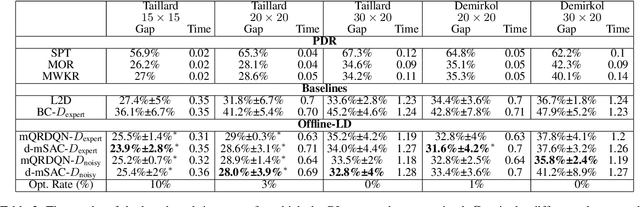
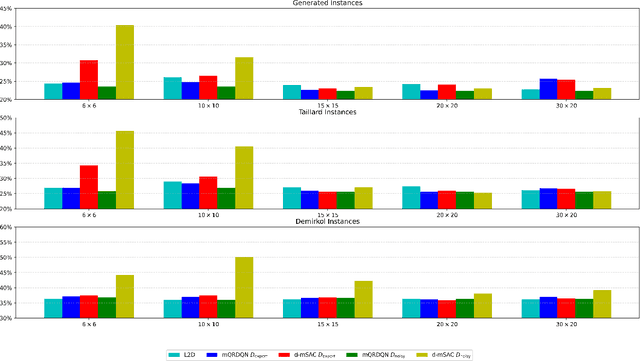
The Job Shop Scheduling Problem (JSSP) is a complex combinatorial optimization problem. There has been growing interest in using online Reinforcement Learning (RL) for JSSP. While online RL can quickly find acceptable solutions, especially for larger problems, it produces lower-quality results than traditional methods like Constraint Programming (CP). A significant downside of online RL is that it cannot learn from existing data, such as solutions generated from CP, requiring them to train from scratch, leading to sample inefficiency and making them unable to learn from more optimal examples. We introduce Offline Reinforcement Learning for Learning to Dispatch (Offline-LD), a novel approach for JSSP that addresses these limitations. Offline-LD adapts two CQL-based Q-learning methods (mQRDQN and discrete mSAC) for maskable action spaces, introduces a new entropy bonus modification for discrete SAC, and exploits reward normalization through preprocessing. Our experiments show that Offline-LD outperforms online RL on both generated and benchmark instances. By introducing noise into the dataset, we achieve similar or better results than those obtained from the expert dataset, indicating that a more diverse training set is preferable because it contains counterfactual information.