 Add to Chrome
 Add to Firefox
 Add to Edge
Adversarial Instance Generation and Robust Training for Neural Combinatorial Optimization with Multiple Objectives
Jan 04, 2026
Deep reinforcement learning (DRL) has shown great promise in addressing multi-objective combinatorial optimization problems (MOCOPs). Nevertheless, the robustness of these learning-based solvers has remained insufficiently explored, especially across diverse and complex problem distributions. In this paper, we propose a unified robustness-oriented framework for preference-conditioned DRL solvers for MOCOPs. Within this framework, we develop a preference-based adversarial attack to generate hard instances that expose solver weaknesses, and quantify the attack impact by the resulting degradation on Pareto-front quality. We further introduce a defense strategy that integrates hardness-aware preference selection into adversarial training to reduce overfitting to restricted preference regions and improve out-of-distribution performance. The experimental results on multi-objective traveling salesman problem (MOTSP), multi-objective capacitated vehicle routing problem (MOCVRP), and multi-objective knapsack problem (MOKP) verify that our attack method successfully learns hard instances for different solvers. Furthermore, our defense method significantly strengthens the robustness and generalizability of neural solvers, delivering superior performance on hard or out-of-distribution instances.

Center-Outward q-Dominance: A Sample-Computable Proxy for Strong Stochastic Dominance in Multi-Objective Optimisation
Nov 16, 2025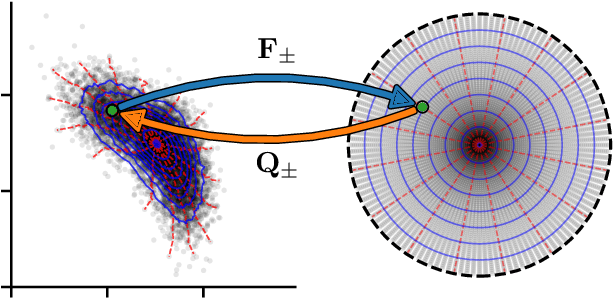
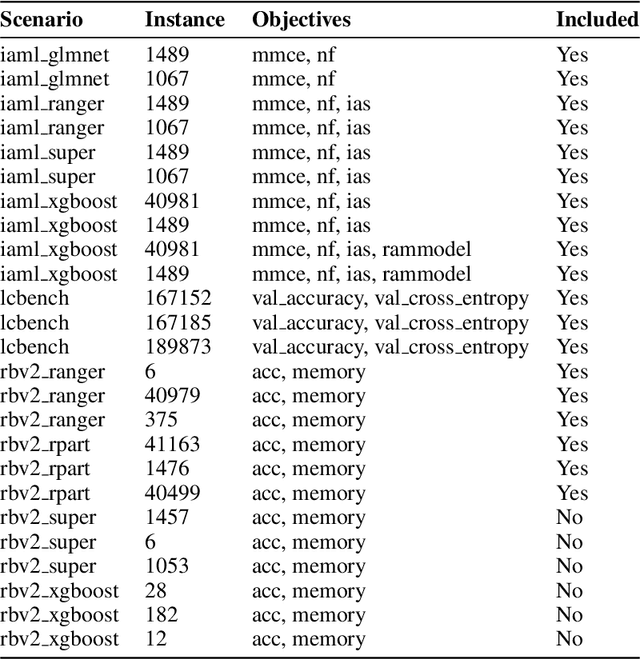
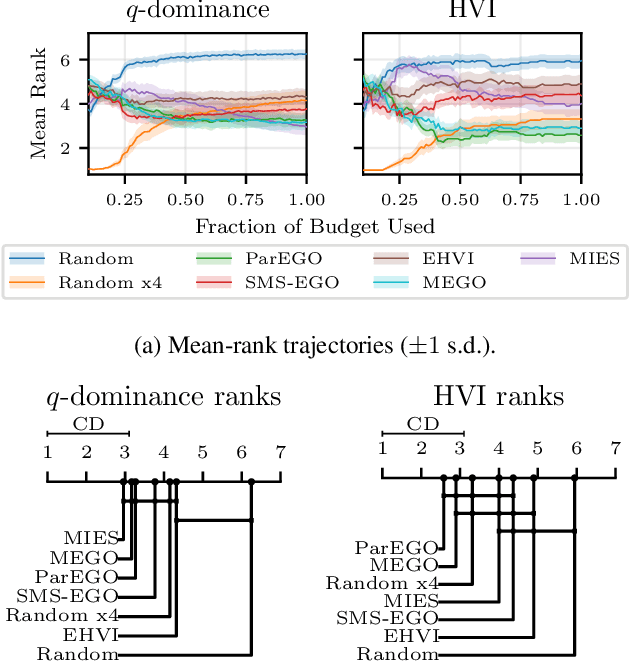
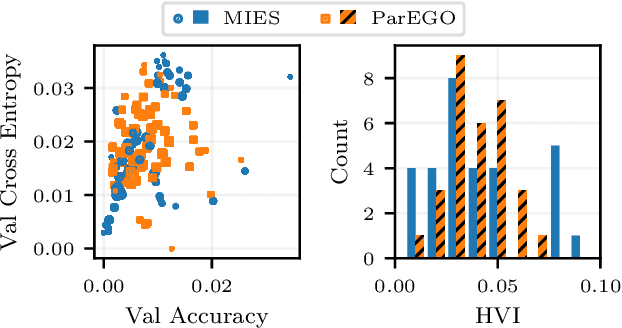
Stochastic multi-objective optimization (SMOOP) requires ranking multivariate distributions; yet, most empirical studies perform scalarization, which loses information and is unreliable. Based on the optimal transport theory, we introduce the center-outward q-dominance relation and prove it implies strong first-order stochastic dominance (FSD). Also, we develop an empirical test procedure based on q-dominance, and derive an explicit sample size threshold, $n^*(δ)$, to control the Type I error. We verify the usefulness of our approach in two scenarios: (1) as a ranking method in hyperparameter tuning; (2) as a selection method in multi-objective optimization algorithms. For the former, we analyze the final stochastic Pareto sets of seven multi-objective hyperparameter tuners on the YAHPO-MO benchmark tasks with q-dominance, which allows us to compare these tuners when the expected hypervolume indicator (HVI, the most common performance metric) of the Pareto sets becomes indistinguishable. For the latter, we replace the mean value-based selection in the NSGA-II algorithm with $q$-dominance, which shows a superior convergence rate on noise-augmented ZDT benchmark problems. These results establish center-outward q-dominance as a principled, tractable foundation for seeking truly stochastically dominant solutions for SMOOPs.