 Add to Chrome
 Add to Firefox
 Add to Edge
DiPRL: Learning Discrete Programmatic Policies via Architecture Entropy Regularization
May 18, 2026
Programmatic reinforcement learning (PRL) offers an interpretable alternative to deep reinforcement learning by representing policies as human-readable and -editable programs. While gradient-based methods have been developed to optimize continuous relaxations of programs, they face a significant performance drop when converting the continuous relaxations back into discrete programs. Post-hoc discretization can discard optimized branches and parameters in a program, which results in a collapse of policy expressivity and lowered task performance, leading in turn to a need for additional fine-tuning. To overcome these limitations, we propose Differentiable Discrete Programmatic Reinforcement Learning (DiPRL), a method that learns programmatic policies that become nearly discrete during training, avoiding a separate post-hoc fine-tuning stage. We first analyze the inherent risks of performance drop introduced by post-hoc discretization of gradient-based methods. Then, we introduce programmatic architecture entropy regularization, which enables smooth, differentiable training that encourages convergence toward a discrete program. DiPRL maintains the efficiency of gradient-based optimization while mitigating the risks of post-hoc discretization. Our experiments across multiple discrete and continuous RL tasks demonstrate that DiPRL can achieve strong performance via interpretable programmatic policies.

Scheduling That Speaks: An Interpretable Programmatic Reinforcement Learning Framework
May 18, 2026Deep reinforcement learning (DRL) has recently emerged as a promising approach to solve combinatorial optimization problems such as job shop scheduling. However, the policies learned by DRL are typically represented by deep neural networks (DNNs), whose opaque neural architectures and non-interpretable policy decisions can lead to critical trust and usability concerns for human decision makers. In addition, the computational requirements of DNNs can further hinder practical deployment in resource constrained environments. In this work, we propose ProRL, a novel interpretable programmatic reinforcement learning framework that achieves high-performance scheduling with human-readable and editable programmatic policies (i.e., programs). We first introduce a domain-specific language for scheduling (DSL-S) to represent scheduling strategies as structured programs. ProRL then explores the program space defined by DSL-S using local search to identify incomplete programs, which are subsequently completed by learning their parameters via Bayesian optimization. ProRL learns which scheduling heuristic rules to select, and hence, it naturally incorporates existing heuristics already used in industrial scenarios. Experiments on widely used benchmark instances demonstrate the strong performance of ProRL against existing heuristics and DRL baselines. Furthermore, ProRL performs well under strongly constrained computational resources, such as training with only 100 episodes. Our code is available at https://github.com/HcPlu/ProRL.
Reasoning in a Combinatorial and Constrained World: Benchmarking LLMs on Natural-Language Combinatorial Optimization
Feb 02, 2026While large language models (LLMs) have shown strong performance in math and logic reasoning, their ability to handle combinatorial optimization (CO) -- searching high-dimensional solution spaces under hard constraints -- remains underexplored. To bridge the gap, we introduce NLCO, a \textbf{N}atural \textbf{L}anguage \textbf{C}ombinatorial \textbf{O}ptimization benchmark that evaluates LLMs on end-to-end CO reasoning: given a language-described decision-making scenario, the model must output a discrete solution without writing code or calling external solvers. NLCO covers 43 CO problems and is organized using a four-layer taxonomy of variable types, constraint families, global patterns, and objective classes, enabling fine-grained evaluation. We provide solver-annotated solutions and comprehensively evaluate LLMs by feasibility, solution optimality, and reasoning efficiency. Experiments across a wide range of modern LLMs show that high-performing models achieve strong feasibility and solution quality on small instances, but both degrade as instance size grows, even if more tokens are used for reasoning. We also observe systematic effects across the taxonomy: set-based tasks are relatively easy, whereas graph-structured problems and bottleneck objectives lead to more frequent failures.
Artificial Intelligence Virtual Cells: From Measurements to Decisions across Modality, Scale, Dynamics, and Evaluation
Oct 14, 2025Artificial Intelligence Virtual Cells (AIVCs) aim to learn executable, decision-relevant models of cell state from multimodal, multiscale measurements. Recent studies have introduced single-cell and spatial foundation models, improved cross-modality alignment, scaled perturbation atlases, and explored pathway-level readouts. Nevertheless, although held-out validation is standard practice, evaluations remain predominantly within single datasets and settings; evidence indicates that transport across laboratories and platforms is often limited, that some data splits are vulnerable to leakage and coverage bias, and that dose, time and combination effects are not yet systematically handled. Cross-scale coupling also remains constrained, as anchors linking molecular, cellular and tissue levels are sparse, and alignment to scientific or clinical readouts varies across studies. We propose a model-agnostic Cell-State Latent (CSL) perspective that organizes learning via an operator grammar: measurement, lift/project for cross-scale coupling, and intervention for dosing and scheduling. This view motivates a decision-aligned evaluation blueprint across modality, scale, context and intervention, and emphasizes function-space readouts such as pathway activity, spatial neighborhoods and clinically relevant endpoints. We recommend operator-aware data design, leakage-resistant partitions, and transparent calibration and reporting to enable reproducible, like-for-like comparisons.
3D Building Generation in Minecraft via Large Language Models
Jun 13, 2024

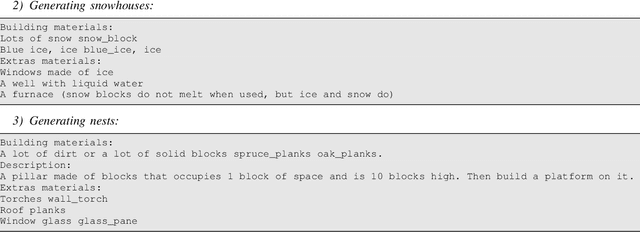

Recently, procedural content generation has exhibited considerable advancements in the domain of 2D game level generation such as Super Mario Bros. and Sokoban through large language models (LLMs). To further validate the capabilities of LLMs, this paper explores how LLMs contribute to the generation of 3D buildings in a sandbox game, Minecraft. We propose a Text to Building in Minecraft (T2BM) model, which involves refining prompts, decoding interlayer representation and repairing. Facade, indoor scene and functional blocks like doors are supported in the generation. Experiments are conducted to evaluate the completeness and satisfaction of buildings generated via LLMs. It shows that LLMs hold significant potential for 3D building generation. Given appropriate prompts, LLMs can generate correct buildings in Minecraft with complete structures and incorporate specific building blocks such as windows and beds, meeting the specified requirements of human users.
Generating Games via LLMs: An Investigation with Video Game Description Language
Apr 11, 2024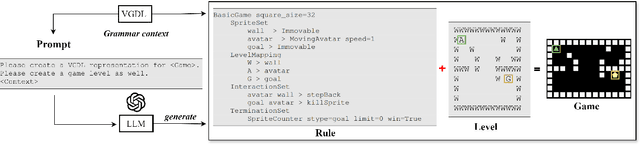
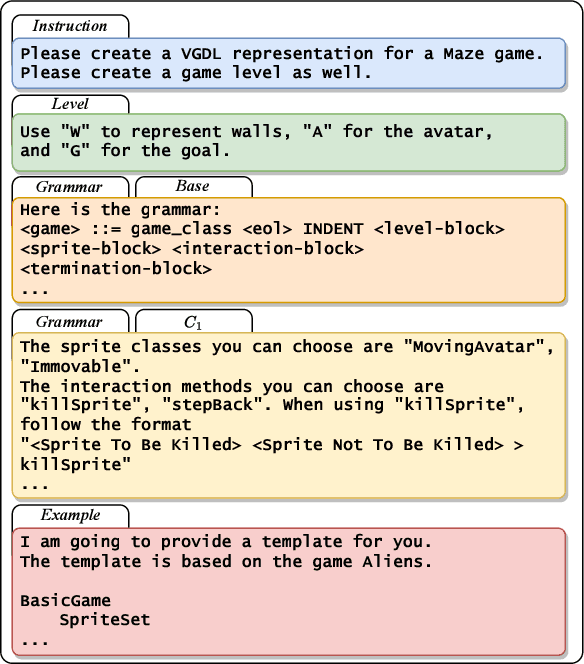
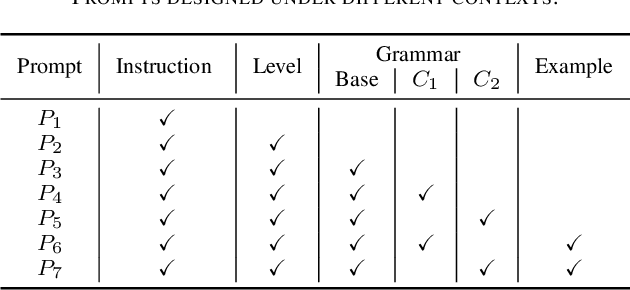
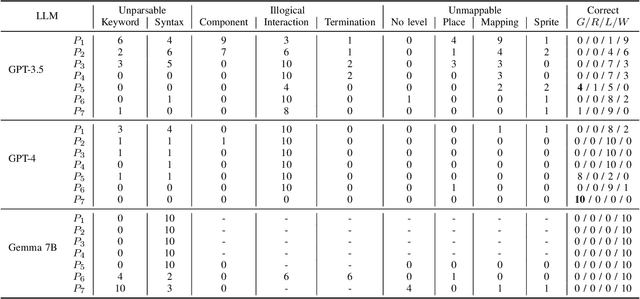
Recently, the emergence of large language models (LLMs) has unlocked new opportunities for procedural content generation. However, recent attempts mainly focus on level generation for specific games with defined game rules such as Super Mario Bros. and Zelda. This paper investigates the game generation via LLMs. Based on video game description language, this paper proposes an LLM-based framework to generate game rules and levels simultaneously. Experiments demonstrate how the framework works with prompts considering different combinations of context. Our findings extend the current applications of LLMs and offer new insights for generating new games in the area of procedural content generation.
Pre-trained Universal Medical Image Transformer
Dec 12, 2023Self-supervised learning has emerged as a viable method to leverage the abundance of unlabeled medical imaging data, addressing the challenge of labeled data scarcity in medical image analysis. In particular, masked image modeling (MIM) with visual token reconstruction has shown promising results in the general computer vision (CV) domain and serves as a candidate for medical image analysis. However, the presence of heterogeneous 2D and 3D medical images often limits the volume and diversity of training data that can be effectively used for a single model structure. In this work, we propose a spatially adaptive convolution (SAC) module, which adaptively adjusts convolution parameters based on the voxel spacing of the input images. Employing this SAC module, we build a universal visual tokenizer and a universal Vision Transformer (ViT) capable of effectively processing a wide range of medical images with various imaging modalities and spatial properties. Moreover, in order to enhance the robustness of the visual tokenizer's reconstruction objective for MIM, we suggest to generalize the discrete token output of the visual tokenizer to a probabilistic soft token. We show that the generalized soft token representation can be effectively integrated with the prior distribution regularization through a constructive interpretation. As a result, we pre-train a universal visual tokenizer followed by a universal ViT via visual token reconstruction on 55 public medical image datasets, comprising over 9 million 2D slices (including over 48,000 3D images). This represents the largest, most comprehensive, and diverse dataset for pre-training 3D medical image models to our knowledge. Experimental results on downstream medical image classification and segmentation tasks demonstrate the superior performance of our model and improved label efficiency.
Generating Redstone Style Cities in Minecraft
Jul 19, 2023Procedurally generating cities in Minecraft provides players more diverse scenarios and could help understand and improve the design of cities in other digital worlds and the real world. This paper presents a city generator that was submitted as an entry to the 2023 Edition of Minecraft Settlement Generation Competition for Minecraft. The generation procedure is composed of six main steps, namely vegetation clearing, terrain reshaping, building layout generation, route planning, streetlight placement, and wall construction. Three algorithms, including a heuristic-based algorithm, an evolving layout algorithm, and a random one are applied to generate the building layout, thus determining where to place different redstone style buildings, and tested by generating cities on random maps in limited time. Experimental results show that the heuristic-based algorithm is capable of finding an acceptable building layout faster for flat maps, while the evolving layout algorithm performs better in evolving layout for rugged maps. A user study is conducted to compare our generator with outstanding entries of the competition's 2022 edition using the competition's evaluation criteria and shows that our generator performs well in the adaptation and functionality criteria
Constrained Reinforcement Learning for Dynamic Material Handling
May 23, 2023


As one of the core parts of flexible manufacturing systems, material handling involves storage and transportation of materials between workstations with automated vehicles. The improvement in material handling can impulse the overall efficiency of the manufacturing system. However, the occurrence of dynamic events during the optimisation of task arrangements poses a challenge that requires adaptability and effectiveness. In this paper, we aim at the scheduling of automated guided vehicles for dynamic material handling. Motivated by some real-world scenarios, unknown new tasks and unexpected vehicle breakdowns are regarded as dynamic events in our problem. We formulate the problem as a constrained Markov decision process which takes into account tardiness and available vehicles as cumulative and instantaneous constraints, respectively. An adaptive constrained reinforcement learning algorithm that combines Lagrangian relaxation and invalid action masking, named RCPOM, is proposed to address the problem with two hybrid constraints. Moreover, a gym-like dynamic material handling simulator, named DMH-GYM, is developed and equipped with diverse problem instances, which can be used as benchmarks for dynamic material handling. Experimental results on the problem instances demonstrate the outstanding performance of our proposed approach compared with eight state-of-the-art constrained and non-constrained reinforcement learning algorithms, and widely used dispatching rules for material handling.
Game-based Platforms for Artificial Intelligence Research
Apr 26, 2023Games have been the perfect test-beds for artificial intelligence research for the characteristics that widely exist in real-world scenarios. Learning and optimisation, decision making in dynamic and uncertain environments, game theory, planning and scheduling, design and education are common research areas shared between games and real-world problems. Numerous open-sourced games or game-based environments have been implemented for studying artificial intelligence. In addition to single- or multi-player, collaborative or adversarial games, there has also been growing interest in implementing platforms for creative design in recent years. Those platforms provide ideal benchmarks for exploring and comparing artificial intelligence ideas and techniques. This paper reviews the game-based platforms for artificial intelligence research, discusses the research trend induced by the evolution of those platforms, and gives an outlook.