 Add to Chrome
 Add to Firefox
 Add to Edge
dVLA-RL: Reinforcement Learning over Denoising Trajectories for Discrete Diffusion Vision-Language-Action Models
Jun 22, 2026
Vision-Language-Action (VLA) models have established a powerful paradigm for generalist robotic manipulation by grounding control into the semantic reasoning of VLMs. Prevailing architectures typically model actions continuously via diffusion or flow processes, or discretely through either autoregressive generation or parallel decoding. Recently, Discrete Diffusion VLAs (dVLAs) have emerged as a distinct alternative, unifying vision, language, and action into a single discrete token space via masked generative modeling. While combining iterative refinement with unified representations, its training has thus far been restricted to Supervised Fine-Tuning (SFT), leaving the potential of Reinforcement Learning (RL) for further policy refinement largely unexplored. A fundamental challenge in RL for dVLAs is that the marginal probability of the final action generated by dVLAs remains intractable. To solve this problem, we propose \textbf{dVLA-RL}, shifting the learning objective from the marginal action probability to the joint probability of the sampled generation path. Specifically, by modeling the denoising process as a Markov Decision Process (MDP), we mathematically formulate this path probability as a product of step-wise transitions. This trajectory-level objective provides a unified formulation that natively accommodates variable denoising steps. Leveraging this intrinsic fexibility, we introduce a unified step scheduling approach for complex multi-task learning, tailoring denoising steps to specific task complexities to maximize both success rates and computational effciency. Extensive evaluations demonstrate that our approach achieves a success rate of \textbf{99.7\%} on LIBERO. Furthermore, it establishes strong VLA-based results on RoboTwin 2.0 by delivering a \textbf{30.6\%} improvement over the SFT baseline, remaining competitive with strong World-Action Model baselines.

Expertise need not monopolize: Action-Specialized Mixture of Experts for Vision-Language-Action Learning
Oct 16, 2025Vision-Language-Action (VLA) models are experiencing rapid development and demonstrating promising capabilities in robotic manipulation tasks. However, scaling up VLA models presents several critical challenges: (1) Training new VLA models from scratch demands substantial computational resources and extensive datasets. Given the current scarcity of robot data, it becomes particularly valuable to fully leverage well-pretrained VLA model weights during the scaling process. (2) Real-time control requires carefully balancing model capacity with computational efficiency. To address these challenges, We propose AdaMoE, a Mixture-of-Experts (MoE) architecture that inherits pretrained weights from dense VLA models, and scales up the action expert by substituting the feedforward layers into sparsely activated MoE layers. AdaMoE employs a decoupling technique that decouples expert selection from expert weighting through an independent scale adapter working alongside the traditional router. This enables experts to be selected based on task relevance while contributing with independently controlled weights, allowing collaborative expert utilization rather than winner-takes-all dynamics. Our approach demonstrates that expertise need not monopolize. Instead, through collaborative expert utilization, we can achieve superior performance while maintaining computational efficiency. AdaMoE consistently outperforms the baseline model across key benchmarks, delivering performance gains of 1.8% on LIBERO and 9.3% on RoboTwin. Most importantly, a substantial 21.5% improvement in real-world experiments validates its practical effectiveness for robotic manipulation tasks.
Imitate TheWorld: A Search Engine Simulation Platform
Aug 10, 2021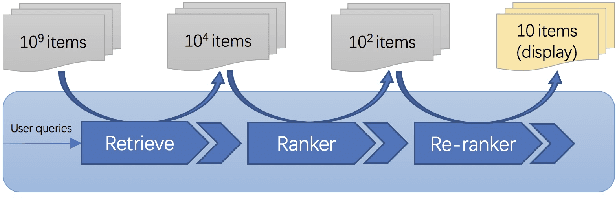
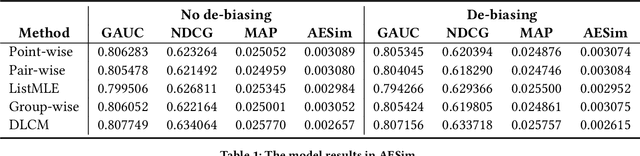
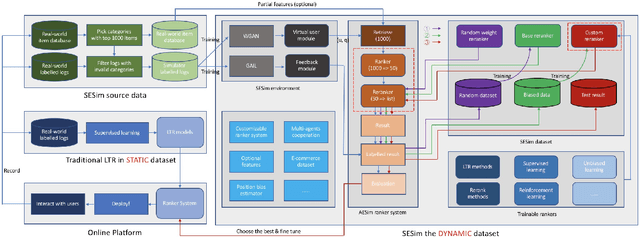

Recent E-commerce applications benefit from the growth of deep learning techniques. However, we notice that many works attempt to maximize business objectives by closely matching offline labels which follow the supervised learning paradigm. This results in models obtain high offline performance in terms of Area Under Curve (AUC) and Normalized Discounted Cumulative Gain (NDCG), but cannot consistently increase the revenue metrics such as purchases amount of users. Towards the issues, we build a simulated search engine AESim that can properly give feedback by a well-trained discriminator for generated pages, as a dynamic dataset. Different from previous simulation platforms which lose connection with the real world, ours depends on the real data in AliExpress Search: we use adversarial learning to generate virtual users and use Generative Adversarial Imitation Learning (GAIL) to capture behavior patterns of users. Our experiments also show AESim can better reflect the online performance of ranking models than classic ranking metrics, implying AESim can play a surrogate of AliExpress Search and evaluate models without going online.