 Add to Chrome
 Add to Firefox
 Add to Edge
Evo-Attacker: Memory-Augmented Reinforcement Learning for Long-Horizon Tool Attacks on LLM-MAS
May 25, 2026
While Large Language Model-based Multi-Agent Systems (LLM-MAS) demonstrate remarkable capabilities in solving complex tasks by orchestrating specialized agents and external tools, the implicit trust in tool outputs creates a critical attack surface. Existing tool attacks are limited by domain specificity or fixed and static templates. To address these challenges, we propose Evo-Attacker, which formulates the tool attack as a self-evolving, memory-augmented reinforcement learning process. Evo-Attacker constructs a dynamic attack memory and employs deliberative reasoning to retrieve adversarial patterns and strategize modifying interventions at critical moments. Furthermore, we introduce Attack-Flow GRPO to optimize intermediate reasoning steps via terminal outcomes, addressing the long-horizon credit assignment challenge. Comprehensive experiments demonstrate that Evo-Attacker consistently outperforms baselines, highlighting its generalization and evolutionary capabilities and the urgent need for defensive tool safeguards.

ClawKeeper: Comprehensive Safety Protection for OpenClaw Agents Through Skills, Plugins, and Watchers
Mar 25, 2026OpenClaw has rapidly established itself as a leading open-source autonomous agent runtime, offering powerful capabilities including tool integration, local file access, and shell command execution. However, these broad operational privileges introduce critical security vulnerabilities, transforming model errors into tangible system-level threats such as sensitive data leakage, privilege escalation, and malicious third-party skill execution. Existing security measures for the OpenClaw ecosystem remain highly fragmented, addressing only isolated stages of the agent lifecycle rather than providing holistic protection. To bridge this gap, we present ClawKeeper, a real-time security framework that integrates multi-dimensional protection mechanisms across three complementary architectural layers. (1) \textbf{Skill-based protection} operates at the instruction level, injecting structured security policies directly into the agent context to enforce environment-specific constraints and cross-platform boundaries. (2) \textbf{Plugin-based protection} serves as an internal runtime enforcer, providing configuration hardening, proactive threat detection, and continuous behavioral monitoring throughout the execution pipeline. (3) \textbf{Watcher-based protection} introduces a novel, decoupled system-level security middleware that continuously verifies agent state evolution. It enables real-time execution intervention without coupling to the agent's internal logic, supporting operations such as halting high-risk actions or enforcing human confirmation. We argue that this Watcher paradigm holds strong potential to serve as a foundational building block for securing next-generation autonomous agent systems. Extensive qualitative and quantitative evaluations demonstrate the effectiveness and robustness of ClawKeeper across diverse threat scenarios. We release our code.
How Real is Your Jailbreak? Fine-grained Jailbreak Evaluation with Anchored Reference
Jan 04, 2026Jailbreak attacks present a significant challenge to the safety of Large Language Models (LLMs), yet current automated evaluation methods largely rely on coarse classifications that focus mainly on harmfulness, leading to substantial overestimation of attack success. To address this problem, we propose FJAR, a fine-grained jailbreak evaluation framework with anchored references. We first categorized jailbreak responses into five fine-grained categories: Rejective, Irrelevant, Unhelpful, Incorrect, and Successful, based on the degree to which the response addresses the malicious intent of the query. This categorization serves as the basis for FJAR. Then, we introduce a novel harmless tree decomposition approach to construct high-quality anchored references by breaking down the original queries. These references guide the evaluator in determining whether the response genuinely fulfills the original query. Extensive experiments demonstrate that FJAR achieves the highest alignment with human judgment and effectively identifies the root causes of jailbreak failures, providing actionable guidance for improving attack strategies.
Type Information Utilized Event Detection via Multi-Channel GNNs in Electrical Power Systems
Nov 15, 2022Event detection in power systems aims to identify triggers and event types, which helps relevant personnel respond to emergencies promptly and facilitates the optimization of power supply strategies. However, the limited length of short electrical record texts causes severe information sparsity, and numerous domain-specific terminologies of power systems makes it difficult to transfer knowledge from language models pre-trained on general-domain texts. Traditional event detection approaches primarily focus on the general domain and ignore these two problems in the power system domain. To address the above issues, we propose a Multi-Channel graph neural network utilizing Type information for Event Detection in power systems, named MC-TED, leveraging a semantic channel and a topological channel to enrich information interaction from short texts. Concretely, the semantic channel refines textual representations with semantic similarity, building the semantic information interaction among potential event-related words. The topological channel generates a relation-type-aware graph modeling word dependencies, and a word-type-aware graph integrating part-of-speech tags. To further reduce errors worsened by professional terminologies in type analysis, a type learning mechanism is designed for updating the representations of both the word type and relation type in the topological channel. In this way, the information sparsity and professional term occurrence problems can be alleviated by enabling interaction between topological and semantic information. Furthermore, to address the lack of labeled data in power systems, we built a Chinese event detection dataset based on electrical Power Event texts, named PoE. In experiments, our model achieves compelling results not only on the PoE dataset, but on general-domain event detection datasets including ACE 2005 and MAVEN.
Deep Learning Schema-based Event Extraction: Literature Review and Current Trends
Jul 22, 2021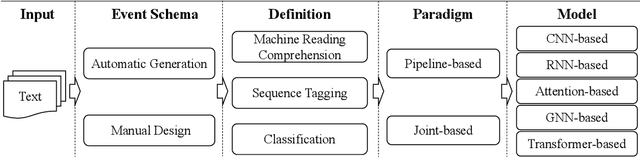
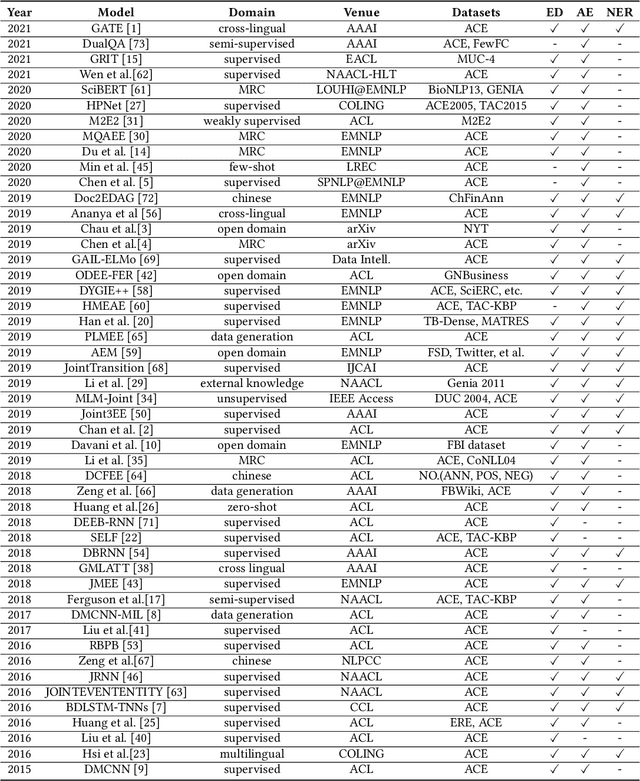


Schema-based event extraction is a critical technique to apprehend the essential content of events promptly. With the rapid development of deep learning technology, event extraction technology based on deep learning has become a research hotspot. Numerous methods, datasets, and evaluation metrics have been proposed in the literature, raising the need for a comprehensive and updated survey. This paper fills the gap by reviewing the state-of-the-art approaches, focusing on deep learning-based models. We summarize the task definition, paradigm, and models of schema-based event extraction and then discuss each of these in detail. We introduce benchmark datasets that support tests of predictions and evaluation metrics. A comprehensive comparison between different techniques is also provided in this survey. Finally, we conclude by summarizing future research directions facing the research area.
CasEE: A Joint Learning Framework with Cascade Decoding for Overlapping Event Extraction
Jul 04, 2021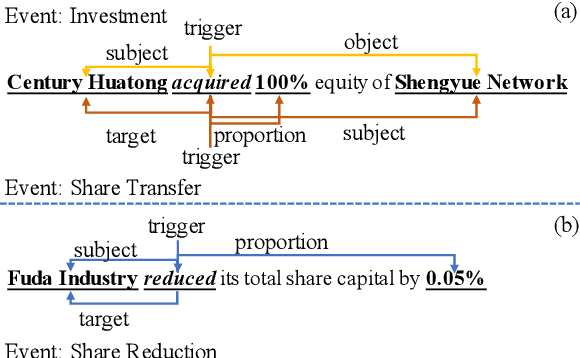
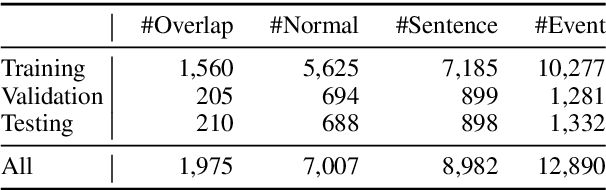
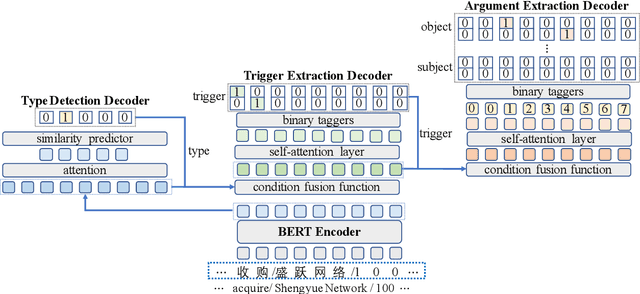
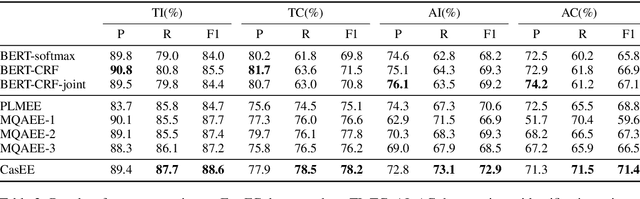
Event extraction (EE) is a crucial information extraction task that aims to extract event information in texts. Most existing methods assume that events appear in sentences without overlaps, which are not applicable to the complicated overlapping event extraction. This work systematically studies the realistic event overlapping problem, where a word may serve as triggers with several types or arguments with different roles. To tackle the above problem, we propose a novel joint learning framework with cascade decoding for overlapping event extraction, termed as CasEE. Particularly, CasEE sequentially performs type detection, trigger extraction and argument extraction, where the overlapped targets are extracted separately conditioned on the specific former prediction. All the subtasks are jointly learned in a framework to capture dependencies among the subtasks. The evaluation on a public event extraction benchmark FewFC demonstrates that CasEE achieves significant improvements on overlapping event extraction over previous competitive methods.