 Add to Chrome
 Add to Firefox
 Add to Edge
Hypergraph Enterprise Agentic Reasoner over Heterogeneous Business Systems
May 14, 2026
Applying Large Language Models (LLMs) to heterogeneous enterprise systems is hindered by hallucinations and failures in multi-hop, n-ary reasoning. Existing paradigms (e.g., GraphRAG, NL2SQL) lack the semantic grounding and auditable execution required for these complex environments. We introduce HEAR, an enterprise agentic reasoner built on a Stratified Hypergraph Ontology. Its base Graph Layer virtualizes provenance-aware data interfaces, while the Hyperedge Layer encodes n-ary business rules and procedural protocols. Operating an evidence-driven reasoning loop, HEAR dynamically orchestrates ontology tools for structured multi-hop analysis without requiring LLM retraining. Evaluations on supply-chain tasks, including order fulfillment blockage root cause analysis (RCA), show HEAR achieves up to 94.7% accuracy. Crucially, HEAR demonstrates adaptive efficiency: utilizing procedural hyperedges to minimize token costs, while leveraging topological exploration for rigorous correctness on complex queries. By matching proprietary model performance with open-weight backbones and automating manual diagnostics, HEAR establishes a scalable, auditable foundation for enterprise intelligence.

From Classification to Ranking: Enhancing LLM Reasoning Capabilities for MBTI Personality Detection
Jan 26, 2026Personality detection aims to measure an individual's corresponding personality traits through their social media posts. The advancements in Large Language Models (LLMs) offer novel perspectives for personality detection tasks. Existing approaches enhance personality trait analysis by leveraging LLMs to extract semantic information from textual posts as prompts, followed by training classifiers for categorization. However, accurately classifying personality traits remains challenging due to the inherent complexity of human personality and subtle inter-trait distinctions. Moreover, prompt-based methods often exhibit excessive dependency on expert-crafted knowledge without autonomous pattern-learning capacity. To address these limitations, we view personality detection as a ranking task rather than a classification and propose a corresponding reinforcement learning training paradigm. First, we employ supervised fine-tuning (SFT) to establish personality trait ranking capabilities while enforcing standardized output formats, creating a robust initialization. Subsequently, we introduce Group Relative Policy Optimization (GRPO) with a specialized ranking-based reward function. Unlike verification tasks with definitive solutions, personality assessment involves subjective interpretations and blurred boundaries between trait categories. Our reward function explicitly addresses this challenge by training LLMs to learn optimal answer rankings. Comprehensive experiments have demonstrated that our method achieves state-of-the-art performance across multiple personality detection benchmarks.
AlignVTOFF: Texture-Spatial Feature Alignment for High-Fidelity Virtual Try-Off
Jan 05, 2026Virtual Try-Off (VTOFF) is a challenging multimodal image generation task that aims to synthesize high-fidelity flat-lay garments under complex geometric deformation and rich high-frequency textures. Existing methods often rely on lightweight modules for fast feature extraction, which struggles to preserve structured patterns and fine-grained details, leading to texture attenuation during generation.To address these issues, we propose AlignVTOFF, a novel parallel U-Net framework built upon a Reference U-Net and Texture-Spatial Feature Alignment (TSFA). The Reference U-Net performs multi-scale feature extraction and enhances geometric fidelity, enabling robust modeling of deformation while retaining complex structured patterns. TSFA then injects the reference garment features into a frozen denoising U-Net via a hybrid attention design, consisting of a trainable cross-attention module and a frozen self-attention module. This design explicitly aligns texture and spatial cues and alleviates the loss of high-frequency information during the denoising process.Extensive experiments across multiple settings demonstrate that AlignVTOFF consistently outperforms state-of-the-art methods, producing flat-lay garment results with improved structural realism and high-frequency detail fidelity.
It is not always greener on the other side: Greenery perception across demographics and personalities in multiple cities
Dec 19, 2025Quantifying and assessing urban greenery is consequential for planning and development, reflecting the everlasting importance of green spaces for multiple climate and well-being dimensions of cities. Evaluation can be broadly grouped into objective (e.g., measuring the amount of greenery) and subjective (e.g., polling the perception of people) approaches, which may differ -- what people see and feel about how green a place is might not match the measurements of the actual amount of vegetation. In this work, we advance the state of the art by measuring such differences and explaining them through human, geographic, and spatial dimensions. The experiments rely on contextual information extracted from street view imagery and a comprehensive urban visual perception survey collected from 1,000 people across five countries with their extensive demographic and personality information. We analyze the discrepancies between objective measures (e.g., Green View Index (GVI)) and subjective scores (e.g., pairwise ratings), examining whether they can be explained by a variety of human and visual factors such as age group and spatial variation of greenery in the scene. The findings reveal that such discrepancies are comparable around the world and that demographics and personality do not play a significant role in perception. Further, while perceived and measured greenery correlate consistently across geographies (both where people and where imagery are from), where people live plays a significant role in explaining perceptual differences, with these two, as the top among seven, features that influences perceived greenery the most. This location influence suggests that cultural, environmental, and experiential factors substantially shape how individuals observe greenery in cities.
Open Polymer Challenge: Post-Competition Report
Dec 09, 2025Machine learning (ML) offers a powerful path toward discovering sustainable polymer materials, but progress has been limited by the lack of large, high-quality, and openly accessible polymer datasets. The Open Polymer Challenge (OPC) addresses this gap by releasing the first community-developed benchmark for polymer informatics, featuring a dataset with 10K polymers and 5 properties: thermal conductivity, radius of gyration, density, fractional free volume, and glass transition temperature. The challenge centers on multi-task polymer property prediction, a core step in virtual screening pipelines for materials discovery. Participants developed models under realistic constraints that include small data, label imbalance, and heterogeneous simulation sources, using techniques such as feature-based augmentation, transfer learning, self-supervised pretraining, and targeted ensemble strategies. The competition also revealed important lessons about data preparation, distribution shifts, and cross-group simulation consistency, informing best practices for future large-scale polymer datasets. The resulting models, analysis, and released data create a new foundation for molecular AI in polymer science and are expected to accelerate the development of sustainable and energy-efficient materials. Along with the competition, we release the test dataset at https://www.kaggle.com/datasets/alexliu99/neurips-open-polymer-prediction-2025-test-data. We also release the data generation pipeline at https://github.com/sobinalosious/ADEPT, which simulates more than 25 properties, including thermal conductivity, radius of gyration, and density.
It's not you, it's me -- Global urban visual perception varies across demographics and personalities
May 19, 2025Understanding people's preferences and needs is crucial for urban planning decisions, yet current approaches often combine them from multi-cultural and multi-city populations, obscuring important demographic differences and risking amplifying biases. We conducted a large-scale urban visual perception survey of streetscapes worldwide using street view imagery, examining how demographics -- including gender, age, income, education, race and ethnicity, and, for the first time, personality traits -- shape perceptions among 1,000 participants, with balanced demographics, from five countries and 45 nationalities. This dataset, introduced as Street Perception Evaluation Considering Socioeconomics (SPECS), exhibits statistically significant differences in perception scores in six traditionally used indicators (safe, lively, wealthy, beautiful, boring, and depressing) and four new ones we propose (live nearby, walk, cycle, green) among demographics and personalities. We revealed that location-based sentiments are carried over in people's preferences when comparing urban streetscapes with other cities. Further, we compared the perception scores based on where participants and streetscapes are from. We found that an off-the-shelf machine learning model trained on an existing global perception dataset tends to overestimate positive indicators and underestimate negative ones compared to human responses, suggesting that targeted intervention should consider locals' perception. Our study aspires to rectify the myopic treatment of street perception, which rarely considers demographics or personality traits.
Learning Repetition-Invariant Representations for Polymer Informatics
May 15, 2025Polymers are large macromolecules composed of repeating structural units known as monomers and are widely applied in fields such as energy storage, construction, medicine, and aerospace. However, existing graph neural network methods, though effective for small molecules, only model the single unit of polymers and fail to produce consistent vector representations for the true polymer structure with varying numbers of units. To address this challenge, we introduce Graph Repetition Invariance (GRIN), a novel method to learn polymer representations that are invariant to the number of repeating units in their graph representations. GRIN integrates a graph-based maximum spanning tree alignment with repeat-unit augmentation to ensure structural consistency. We provide theoretical guarantees for repetition-invariance from both model and data perspectives, demonstrating that three repeating units are the minimal augmentation required for optimal invariant representation learning. GRIN outperforms state-of-the-art baselines on both homopolymer and copolymer benchmarks, learning stable, repetition-invariant representations that generalize effectively to polymer chains of unseen sizes.
ZenSVI: An Open-Source Software for the Integrated Acquisition, Processing and Analysis of Street View Imagery Towards Scalable Urban Science
Dec 24, 2024
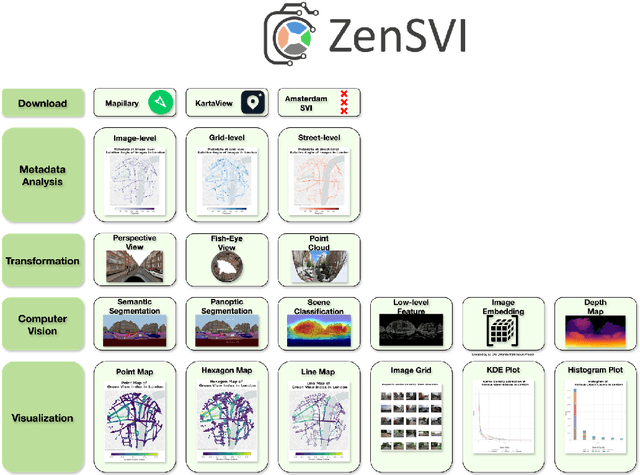
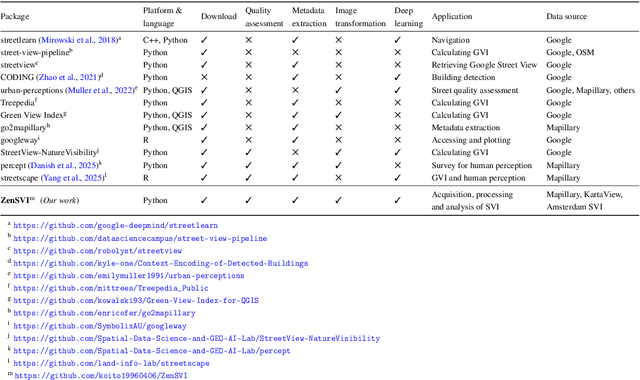
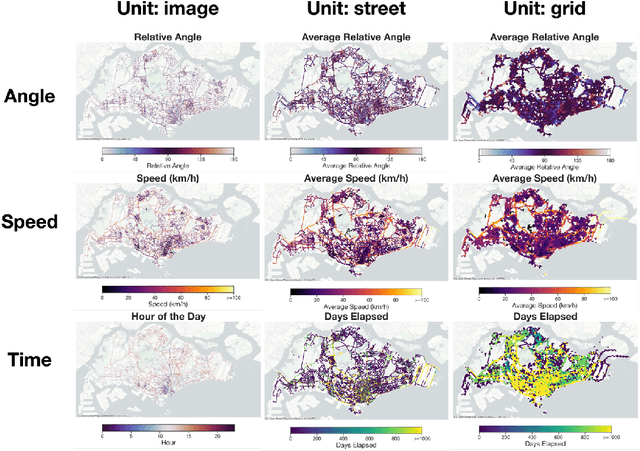
Street view imagery (SVI) has been instrumental in many studies in the past decade to understand and characterize street features and the built environment. Researchers across a variety of domains, such as transportation, health, architecture, human perception, and infrastructure have employed different methods to analyze SVI. However, these applications and image-processing procedures have not been standardized, and solutions have been implemented in isolation, often making it difficult for others to reproduce existing work and carry out new research. Using SVI for research requires multiple technical steps: accessing APIs for scalable data collection, preprocessing images to standardize formats, implementing computer vision models for feature extraction, and conducting spatial analysis. These technical requirements create barriers for researchers in urban studies, particularly those without extensive programming experience. We develop ZenSVI, a free and open-source Python package that integrates and implements the entire process of SVI analysis, supporting a wide range of use cases. Its end-to-end pipeline includes downloading SVI from multiple platforms (e.g., Mapillary and KartaView) efficiently, analyzing metadata of SVI, applying computer vision models to extract target features, transforming SVI into different projections (e.g., fish-eye and perspective) and different formats (e.g., depth map and point cloud), visualizing analyses with maps and plots, and exporting outputs to other software tools. We demonstrate its use in Singapore through a case study of data quality assessment and clustering analysis in a streamlined manner. Our software improves the transparency, reproducibility, and scalability of research relying on SVI and supports researchers in conducting urban analyses efficiently. Its modular design facilitates extensions and unlocking new use cases.