 Add to Chrome
 Add to Firefox
 Add to Edge
SpikeTrack: A Spike-driven Framework for Efficient Visual Tracking
Feb 27, 2026
Spiking Neural Networks (SNNs) promise energy-efficient vision, but applying them to RGB visual tracking remains difficult: Existing SNN tracking frameworks either do not fully align with spike-driven computation or do not fully leverage neurons' spatiotemporal dynamics, leading to a trade-off between efficiency and accuracy. To address this, we introduce SpikeTrack, a spike-driven framework for energy-efficient RGB object tracking. SpikeTrack employs a novel asymmetric design that uses asymmetric timestep expansion and unidirectional information flow, harnessing spatiotemporal dynamics while cutting computation. To ensure effective unidirectional information transfer between branches, we design a memory-retrieval module inspired by neural inference mechanisms. This module recurrently queries a compact memory initialized by the template to retrieve target cues and sharpen target perception over time. Extensive experiments demonstrate that SpikeTrack achieves the state-of-the-art among SNN-based trackers and remains competitive with advanced ANN trackers. Notably, it surpasses TransT on LaSOT dataset while consuming only 1/26 of its energy. To our knowledge, SpikeTrack is the first spike-driven framework to make RGB tracking both accurate and energy efficient. The code and models are available at https://github.com/faicaiwawa/SpikeTrack.

AlignVTOFF: Texture-Spatial Feature Alignment for High-Fidelity Virtual Try-Off
Jan 05, 2026Virtual Try-Off (VTOFF) is a challenging multimodal image generation task that aims to synthesize high-fidelity flat-lay garments under complex geometric deformation and rich high-frequency textures. Existing methods often rely on lightweight modules for fast feature extraction, which struggles to preserve structured patterns and fine-grained details, leading to texture attenuation during generation.To address these issues, we propose AlignVTOFF, a novel parallel U-Net framework built upon a Reference U-Net and Texture-Spatial Feature Alignment (TSFA). The Reference U-Net performs multi-scale feature extraction and enhances geometric fidelity, enabling robust modeling of deformation while retaining complex structured patterns. TSFA then injects the reference garment features into a frozen denoising U-Net via a hybrid attention design, consisting of a trainable cross-attention module and a frozen self-attention module. This design explicitly aligns texture and spatial cues and alleviates the loss of high-frequency information during the denoising process.Extensive experiments across multiple settings demonstrate that AlignVTOFF consistently outperforms state-of-the-art methods, producing flat-lay garment results with improved structural realism and high-frequency detail fidelity.
Video Emotion Open-vocabulary Recognition Based on Multimodal Large Language Model
Aug 22, 2024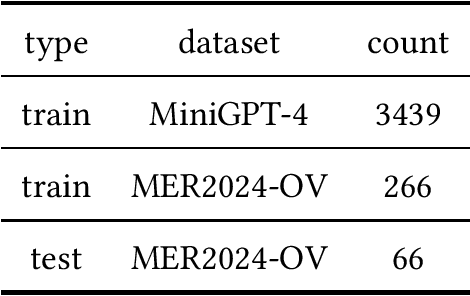
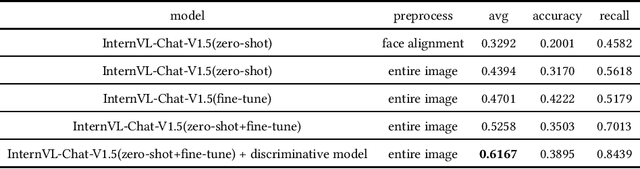
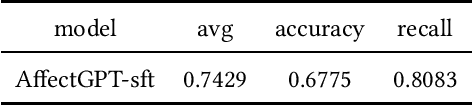
Multimodal emotion recognition is a task of great concern. However, traditional data sets are based on fixed labels, resulting in models that often focus on main emotions and ignore detailed emotional changes in complex scenes. This report introduces the solution of using MLLMs technology to generate open-vocabulary emotion labels from a video. The solution includes the use of framework, data generation and processing, training methods, results generation and multi-model co-judgment. In the MER-OV (Open-Word Emotion Recognition) of the MER2024 challenge, our method achieved significant advantages, leading to its superior capabilities in complex emotion computation.