 Add to Chrome
 Add to Firefox
 Add to Edge
Rethinking Visual-Language-Action Model Scaling: Alignment, Mixture, and Regularization
Feb 10, 2026
While Vision-Language-Action (VLA) models show strong promise for generalist robot control, it remains unclear whether -- and under what conditions -- the standard "scale data" recipe translates to robotics, where training data is inherently heterogeneous across embodiments, sensors, and action spaces. We present a systematic, controlled study of VLA scaling that revisits core training choices for pretraining across diverse robots. Using a representative VLA framework that combines a vision-language backbone with flow-matching, we ablate key design decisions under matched conditions and evaluate in extensive simulation and real-robot experiments. To improve the reliability of real-world results, we introduce a Grouped Blind Ensemble protocol that blinds operators to model identity and separates policy execution from outcome judgment, reducing experimenter bias. Our analysis targets three dimensions of VLA scaling. (1) Physical alignment: we show that a unified end-effector (EEF)-relative action representation is critical for robust cross-embodiment transfer. (2) Embodiment mixture: we find that naively pooling heterogeneous robot datasets often induces negative transfer rather than gains, underscoring the fragility of indiscriminate data scaling. (3) Training regularization: we observe that intuitive strategies, such as sensory dropout and multi-stage fine-tuning, do not consistently improve performance at scale. Together, this study challenge some common assumptions about embodied scaling and provide practical guidance for training large-scale VLA policies from diverse robotic data. Project website: https://research.beingbeyond.com/rethink_vla

Multiple Linked Tensor Factorization
Feb 27, 2025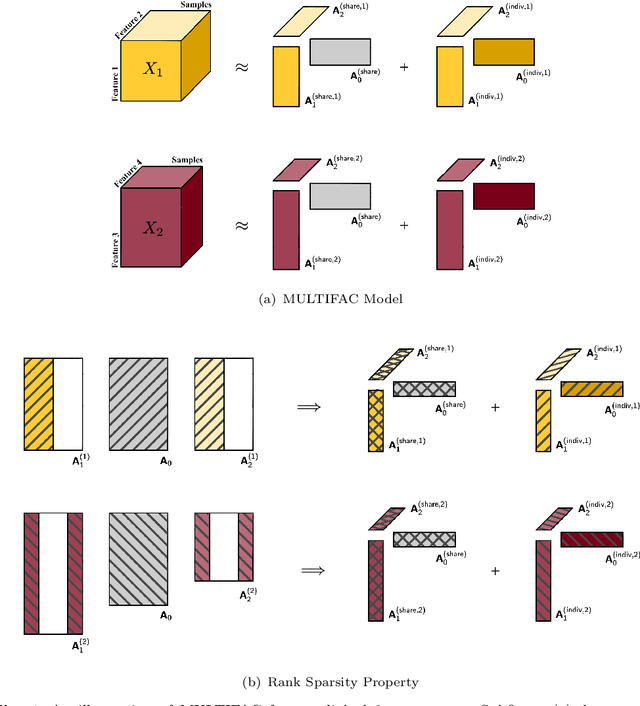
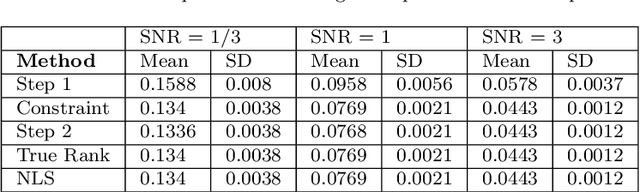
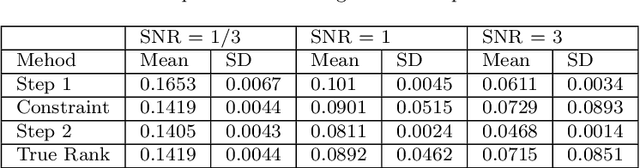
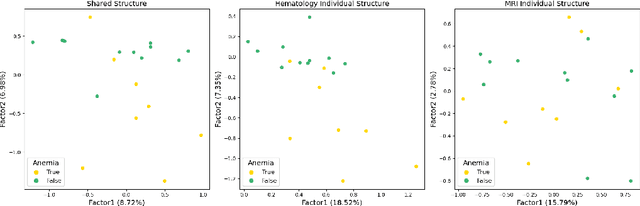
In biomedical research and other fields, it is now common to generate high content data that are both multi-source and multi-way. Multi-source data are collected from different high-throughput technologies while multi-way data are collected over multiple dimensions, yielding multiple tensor arrays. Integrative analysis of these data sets is needed, e.g., to capture and synthesize different facets of complex biological systems. However, despite growing interest in multi-source and multi-way factorization techniques, methods that can handle data that are both multi-source and multi-way are limited. In this work, we propose a Multiple Linked Tensors Factorization (MULTIFAC) method extending the CANDECOMP/PARAFAC (CP) decomposition to simultaneously reduce the dimension of multiple multi-way arrays and approximate underlying signal. We first introduce a version of the CP factorization with L2 penalties on the latent factors, leading to rank sparsity. When extended to multiple linked tensors, the method automatically reveals latent components that are shared across data sources or individual to each data source. We also extend the decomposition algorithm to its expectation-maximization (EM) version to handle incomplete data with imputation. Extensive simulation studies are conducted to demonstrate MULTIFAC's ability to (i) approximate underlying signal, (ii) identify shared and unshared structures, and (iii) impute missing data. The approach yields an interpretable decomposition on multi-way multi-omics data for a study on early-life iron deficiency.