 Add to Chrome
 Add to Firefox
 Add to Edge
PairCoder++: Pair Programming as a Universal Paradigm for Verified Code-Driven Multimodal and Structured-Artifact Generation
Jul 02, 2026
Code is the medium through which large language models generate structured artifacts: charts, scientific figures, vector graphics, CAD models, 3D scenes, and hardware designs are all produced by writing programs. In this regime single pass inference is brittle, because the compiler, renderer, or simulator that decides whether the artifact exists is invisible to the model. We present PairCoder, which grounds review in the toolchain and realizes it as two agent pair programming: a Driver agent writes the program, a Navigator agent reviews it against verification evidence (diagnostics, execution results, and renderings of the current artifact beside the target), and the two switch roles when errors persist. Across 17 public benchmarks and seven models from three vendors, PairCoder improves essentially every benchmark whose artifact is verifiable, on full official metric suites rather than execution alone (for example, Blender scene executability 0.20 to 0.78; TikZ compile rate up 10 to 30 points on every model), at 2.9 to 9.2 times single model cost (about 7 times overall). The improvements concentrate where the toolchain provides an informative oracle and the baseline leaves headroom, and the method ties or mildly regresses where the oracle is weak; we frame pair programming as a reliable recipe for verified code driven generation.

DeskVision: Large Scale Desktop Region Captioning for Advanced GUI Agents
Mar 14, 2025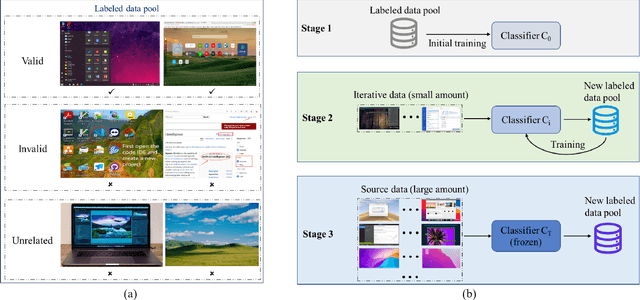
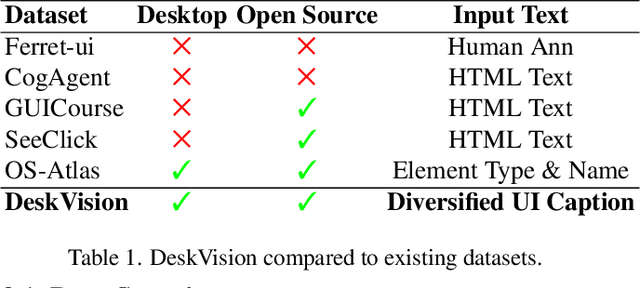
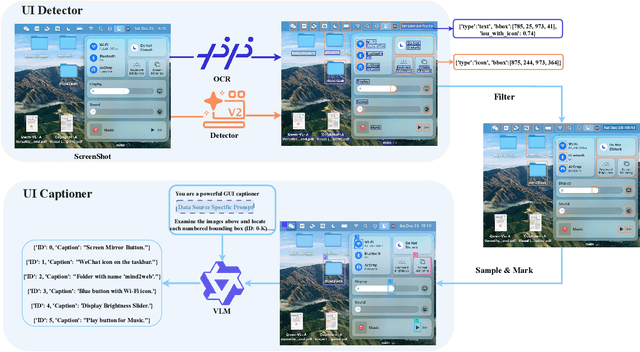
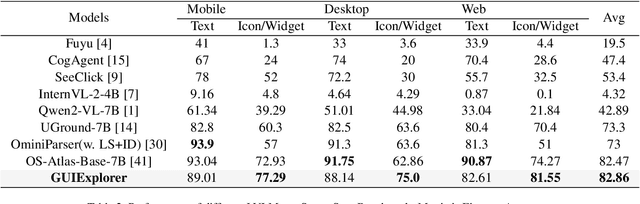
The limitation of graphical user interface (GUI) data has been a significant barrier to the development of GUI agents today, especially for the desktop / computer use scenarios. To address this, we propose an automated GUI data generation pipeline, AutoCaptioner, which generates data with rich descriptions while minimizing human effort. Using AutoCaptioner, we created a novel large-scale desktop GUI dataset, DeskVision, along with the largest desktop test benchmark, DeskVision-Eval, which reflects daily usage and covers diverse systems and UI elements, each with rich descriptions. With DeskVision, we train a new GUI understanding model, GUIExplorer. Results show that GUIExplorer achieves state-of-the-art (SOTA) performance in understanding/grounding visual elements without the need for complex architectural designs. We further validated the effectiveness of the DeskVision dataset through ablation studies on various large visual language models (LVLMs). We believe that AutoCaptioner and DeskVision will significantly advance the development of GUI agents, and will open-source them for the community.
Privacy-Preserving UCB Decision Process Verification via zk-SNARKs
Apr 18, 2024With the increasingly widespread application of machine learning, how to strike a balance between protecting the privacy of data and algorithm parameters and ensuring the verifiability of machine learning has always been a challenge. This study explores the intersection of reinforcement learning and data privacy, specifically addressing the Multi-Armed Bandit (MAB) problem with the Upper Confidence Bound (UCB) algorithm. We introduce zkUCB, an innovative algorithm that employs the Zero-Knowledge Succinct Non-Interactive Argument of Knowledge (zk-SNARKs) to enhance UCB. zkUCB is carefully designed to safeguard the confidentiality of training data and algorithmic parameters, ensuring transparent UCB decision-making. Experiments highlight zkUCB's superior performance, attributing its enhanced reward to judicious quantization bit usage that reduces information entropy in the decision-making process. zkUCB's proof size and verification time scale linearly with the execution steps of zkUCB. This showcases zkUCB's adept balance between data security and operational efficiency. This approach contributes significantly to the ongoing discourse on reinforcing data privacy in complex decision-making processes, offering a promising solution for privacy-sensitive applications.
THG: Transformer with Hyperbolic Geometry
Jun 01, 2021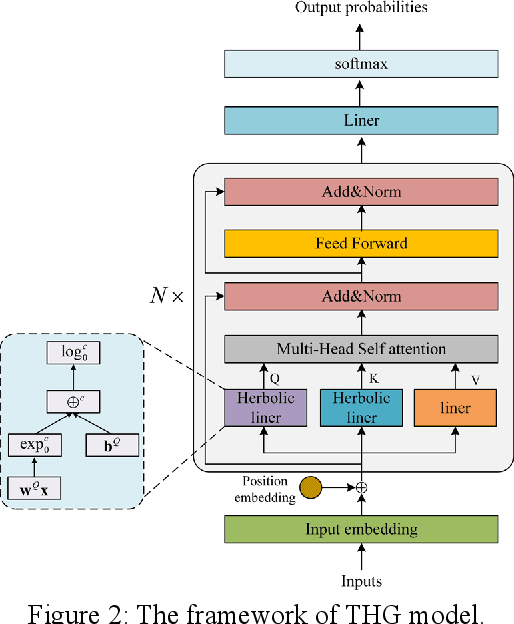
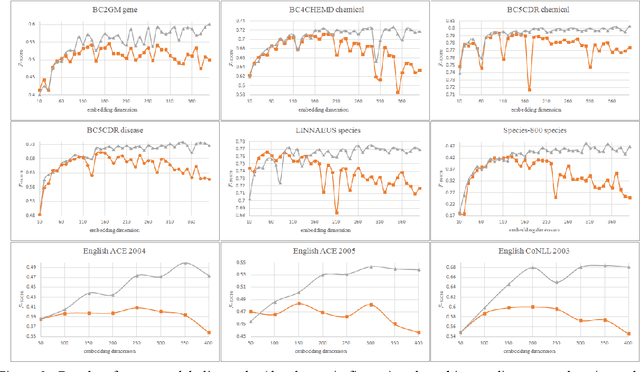
Transformer model architectures have become an indispensable staple in deep learning lately for their effectiveness across a range of tasks. Recently, a surge of "X-former" models have been proposed which improve upon the original Transformer architecture. However, most of these variants make changes only around the quadratic time and memory complexity of self-attention, i.e. the dot product between the query and the key. What's more, they are calculate solely in Euclidean space. In this work, we propose a novel Transformer with Hyperbolic Geometry (THG) model, which take the advantage of both Euclidean space and Hyperbolic space. THG makes improvements in linear transformations of self-attention, which are applied on the input sequence to get the query and the key, with the proposed hyperbolic linear. Extensive experiments on sequence labeling task, machine reading comprehension task and classification task demonstrate the effectiveness and generalizability of our model. It also demonstrates THG could alleviate overfitting.