 Add to Chrome
 Add to Firefox
 Add to Edge
Video Models as Native 4D Renderers: World-Grounded Conditioning from Animated Mesh
Jul 30, 2026
Pretrained video diffusion models can act as renderers when the desired scene state is already specified by an animated mesh, a camera trajectory, and a reference image. This 4D generative rendering setting raises a representation question: what image-format condition lets a video backbone obey both camera motion and scene-internal animation? We propose DAR, a reference-guided renderer that extends Wan2.2 camera control from Plücker rays alone to a joint camera-plus-geometry interface. DAR projects a neural 4D G-buffer (tracking, world position, and normal) from the animated mesh and injects it through a widened control adapter while preserving the pretrained image-to-video prior. The central design choice is the pair of tracking and world position. Tracking identifies the persistent surface element that should carry appearance; world position gives its current scene-coordinate state; normal supplies local shape. Depth plus calibrated rays can recover 3D in principle, but depth is a camera-dependent chart in which camera and object motion are mixed. On the 68-case DAR-4D benchmark, LoRA DAR reaches PSNR 23.22, SSIM 0.895, and LPIPS 0.134, improving over off-the-shelf Wan2.2-Depth by 1.54 dB PSNR; a full fine-tune reaches PSNR 25.36 and SSIM 0.917. Matched ablations show that replacing world position by depth reduces PSNR by 1.26--1.55 dB at every checkpoint, supporting tracking+world-position correspondence as a practical 4D rendering condition.

PairCoder++: Pair Programming as a Universal Paradigm for Verified Code-Driven Multimodal and Structured-Artifact Generation
Jul 02, 2026Code is the medium through which large language models generate structured artifacts: charts, scientific figures, vector graphics, CAD models, 3D scenes, and hardware designs are all produced by writing programs. In this regime single pass inference is brittle, because the compiler, renderer, or simulator that decides whether the artifact exists is invisible to the model. We present PairCoder, which grounds review in the toolchain and realizes it as two agent pair programming: a Driver agent writes the program, a Navigator agent reviews it against verification evidence (diagnostics, execution results, and renderings of the current artifact beside the target), and the two switch roles when errors persist. Across 17 public benchmarks and seven models from three vendors, PairCoder improves essentially every benchmark whose artifact is verifiable, on full official metric suites rather than execution alone (for example, Blender scene executability 0.20 to 0.78; TikZ compile rate up 10 to 30 points on every model), at 2.9 to 9.2 times single model cost (about 7 times overall). The improvements concentrate where the toolchain provides an informative oracle and the baseline leaves headroom, and the method ties or mildly regresses where the oracle is weak; we frame pair programming as a reliable recipe for verified code driven generation.
One Video, One World: Turning Monocular Video into Physical 4D Scenes
Jun 30, 2026We introduce \textbf{OVOW}, the first training-free system that reconstructs \emph{instance-level, simulation-ready} 4D mesh scenes from a single monocular video. Recent 4D reconstruction achieves impressive rendering quality, but its outputs (\eg, implicit fields, Gaussian primitives, or point clouds) lack the watertight topology, instance separation, and standardized physical interfaces required by physics simulators and embodied AI. OVOW closes this gap with a four-stage pipeline: a vision-language model discovers, labels, and motion-classifies all instances; category-aware reconstruction yields per-instance meshes for rigid objects and topology-consistent mesh sequences for deformable ones; an iterative render-match-optimize procedure recovers metric scale and 6-DoF pose trajectories; and physics-grounded assembly enforces ground contact and inter-object support. Crucially, we model all motion, rigid and non-rigid, through direct vertex deformation without category-specific priors or skeleton rigging, producing watertight mesh scenes ready for downstream physics simulation and editing. We further establish the first benchmark for \emph{structured Video-to-4D} evaluation, with metrics for geometric correctness, instance separation, and physical plausibility beyond visual fidelity; the same pipeline doubles as a scalable engine for \emph{synthesizing} paired video-to-4D simulation data for future 4D world models and embodied AI. Across two synthetic benchmarks (static and 4D), OVOW attains the best overall layout and geometry accuracy and the lowest photometric and semantic error among all baselines, and on monocular video runs one to two orders of magnitude faster than the baselines, while downstream physics simulation confirms its physical stability.
Human-AI Collaborative Game Testing with Vision Language Models
Jan 20, 2025
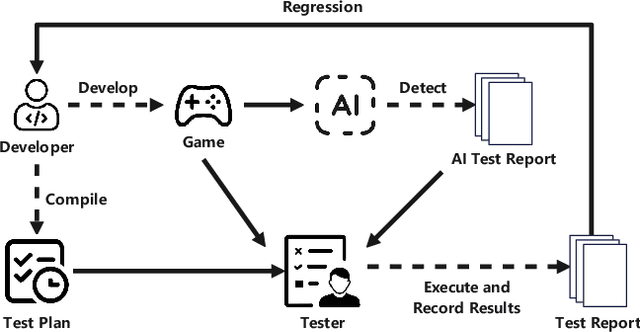
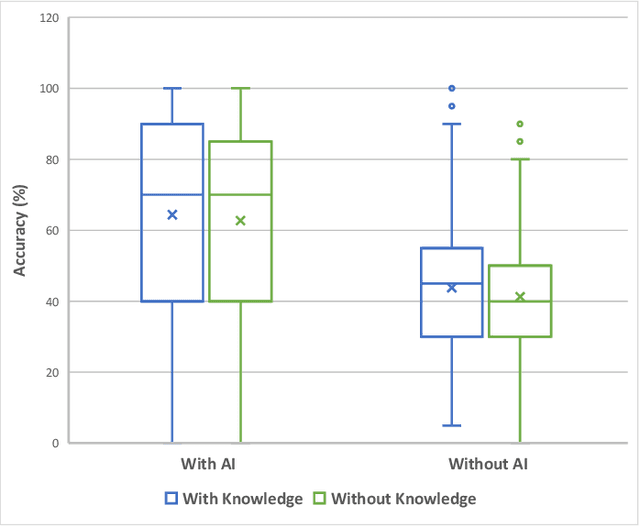
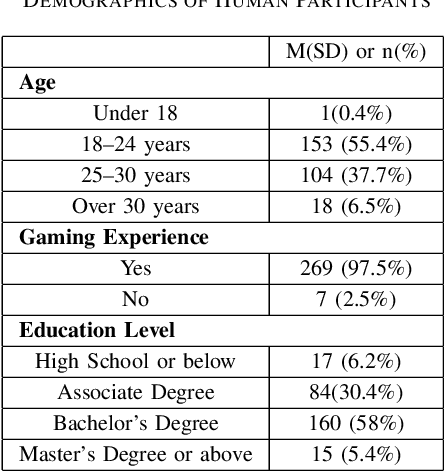
As modern video games become increasingly complex, traditional manual testing methods are proving costly and inefficient, limiting the ability to ensure high-quality game experiences. While advancements in Artificial Intelligence (AI) offer the potential to assist human testers, the effectiveness of AI in truly enhancing real-world human performance remains underexplored. This study investigates how AI can improve game testing by developing and experimenting with an AI-assisted workflow that leverages state-of-the-art machine learning models for defect detection. Through an experiment involving 800 test cases and 276 participants of varying backgrounds, we evaluate the effectiveness of AI assistance under four conditions: with or without AI support, and with or without detailed knowledge of defects and design documentation. The results indicate that AI assistance significantly improves defect identification performance, particularly when paired with detailed knowledge. However, challenges arise when AI errors occur, negatively impacting human decision-making. Our findings show the importance of optimizing human-AI collaboration and implementing strategies to mitigate the effects of AI inaccuracies. By this research, we demonstrate AI's potential and problems in enhancing efficiency and accuracy in game testing workflows and offers practical insights for integrating AI into the testing process.