 Add to Chrome
 Add to Firefox
 Add to Edge
TCPO: Turn-Level Credit Policy Optimization
Aug 03, 2026
Verifier-guided reinforcement learning has become a powerful paradigm for improving LLM reasoning. In multi-turn settings, models receive a verifier score after each turn and iteratively refine their outputs. Although such scores provide dense feedback, they do not directly provide dense credit: a score measures the quality of the current output, while credit should measure how the current turn changes the refinement trajectory. We propose TCPO, a turn-level credit assignment method for verifier-guided multi-turn RL. TCPO casts credit assignment as score-to-credit conversion and constructs turn-level advantages through reference-based comparisons: retrospective credit captures immediate progress and regression relative to the best prior state; hindsight delayed credit identifies non-improving turns with later payoff; and selective fixed-history counterfactual estimation refines high-surprisal turns under the same history. Experiments on math reasoning, code generation, and AppWorld agent tasks show that TCPO improves or matches the strongest baselines across model scales, task domains, and verifier types. TCPO achieves the best or tied-best best-turn Pass@8 on Qwen3-4B and DeepSeek-R1-Distill-Llama-8B, reduces turns to success, and improves multi-turn agent performance. These results highlight score-to-credit conversion as a central ingredient for verifier-guided multi-turn policy optimization.

LEAP: Lean Environment-Feedback via Adaptive Pruning for Code RL in GPU Kernel Generation
Aug 03, 2026Post-training large language models (LLMs) via reinforcement learning (RL) has significantly advanced code generation capabilities. To bypass the heavy memory footprint of critic networks, current state-of-the-art frameworks leverage critic-free paradigms like Group Relative Policy Optimization (GRPO) tied to rule-based verification sandboxes. However, applying these frameworks to low-level systems programming, such as CUDA kernel generation-presents severe challenges: binary pass/fail rewards introduce severe signal sparsity, while multi-turn environmental feedback loops suffer from prohibitive compilation latencies and reward dilution across trajectories. In this work, we introduce LEAP (Lean Environment-Feedback via Adaptive Pruning), a scalable and computationally efficient multi-turn RL framework optimized for low-level hardware accelerator alignment. LEAP features Difficulty-Conditioned Pruning (DCP), a dynamic gating mechanism that adaptively cuts off simple and overly catastrophic tasks from multi-turn expansion, focusing resource-heavy compilation and hardware exploration exclusively on high-value, complex tasks. To fully operationalize these paths without manual hyperparameter engineering, we propose a Rank-Based Reward formulation. By deriving scale-free relative advantages from pairwise tournament outcomes within the GRPO rollout group, our method inherently penalizes token inefficiency on simple prompts while maximizing learning gradients on challenging distributions. Empirical evaluations show that LEAP achieves superior first-turn proficiency and robust multi-turn debugging resilience while converging faster than unpruned multi-turn baselines, establishing a practical paradigm for low-level code RL.
Beyond the Best Teacher: Expanding and Compressing the Reasoning Solution Manifold
Jul 30, 2026A single reinforcement-learning run can produce a strong reasoner yet an incomplete teacher: it often amplifies only a subset of the valid solution modes. We argue that reinforcement learning (RL)-trained policies should therefore be viewed as local probes of a multi-basin reasoning solution manifold, rather than as globally reliable supervisors. Based on this view, we propose an expand-then-compress framework that couples teacher construction with multi-teacher policy distillation. In the expansion stage, Residual Group Relative Policy Optimization (RGRPO) trains a sequence of teachers from a common initialization and redirects each later round toward examples not yet covered by the accumulated teacher union. In the compression stage, reliability-gated Teacher-Union On-policy Distillation (TU-OPD) lets the student learn from its own response prefixes. For each example, only reliable teachers contribute, and their sampled-token OPD losses are weighted by their per-example quality. We further introduce Consensus-Residual Decomposition, which preserves a winner teacher's excess token preferences over its reliable peers, preventing specialist behavior from being suppressed during teacher aggregation. Experiments on mathematical reasoning, code generation, and instruction following show that the resulting Qwen3-1.7B student consistently outperforms the strongest individual teacher across all three domains, yielding relative improvements of 2.0%, 8.3%, and 6.9%, respectively, while retaining single-model inference. These results establish a simple but powerful principle: stronger students can be obtained not by selecting a single better teacher, but by deliberately constructing and compressing a complementary teacher union.
MusaCoder: Native GPU Kernel Generation with Full-Stack Training on Moore Threads GPU
Jun 03, 2026Native GPU kernel generation turns high-level tensor programs into executable, efficient low-level code. Existing Large Language Models (LLMs) struggle with this task, while execution-based reinforcement learning suffers from sparse rewards, reward hacking, and training instability. We present MusaCoder, a full-stack training framework for native GPU kernel generation on CUDA and MUSA backends. MusaCoder combines progressive kernel-oriented data synthesis, diversity-preserving rejection fine-tuning, and execution-feedback Reinforcement Learning (RL) through MooreEval, a distributed verifier and reward environment. To stabilize RL, MusaCoder introduces PrimeEcho for first-turn-anchored multi-turn rewards, Buffered Dynamic Retry for recovering signals from all-failed hard samples, and MirrorPop for off-policy sequence filtering. Experiments on KernelBench and a MUSA-ported variant show that MusaCoder outperforms strong open-source and proprietary baselines in both correctness and empirical speedup, with the 9B model matching or exceeding frontier closed-source models and the 27B model establishing a new state of the art. These results demonstrate not only the effectiveness of full-stack execution-feedback training for native kernel generation, but also the capability of Moore Threads GPUs to support the complete LLM post-training stack, providing a practical foundation for large-model training and optimization on emerging accelerators.
UniSem: Generalizable Semantic 3D Reconstruction from Sparse Unposed Images
Mar 18, 2026Semantic-aware 3D reconstruction from sparse, unposed images remains challenging for feed-forward 3D Gaussian Splatting (3DGS). Existing methods often predict an over-complete set of Gaussian primitives under sparse-view supervision, leading to unstable geometry and inferior depth quality. Meanwhile, they rely solely on 2D segmenter features for semantic lifting, which provides weak 3D-level and limited generalizable supervision, resulting in incomplete 3D semantics in novel scenes. To address these issues, we propose UniSem, a unified framework that jointly improves depth accuracy and semantic generalization via two key components. First, Error-aware Gaussian Dropout (EGD) performs error-guided capacity control by suppressing redundancy-prone Gaussians using rendering error cues, producing meaningful, geometrically stable Gaussian representations for improved depth estimation. Second, we introduce a Mix-training Curriculum (MTC) that progressively blends 2D segmenter-lifted semantics with the model's own emergent 3D semantic priors, implemented with object-level prototype alignment to enhance semantic coherence and completeness. Extensive experiments on ScanNet and Replica show that UniSem achieves superior performance in depth prediction and open-vocabulary 3D segmentation across varying numbers of input views. Notably, with 16-view inputs, UniSem reduces depth Rel by 15.2% and improves open-vocabulary segmentation mAcc by 3.7% over strong baselines.
URPO: A Unified Reward & Policy Optimization Framework for Large Language Models
Jul 23, 2025Large-scale alignment pipelines typically pair a policy model with a separately trained reward model whose parameters remain frozen during reinforcement learning (RL). This separation creates a complex, resource-intensive pipeline and suffers from a performance ceiling due to a static reward signal. We propose a novel framework, Unified Reward & Policy Optimization (URPO), that unifies instruction-following ("player") and reward modeling ("referee") within a single model and a single training phase. Our method recasts all alignment data-including preference pairs, verifiable reasoning, and open-ended instructions-into a unified generative format optimized by a single Group-Relative Policy Optimization (GRPO) loop. This enables the model to learn from ground-truth preferences and verifiable logic while simultaneously generating its own rewards for open-ended tasks. Experiments on the Qwen2.5-7B model demonstrate URPO's superiority. Our unified model significantly outperforms a strong baseline using a separate generative reward model, boosting the instruction-following score on AlpacaEval from 42.24 to 44.84 and the composite reasoning average from 32.66 to 35.66. Furthermore, URPO cultivates a superior internal evaluator as a byproduct of training, achieving a RewardBench score of 85.15 and surpassing the dedicated reward model it replaces (83.55). By eliminating the need for a separate reward model and fostering a co-evolutionary dynamic between generation and evaluation, URPO presents a simpler, more efficient, and more effective path towards robustly aligned language models.
DeskVision: Large Scale Desktop Region Captioning for Advanced GUI Agents
Mar 14, 2025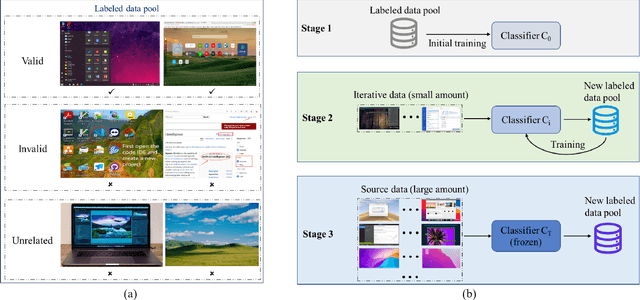
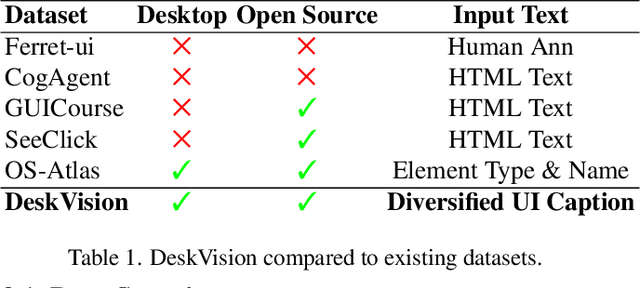
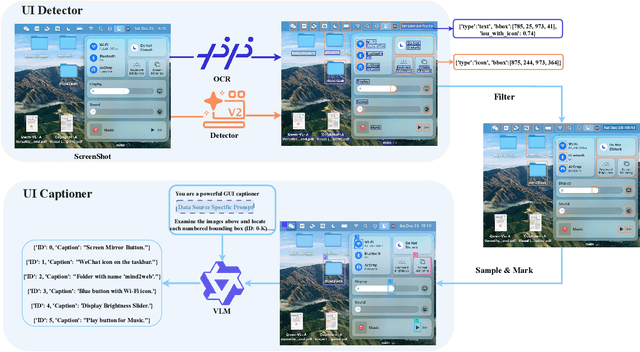
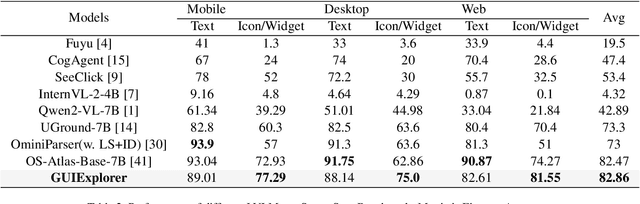
The limitation of graphical user interface (GUI) data has been a significant barrier to the development of GUI agents today, especially for the desktop / computer use scenarios. To address this, we propose an automated GUI data generation pipeline, AutoCaptioner, which generates data with rich descriptions while minimizing human effort. Using AutoCaptioner, we created a novel large-scale desktop GUI dataset, DeskVision, along with the largest desktop test benchmark, DeskVision-Eval, which reflects daily usage and covers diverse systems and UI elements, each with rich descriptions. With DeskVision, we train a new GUI understanding model, GUIExplorer. Results show that GUIExplorer achieves state-of-the-art (SOTA) performance in understanding/grounding visual elements without the need for complex architectural designs. We further validated the effectiveness of the DeskVision dataset through ablation studies on various large visual language models (LVLMs). We believe that AutoCaptioner and DeskVision will significantly advance the development of GUI agents, and will open-source them for the community.
SEKI: Self-Evolution and Knowledge Inspiration based Neural Architecture Search via Large Language Models
Feb 27, 2025We introduce SEKI, a novel large language model (LLM)-based neural architecture search (NAS) method. Inspired by the chain-of-thought (CoT) paradigm in modern LLMs, SEKI operates in two key stages: self-evolution and knowledge distillation. In the self-evolution stage, LLMs initially lack sufficient reference examples, so we implement an iterative refinement mechanism that enhances architectures based on performance feedback. Over time, this process accumulates a repository of high-performance architectures. In the knowledge distillation stage, LLMs analyze common patterns among these architectures to generate new, optimized designs. Combining these two stages, SEKI greatly leverages the capacity of LLMs on NAS and without requiring any domain-specific data. Experimental results show that SEKI achieves state-of-the-art (SOTA) performance across various datasets and search spaces while requiring only 0.05 GPU-days, outperforming existing methods in both efficiency and accuracy. Furthermore, SEKI demonstrates strong generalization capabilities, achieving SOTA-competitive results across multiple tasks.
Round Attention: A Novel Round-Level Attention Mechanism to Accelerate LLM Inference
Feb 21, 2025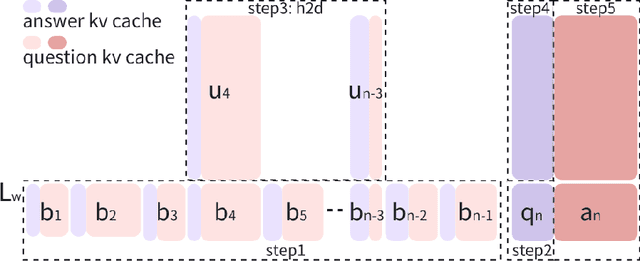
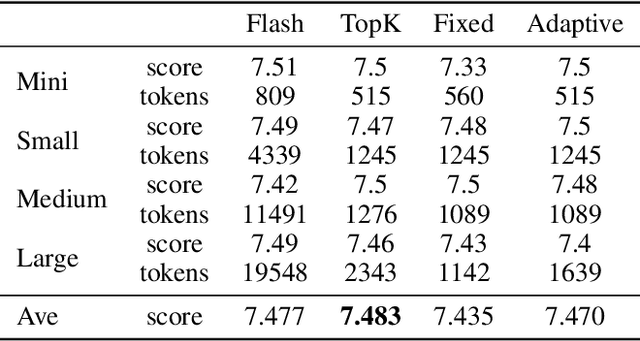
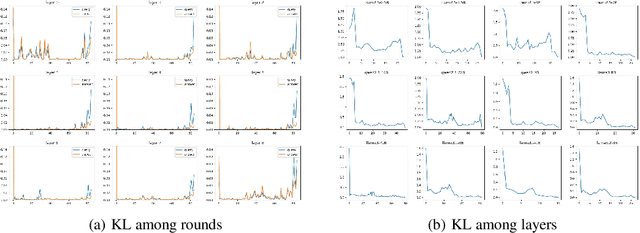
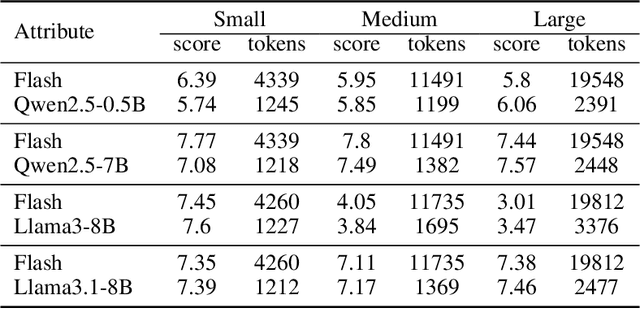
The increasing context window size in large language models (LLMs) has improved their ability to handle complex, long-text tasks. However, as the conversation rounds continue, it is required to store a large amount of KV cache in GPU memory, which significantly affects the efficiency and even availability of the model serving systems. This paper analyzes dialogue data from real users and discovers that the LLM inference manifests a watershed layer, after which the distribution of round-level attention shows notable similarity. We propose Round Attention, a novel round-level attention mechanism that only recalls and computes the KV cache of the most relevant rounds. The experiments show that our method saves 55\% memory usage without compromising model performance.
TurboRAG: Accelerating Retrieval-Augmented Generation with Precomputed KV Caches for Chunked Text
Oct 10, 2024
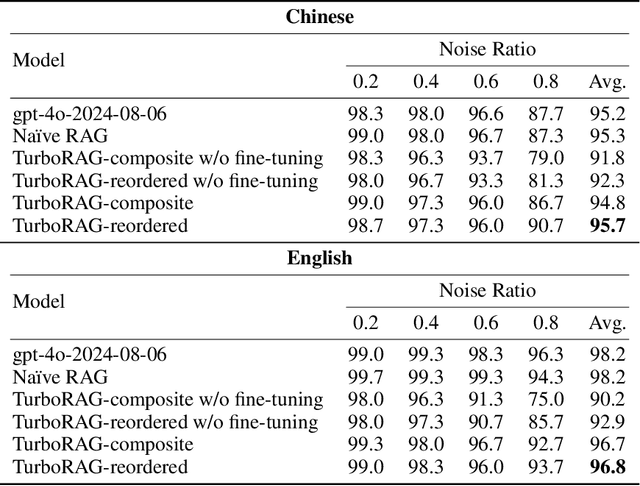

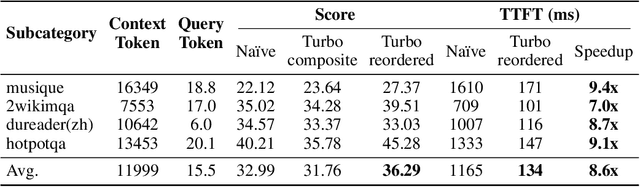
Current Retrieval-Augmented Generation (RAG) systems concatenate and process numerous retrieved document chunks for prefill which requires a large volume of computation, therefore leading to significant latency in time-to-first-token (TTFT). To reduce the computation overhead as well as TTFT, we introduce TurboRAG, a novel RAG system that redesigns the inference paradigm of the current RAG system by first pre-computing and storing the key-value (KV) caches of documents offline, and then directly retrieving the saved KV cache for prefill. Hence, online computation of KV caches is eliminated during inference. In addition, we provide a number of insights into the mask matrix and positional embedding mechanisms, plus fine-tune a pretrained language model to maintain model accuracy of TurboRAG. Our approach is applicable to most existing large language models and their applications without any requirement in modification of models and inference systems. Experimental results across a suite of RAG benchmarks demonstrate that TurboRAG reduces TTFT by up to 9.4x compared to the conventional RAG systems (on an average of 8.6x), but reserving comparable performance to the standard RAG systems.