 Add to Chrome
 Add to Firefox
 Add to Edge
MARCO: Click-Intent Decomposition for Calibrated Ads Conversion Prediction
Aug 11, 2026
Not all clicks are equal. Industrial ads ranking decouples conversion probability into click-through rate (CTR) and post-click conversion rate (CVR), yet treats every click as the same event. In reality, users provide a free, self-generated signal of intent through their physical UI interactions. Different click types on the same ad exhibit a 4-fold difference in actual conversion rates. By conflating these signals, the standard CVR model under-predicts high-intent clicks and over-predicts low-intent ones, which is a bias masked by near-perfect aggregate calibration. We propose MARCO (Multi-intent Ads Ranking Composition Optimization), a framework that resolves this bias by decomposing each click by intent. Using the logged click type as a free behavioral label, MARCO trains per-intent CVR heads on homogeneous populations, and at serving time composes their per-intent CVR estimates under a predicted distribution over intents. Theoretically, we prove that decomposition never raises population risk, give the exact headroom under squared loss and non-negativity under the deployed loss, and show through a routing-efficiency dial how much of it reaches serving. Because the population-optimal score is unchanged, any gain is a finite-capacity estimation and calibration effect that we validated both offline and online. For deployment at scale, we further cast multi-impression, multi-click attribution as credit assignment with a bias-variance tradeoff analogous to RL return estimation, showing last-impression, first-click attribution is the low-bias, low-variance, deterministic choice under production constraints, and derive three consistency conditions enforced end-to-end at scale. Deployed at binary intent granularity, MARCO corrects per-intent calibration to approximately 100%, lifts conversions per click by +2.80%, and drives +0.98% cumulative improvement in topline metrics.

Disentangling Shared and Task-Specific Representations from Multi-Modal Clinical Data
May 05, 2026Real-world clinical data is inherently multimodal, providing complementary evidence that mirrors the practical necessity of jointly assessing multiple related outcomes. Although multi-task learning can improve efficiency by sharing information across outcomes, existing approaches often fail to balance shared representation learning with outcome-specific modeling. Hard parameter sharing can trigger negative transfer when task gradients conflict, while flexible sharing may still entangle shared and task-specific signals. To address this, we propose a multi-task framework built on a unified Transformer for multimodal fusion, augmented with Orthogonal Task Decomposition (OrthTD) to split patient representations into shared and task-specific subspaces and impose a geometric orthogonality constraint to reduce redundancy and isolate task-specific signals. We evaluated OrthTD on a real-world cohort of 12,430 surgical patients for predicting four outcomes. OrthTD achieved average AUC (area under the receiver operating characteristic curve) of 87.5% and average AUPRC (area under the precision-recall curve) of 37.2%, consistently outperformed advanced tabular and multi-task methods. Notably, OrthTD achieves substantial gains in AUPRC, indicating superior performance in identifying rare events within imbalanced clinical data. These results suggest that enforcing non-redundant shared and task-specific representations can improve multi-outcome prediction from multimodal clinical data.
Low-Bit Quantization of Bandlimited Graph Signals via Iterative Methods
Jan 26, 2026We study the quantization of real-valued bandlimited signals on graphs, focusing on low-bit representations. We propose iterative noise-shaping algorithms for quantization, including sampling approaches with and without vertex replacement. The methods leverage the spectral properties of the graph Laplacian and exploit graph incoherence to achieve high-fidelity approximations. Theoretical guarantees are provided for the random sampling method, and extensive numerical experiments on synthetic and real-world graphs illustrate the efficiency and robustness of the proposed schemes.
Privacy-Preserving UCB Decision Process Verification via zk-SNARKs
Apr 18, 2024With the increasingly widespread application of machine learning, how to strike a balance between protecting the privacy of data and algorithm parameters and ensuring the verifiability of machine learning has always been a challenge. This study explores the intersection of reinforcement learning and data privacy, specifically addressing the Multi-Armed Bandit (MAB) problem with the Upper Confidence Bound (UCB) algorithm. We introduce zkUCB, an innovative algorithm that employs the Zero-Knowledge Succinct Non-Interactive Argument of Knowledge (zk-SNARKs) to enhance UCB. zkUCB is carefully designed to safeguard the confidentiality of training data and algorithmic parameters, ensuring transparent UCB decision-making. Experiments highlight zkUCB's superior performance, attributing its enhanced reward to judicious quantization bit usage that reduces information entropy in the decision-making process. zkUCB's proof size and verification time scale linearly with the execution steps of zkUCB. This showcases zkUCB's adept balance between data security and operational efficiency. This approach contributes significantly to the ongoing discourse on reinforcing data privacy in complex decision-making processes, offering a promising solution for privacy-sensitive applications.
Implicit regularization in Heavy-ball momentum accelerated stochastic gradient descent
Feb 02, 2023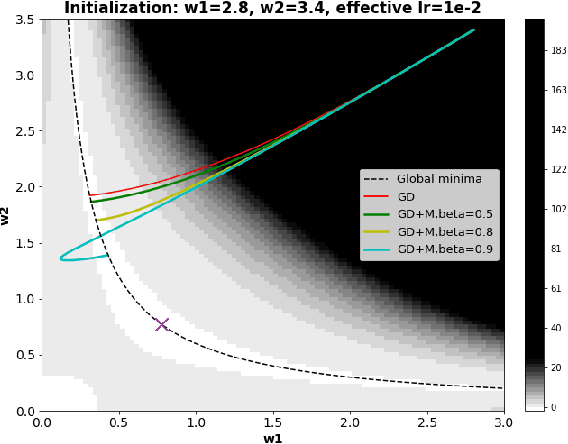
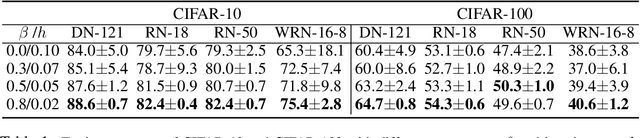
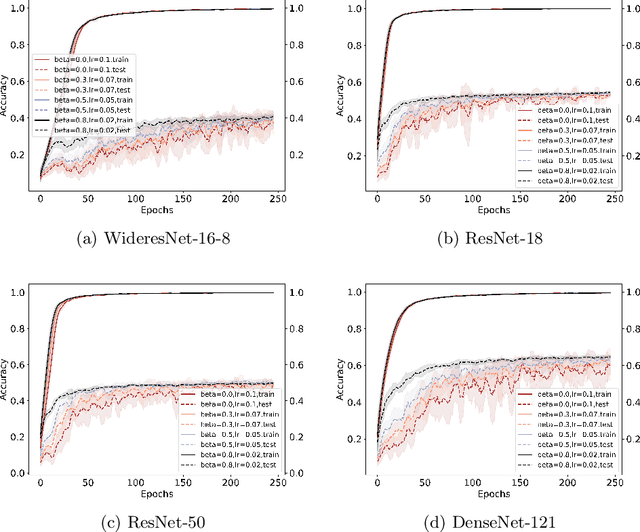
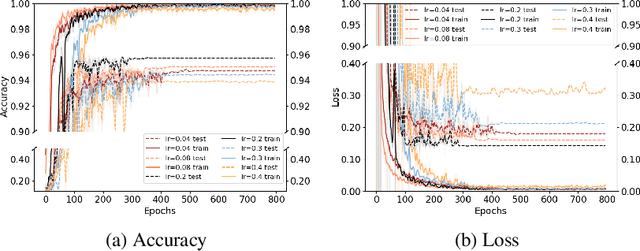
It is well known that the finite step-size ($h$) in Gradient Descent (GD) implicitly regularizes solutions to flatter minima. A natural question to ask is "Does the momentum parameter $\beta$ play a role in implicit regularization in Heavy-ball (H.B) momentum accelerated gradient descent (GD+M)?". To answer this question, first, we show that the discrete H.B momentum update (GD+M) follows a continuous trajectory induced by a modified loss, which consists of an original loss and an implicit regularizer. Then, we show that this implicit regularizer for (GD+M) is stronger than that of (GD) by factor of $(\frac{1+\beta}{1-\beta})$, thus explaining why (GD+M) shows better generalization performance and higher test accuracy than (GD). Furthermore, we extend our analysis to the stochastic version of gradient descent with momentum (SGD+M) and characterize the continuous trajectory of the update of (SGD+M) in a pointwise sense. We explore the implicit regularization in (SGD+M) and (GD+M) through a series of experiments validating our theory.
Manifold Denoising by Nonlinear Robust Principal Component Analysis
Nov 10, 2019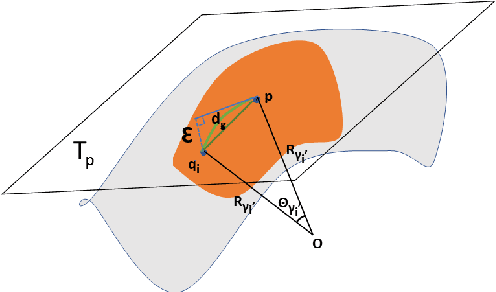
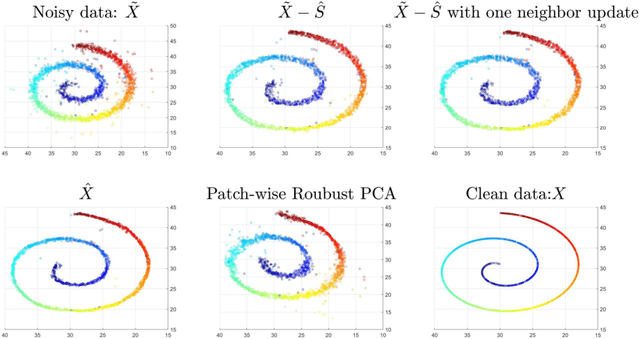
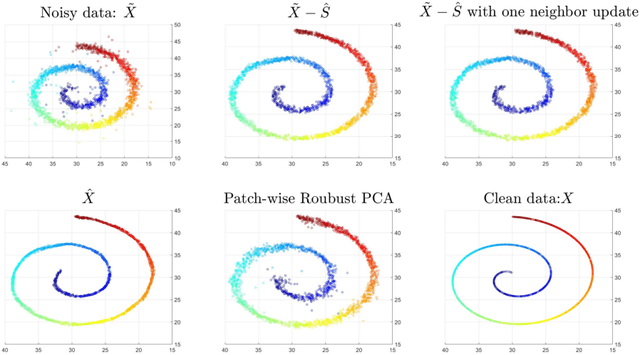
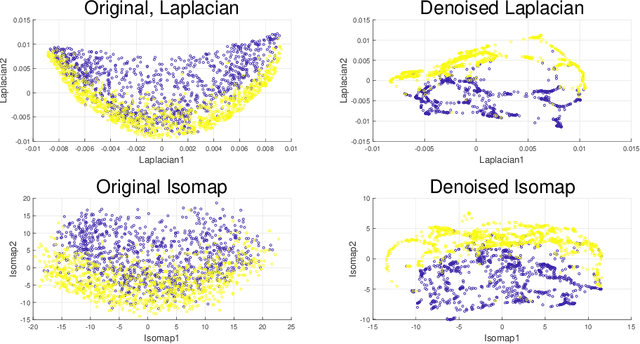
This paper extends robust principal component analysis (RPCA) to nonlinear manifolds. Suppose that the observed data matrix is the sum of a sparse component and a component drawn from some low dimensional manifold. Is it possible to separate them by using similar ideas as RPCA? Is there any benefit in treating the manifold as a whole as opposed to treating each local region independently? We answer these two questions affirmatively by proposing and analyzing an optimization framework that separates the sparse component from the manifold under noisy data. Theoretical error bounds are provided when the tangent spaces of the manifold satisfy certain incoherence conditions. We also provide a near optimal choice of the tuning parameters for the proposed optimization formulation with the help of a new curvature estimation method. The efficacy of our method is demonstrated on both synthetic and real datasets.