 Add to Chrome
 Add to Firefox
 Add to Edge
Prompt, Plan, Extract: Zero-Shot Agentic LLMs Workflows for Lung Pathology Extraction from Clinical Narratives
Jun 18, 2026
Information extraction from pathology reports is essential for cancer staging, tumor registry population. Yet key data remains embedded in narrative reports, making manual extraction labor-intensive and error-prone. Traditional supervised Natural Language Processing pipelines address this through fully supervised Named Entity Recognition and Relation Extraction, but require expensive manual annotation and suffer cascading failures when upstream entities are missed. In this study, we developed a zero-shot, agentic workflow, and evaluated five open-source generative Large Language Models (LLMs) to populate 13 College of American Pathologists synoptic fields from lung resection pathology reports. We compared them against a state-of-the-art supervised GatorTron NER-RE baseline using a novel, registry-aligned evaluation framework. The baseline achieved Micro-F1of 0.960, while the best zero-shot model (GPT-OSS-20B) achieved Micro-F1 of 0.893 (recall: 0.949), accurately extracting complex relations like Pathologic Stage without task-specific training. These results suggest that open-source, zero-shot agentic LLMs are a low-cost solution for extracting lung pathology information.

Detecting HIV-Related Stigma in Clinical Narratives Using Large Language Models
Apr 09, 2026Human immunodeficiency virus (HIV)-related stigma is a critical psychosocial determinant of health for people living with HIV (PLWH), influencing mental health, engagement in care, and treatment outcomes. Although stigma-related experiences are documented in clinical narratives, there is a lack of off-the-shelf tools to extract and categorize them. This study aims to develop a large language model (LLM)-based tool for identifying HIV stigma from clinical notes. We identified clinical notes from PLWH receiving care at the University of Florida (UF) Health between 2012 and 2022. Candidate sentences were identified using expert-curated stigma-related keywords and iteratively expanded via clinical word embeddings. A total of 1,332 sentences were manually annotated across four stigma subscales: Concern with Public Attitudes, Disclosure Concerns, Negative Self-Image, and Personalized Stigma. We compared GatorTron-large and BERT as encoder-based baselines, and GPT-OSS-20B, LLaMA-8B, and MedGemma-27B as generative LLMs, under zero-shot and few-shot prompting. GatorTron-large achieved the best overall performance (Micro F1 = 0.62). Few-shot prompting substantially improved generative model performance, with 5-shot GPT-OSS-20B and LLaMA-8B achieving Micro-F1 scores of 0.57 and 0.59, respectively. Performance varied by stigma subscale, with Negative Self-Image showing the highest predictability and Personalized Stigma remaining the most challenging. Zero-shot generative inference exhibited non-trivial failure rates (up to 32%). This study develops the first practical NLP tool for identifying HIV stigma in clinical notes.
DETQUS: Decomposition-Enhanced Transformers for QUery-focused Summarization
Mar 07, 2025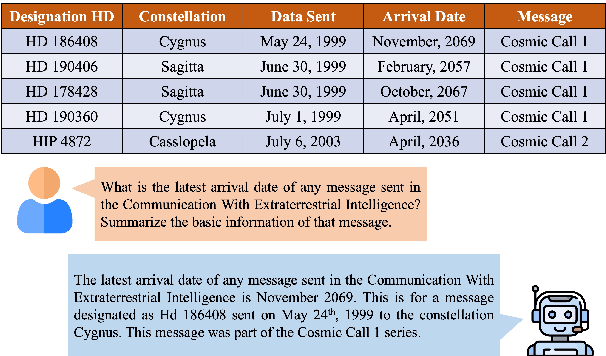

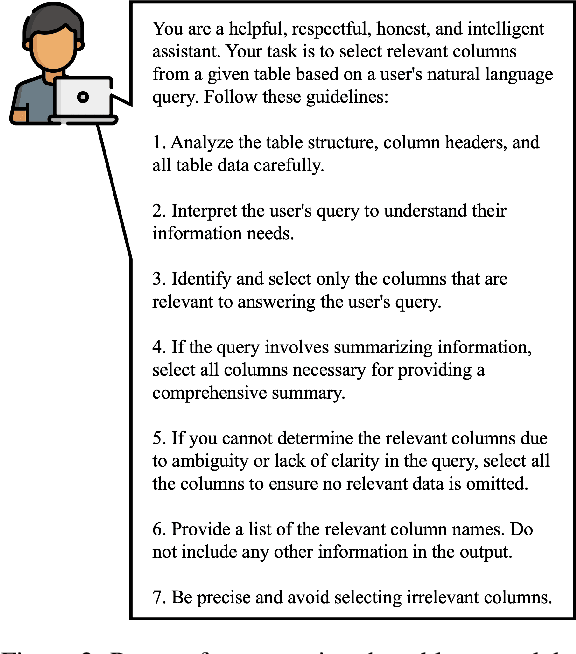
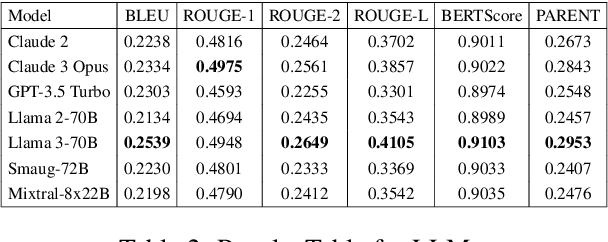
Query-focused tabular summarization is an emerging task in table-to-text generation that synthesizes a summary response from tabular data based on user queries. Traditional transformer-based approaches face challenges due to token limitations and the complexity of reasoning over large tables. To address these challenges, we introduce DETQUS (Decomposition-Enhanced Transformers for QUery-focused Summarization), a system designed to improve summarization accuracy by leveraging tabular decomposition alongside a fine-tuned encoder-decoder model. DETQUS employs a large language model to selectively reduce table size, retaining only query-relevant columns while preserving essential information. This strategy enables more efficient processing of large tables and enhances summary quality. Our approach, equipped with table-based QA model Omnitab, achieves a ROUGE-L score of 0.4437, outperforming the previous state-of-the-art REFACTOR model (ROUGE-L: 0.422). These results highlight DETQUS as a scalable and effective solution for query-focused tabular summarization, offering a structured alternative to more complex architectures.