 Add to Chrome
 Add to Firefox
 Add to Edge
Detecting HIV-Related Stigma in Clinical Narratives Using Large Language Models
Apr 09, 2026
Human immunodeficiency virus (HIV)-related stigma is a critical psychosocial determinant of health for people living with HIV (PLWH), influencing mental health, engagement in care, and treatment outcomes. Although stigma-related experiences are documented in clinical narratives, there is a lack of off-the-shelf tools to extract and categorize them. This study aims to develop a large language model (LLM)-based tool for identifying HIV stigma from clinical notes. We identified clinical notes from PLWH receiving care at the University of Florida (UF) Health between 2012 and 2022. Candidate sentences were identified using expert-curated stigma-related keywords and iteratively expanded via clinical word embeddings. A total of 1,332 sentences were manually annotated across four stigma subscales: Concern with Public Attitudes, Disclosure Concerns, Negative Self-Image, and Personalized Stigma. We compared GatorTron-large and BERT as encoder-based baselines, and GPT-OSS-20B, LLaMA-8B, and MedGemma-27B as generative LLMs, under zero-shot and few-shot prompting. GatorTron-large achieved the best overall performance (Micro F1 = 0.62). Few-shot prompting substantially improved generative model performance, with 5-shot GPT-OSS-20B and LLaMA-8B achieving Micro-F1 scores of 0.57 and 0.59, respectively. Performance varied by stigma subscale, with Negative Self-Image showing the highest predictability and Personalized Stigma remaining the most challenging. Zero-shot generative inference exhibited non-trivial failure rates (up to 32%). This study develops the first practical NLP tool for identifying HIV stigma in clinical notes.

A Topic Modeling Analysis of Stigma Dimensions, Social, and Related Behavioral Circumstances in Clinical Notes Among Patients with HIV
Jun 10, 2025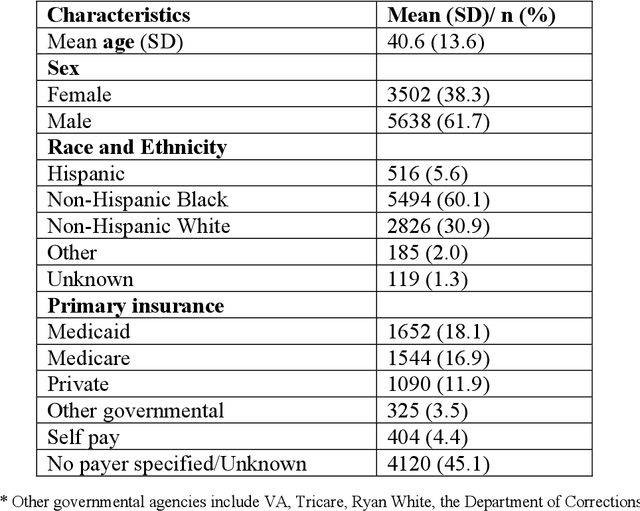
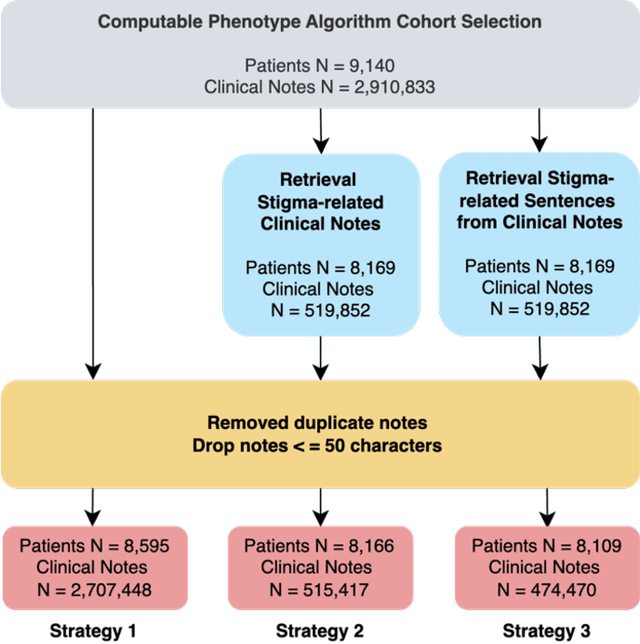
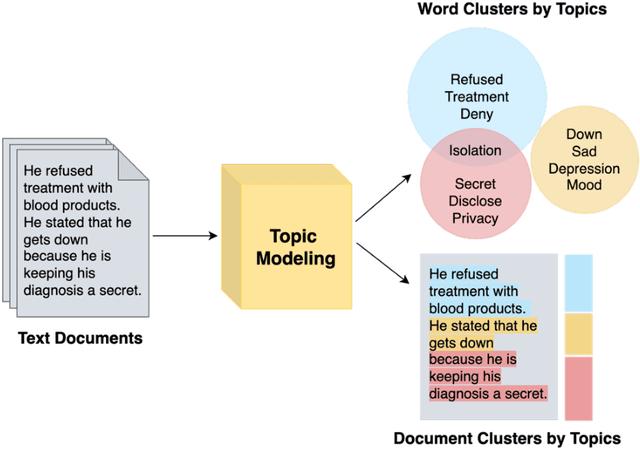
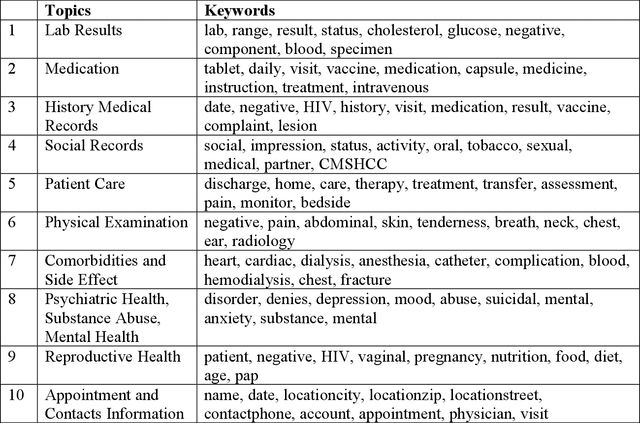
Objective: To characterize stigma dimensions, social, and related behavioral circumstances in people living with HIV (PLWHs) seeking care, using natural language processing methods applied to a large collection of electronic health record (EHR) clinical notes from a large integrated health system in the southeast United States. Methods: We identified 9,140 cohort of PLWHs from the UF Health IDR and performed topic modeling analysis using Latent Dirichlet Allocation (LDA) to uncover stigma dimensions, social, and related behavioral circumstances. Domain experts created a seed list of HIV-related stigma keywords, then applied a snowball strategy to iteratively review notes for additional terms until saturation was reached. To identify more target topics, we tested three keyword-based filtering strategies. Domain experts manually reviewed the detected topics using the prevalent terms and key discussion topics. Word frequency analysis was used to highlight the prevalent terms associated with each topic. In addition, we conducted topic variation analysis among subgroups to examine differences across age and sex-specific demographics. Results and Conclusion: Topic modeling on sentences containing at least one keyword uncovered a wide range of topic themes associated with HIV-related stigma, social, and related behaviors circumstances, including "Mental Health Concern and Stigma", "Social Support and Engagement", "Limited Healthcare Access and Severe Illness", "Treatment Refusal and Isolation" and so on. Topic variation analysis across age subgroups revealed differences. Extracting and understanding the HIV-related stigma dimensions, social, and related behavioral circumstances from EHR clinical notes enables scalable, time-efficient assessment, overcoming the limitations of traditional questionnaires and improving patient outcomes.