 Add to Chrome
 Add to Firefox
 Add to Edge
Prompt, Plan, Extract: Zero-Shot Agentic LLMs Workflows for Lung Pathology Extraction from Clinical Narratives
Jun 18, 2026
Information extraction from pathology reports is essential for cancer staging, tumor registry population. Yet key data remains embedded in narrative reports, making manual extraction labor-intensive and error-prone. Traditional supervised Natural Language Processing pipelines address this through fully supervised Named Entity Recognition and Relation Extraction, but require expensive manual annotation and suffer cascading failures when upstream entities are missed. In this study, we developed a zero-shot, agentic workflow, and evaluated five open-source generative Large Language Models (LLMs) to populate 13 College of American Pathologists synoptic fields from lung resection pathology reports. We compared them against a state-of-the-art supervised GatorTron NER-RE baseline using a novel, registry-aligned evaluation framework. The baseline achieved Micro-F1of 0.960, while the best zero-shot model (GPT-OSS-20B) achieved Micro-F1 of 0.893 (recall: 0.949), accurately extracting complex relations like Pathologic Stage without task-specific training. These results suggest that open-source, zero-shot agentic LLMs are a low-cost solution for extracting lung pathology information.

Extracting Thyroid Nodules Characteristics from Ultrasound Reports Using Transformer-based Natural Language Processing Methods
Mar 31, 2023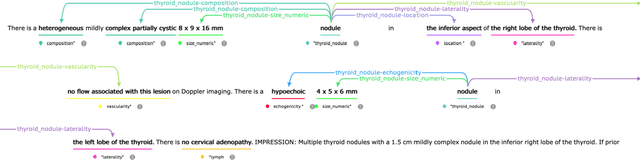

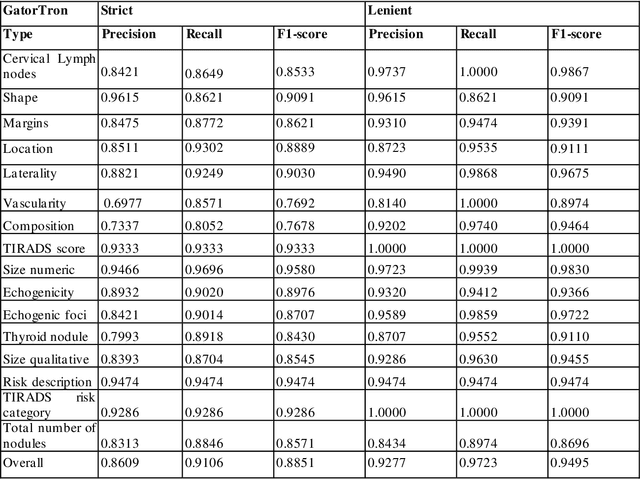
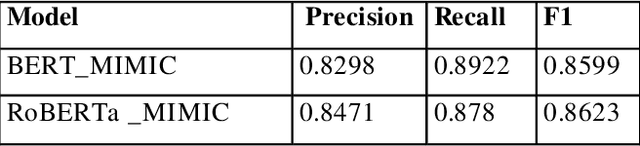
The ultrasound characteristics of thyroid nodules guide the evaluation of thyroid cancer in patients with thyroid nodules. However, the characteristics of thyroid nodules are often documented in clinical narratives such as ultrasound reports. Previous studies have examined natural language processing (NLP) methods in extracting a limited number of characteristics (<9) using rule-based NLP systems. In this study, a multidisciplinary team of NLP experts and thyroid specialists, identified thyroid nodule characteristics that are important for clinical care, composed annotation guidelines, developed a corpus, and compared 5 state-of-the-art transformer-based NLP methods, including BERT, RoBERTa, LongFormer, DeBERTa, and GatorTron, for extraction of thyroid nodule characteristics from ultrasound reports. Our GatorTron model, a transformer-based large language model trained using over 90 billion words of text, achieved the best strict and lenient F1-score of 0.8851 and 0.9495 for the extraction of a total number of 16 thyroid nodule characteristics, and 0.9321 for linking characteristics to nodules, outperforming other clinical transformer models. To the best of our knowledge, this is the first study to systematically categorize and apply transformer-based NLP models to extract a large number of clinical relevant thyroid nodule characteristics from ultrasound reports. This study lays ground for assessing the documentation quality of thyroid ultrasound reports and examining outcomes of patients with thyroid nodules using electronic health records.