 Add to Chrome
 Add to Firefox
 Add to Edge
Beyond N-gram: Data-Aware X-GRAM Extraction for Efficient Embedding Parameter Scaling
Apr 23, 2026
Large token-indexed lookup tables provide a compute-decoupled scaling path, but their practical gains are often limited by poor parameter efficiency and rapid memory growth. We attribute these limitations to Zipfian under-training of the long tail, heterogeneous demand across layers, and "slot collapse" that produces redundant embeddings. To address this, we propose X-GRAM, a frequency-aware dynamic token-injection framework. X-GRAM employs hybrid hashing and alias mixing to compress the tail while preserving head capacity, and refines retrieved vectors via normalized SwiGLU ShortConv to extract diverse local n-gram features. These signals are integrated into attention value streams and inter-layer residuals using depth-aware gating, effectively aligning static memory with dynamic context. This design introduces a memory-centric scaling axis that decouples model capacity from FLOPs. Extensive evaluations at the 0.73B and 1.15B scales show that X-GRAM improves average accuracy by as much as 4.4 points over the vanilla backbone and 3.2 points over strong retrieval baselines, while using substantially smaller tables in the 50% configuration. Overall, by decoupling capacity from compute through efficient memory management, X-GRAM offers a scalable and practical paradigm for future memory-augmented architectures. Code aviliable in https://github.com/Longyichen/X-gram.

Inner Thinking Transformer: Leveraging Dynamic Depth Scaling to Foster Adaptive Internal Thinking
Feb 19, 2025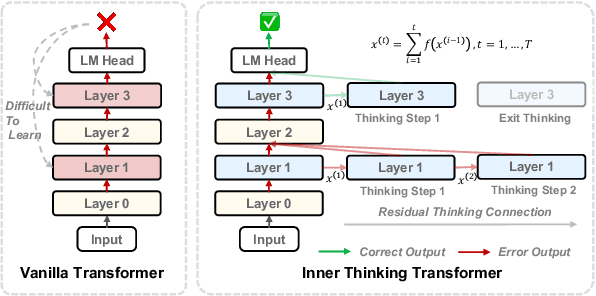

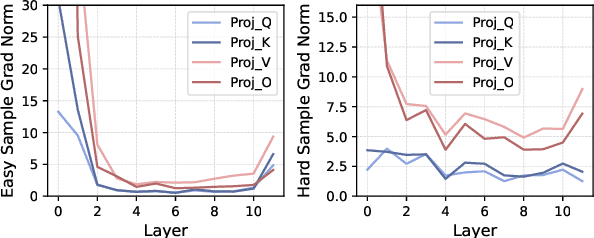
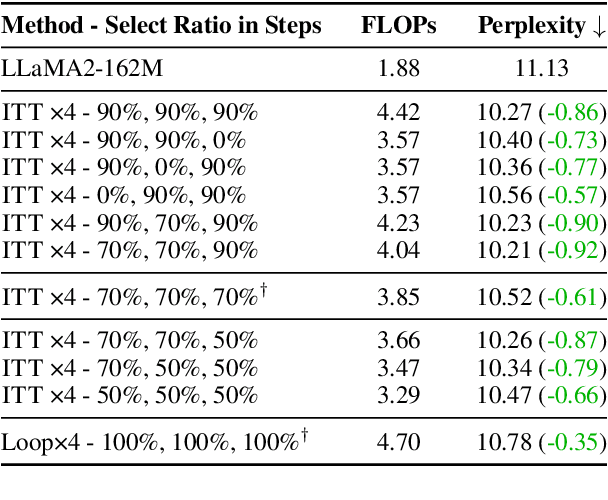
Large language models (LLMs) face inherent performance bottlenecks under parameter constraints, particularly in processing critical tokens that demand complex reasoning. Empirical analysis reveals challenging tokens induce abrupt gradient spikes across layers, exposing architectural stress points in standard Transformers. Building on this insight, we propose Inner Thinking Transformer (ITT), which reimagines layer computations as implicit thinking steps. ITT dynamically allocates computation through Adaptive Token Routing, iteratively refines representations via Residual Thinking Connections, and distinguishes reasoning phases using Thinking Step Encoding. ITT enables deeper processing of critical tokens without parameter expansion. Evaluations across 162M-466M parameter models show ITT achieves 96.5\% performance of a 466M Transformer using only 162M parameters, reduces training data by 43.2\%, and outperforms Transformer/Loop variants in 11 benchmarks. By enabling elastic computation allocation during inference, ITT balances performance and efficiency through architecture-aware optimization of implicit thinking pathways.