 Add to Chrome
 Add to Firefox
 Add to Edge
Optimized Adaptive Loop Filter in Versatile Video Coding
Jul 08, 2026
In the Versatile Video Coding~(VVC) standard, adaptive loop filter~(ALF), including Geometry transformation-based Adaptive Loop Filter~(GALF) and Cross Component Adaptive Loop Filter~(CCALF), plays an essential role in reducing compression artifacts. However, it also has high coding complexity and requires many picture buffer accesses in the encoder that will increase external memory access and is unfriendly to the software and hardware design. Therefore, we propose an optimized ALF framework, including the parallel design of GALF and CCALF, the adaptive parameter decision of GALF, and one-pass CCALF scheme by effectively estimating the CCALF filtering distortion without conducting filter operation. Compared to VTM-8.0, the proposed method can reduce the picture buffer access from 152 to 1 and achieve roughly 25\% time-savings of the ALF module with negligible coding performance change under RA configuration. Some of the proposed methods have been adopted in the VVC reference software.

Edge-directed geometric partitioning for versatile video coding
Jun 01, 2026To improve the coding performance, geometric partition (GEO) was proposed for the upcoming VVC standard. GEO provides 140 partition candidates. The index of optimal GEO mode needs to be signaled explicitly. Considering different structural characteristics of different CUs and the correlation between spatial adjacent blocks and temporal collocated blocks, we propose a GEO mode prediction strategy by constructing a Most Probable Mode (MPM) list to reduce the overhead of GEO index and improve coding efficiency. Based on the observation of the high correlation between the partition mode and object boundaries, an edge-directed geometric partition scheme is proposed to construct the MPM list according to spatio-temporal edge information. The proposed method provides an objective BD-rate gain of 0.58% and 1.00% on average for RA and LDB configurations compared to VTM-6.0. Besides, it also promotes the visual quality of object boundaries.
* This paper has been published in IEEE ICME
Deformable Wiener Filter for Future Video Coding
Jun 01, 2026In-loop filters have attracted increasing attention due to the remarkable noise-reduction capability in the hybrid video coding framework. However, the existing in-loop filters in Versatile Video Coding (VVC) mainly take advantage of the image local similarity. Although some non-local based in-loop filters can make up for this shortcoming, the widely-used unsupervised parameter estimation method by non-local filters limits the performance. In view of this, we propose a deformable Wiener Filter (DWF). It combines the local and non-local characteristics and supervisedly trains the filter coefficients based on the Wiener Filter theory. In the filtering process, local adjacent samples and non-local similar samples are first derived for each sample of interest. Then the to-be-filtered samples are classified into specific groups based on the patch level noise and sample-level characteristics. Samples in each group share the same filter coefficients. After that, the local and non-local reference samples are adaptively fused based on the classification results. Finally, the filtering operation with outlier data constraints is conducted for each to-be-filtered sample. Moreover, the performance of the proposed DWF is analyzed with different reference sample derivation schemes in detail. Simulation results show that the proposed approach achieves 1.16%, 1.92%, and 2.67% bit-rate savings on average compared to the VTM-11.0 for All Intra, Random Access, and Low-Delay B configurations, respectively.
* This paper has been published in IEEE Transactions on Image Processing
Spatio-Temporal Correlation Guided Geometric Partitioning for Versatile Video Coding
Jun 01, 2026Geometric partitioning has attracted increasing attention by its remarkable motion field description capability in the hybrid video coding framework. However, the existing geometric partitioning (GEO) scheme in Versatile Video Coding (VVC) causes a non-negligible burden for signaling the side information. Consequently, the coding efficiency is limited. In view of this, we propose a spatio-temporal correlation guided geometric partitioning (STGEO) scheme to efficiently describe the object information in the motion field of video coding. The proposed method can economize the bits consumed for side information signaling, including the partitioning mode and motion information. We firstly analyze the characteristics of partitioning mode decision and motion vector selection in a statistically-sound way. Based on the observed spatio-temporal correlation, we design a mode prediction and coding method to reduce the overhead for representing the above mentioned side information. The main idea is to predict the STGEO modes and motion candidates that have higher selection possibilities, which can guide the entropy coding, i.e., representing the predicted high-probability modes and motion candidates with fewer bits. In particular, the high-probability STGEO modes are predicted based on the edge information and history modes of adjacent STGEO-coded blocks. The corresponding motion information is represented by the index in a merge candidate list, which is adaptively inferred based on the off-line trained merge candidate selection probability. Simulation results show that the proposed approach achieves 0.95% and 1.98% bit-rate savings on average compared to VTM-8.0 without GEO for Random Access and Low-Delay B configurations, respectively.
Predicting Satisfied User and Machine Ratio for Compressed Images: A Unified Approach
Dec 23, 2024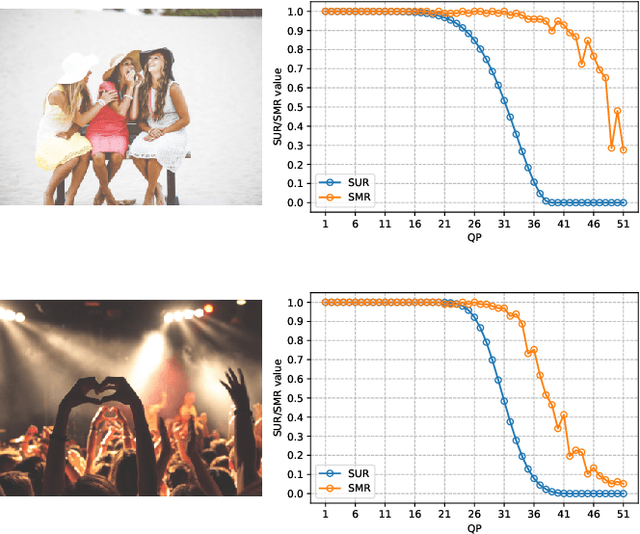
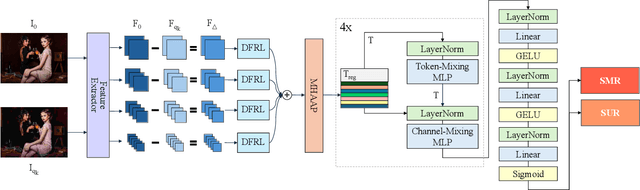
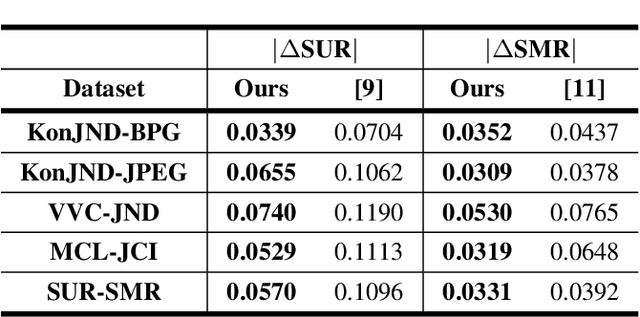
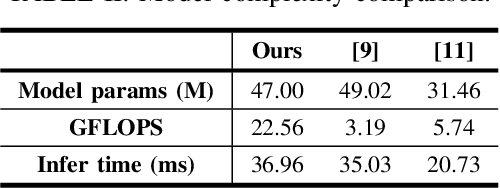
Nowadays, high-quality images are pursued by both humans for better viewing experience and by machines for more accurate visual analysis. However, images are usually compressed before being consumed, decreasing their quality. It is meaningful to predict the perceptual quality of compressed images for both humans and machines, which guides the optimization for compression. In this paper, we propose a unified approach to address this. Specifically, we create a deep learning-based model to predict Satisfied User Ratio (SUR) and Satisfied Machine Ratio (SMR) of compressed images simultaneously. We first pre-train a feature extractor network on a large-scale SMR-annotated dataset with human perception-related quality labels generated by diverse image quality models, which simulates the acquisition of SUR labels. Then, we propose an MLP-Mixer-based network to predict SUR and SMR by leveraging and fusing the extracted multi-layer features. We introduce a Difference Feature Residual Learning (DFRL) module to learn more discriminative difference features. We further use a Multi-Head Attention Aggregation and Pooling (MHAAP) layer to aggregate difference features and reduce their redundancy. Experimental results indicate that the proposed model significantly outperforms state-of-the-art SUR and SMR prediction methods. Moreover, our joint learning scheme of human and machine perceptual quality prediction tasks is effective at improving the performance of both.
Advanced Learning-Based Inter Prediction for Future Video Coding
Nov 24, 2024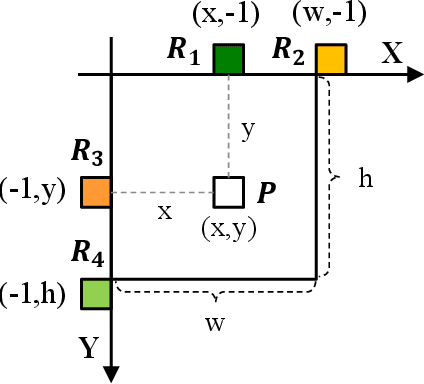
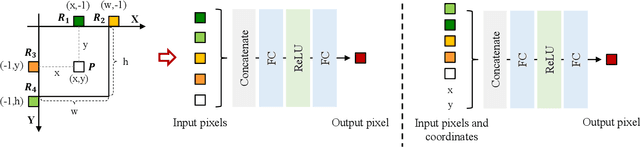
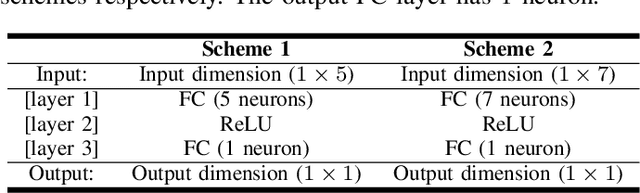
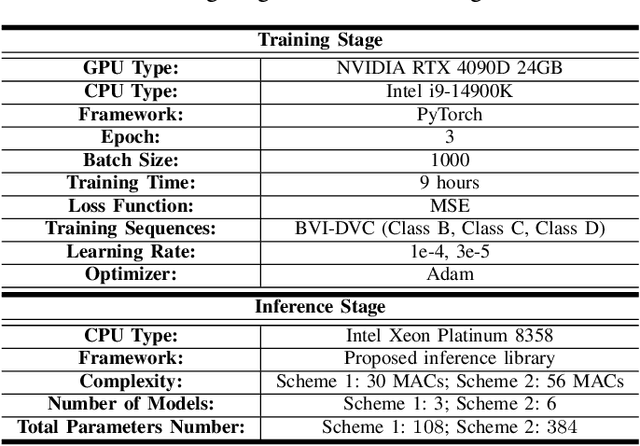
In the fourth generation Audio Video coding Standard (AVS4), the Inter Prediction Filter (INTERPF) reduces discontinuities between prediction and adjacent reconstructed pixels in inter prediction. The paper proposes a low complexity learning-based inter prediction (LLIP) method to replace the traditional INTERPF. LLIP enhances the filtering process by leveraging a lightweight neural network model, where parameters can be exported for efficient inference. Specifically, we extract pixels and coordinates utilized by the traditional INTERPF to form the training dataset. Subsequently, we export the weights and biases of the trained neural network model and implement the inference process without any third-party dependency, enabling seamless integration into video codec without relying on Libtorch, thus achieving faster inference speed. Ultimately, we replace the traditional handcraft filtering parameters in INTERPF with the learned optimal filtering parameters. This practical solution makes the combination of deep learning encoding tools with traditional video encoding schemes more efficient. Experimental results show that our approach achieves 0.01%, 0.31%, and 0.25% coding gain for the Y, U, and V components under the random access (RA) configuration on average.
Diffusion-Based 3D Human Pose Estimation with Multi-Hypothesis Aggregation
Mar 21, 2023
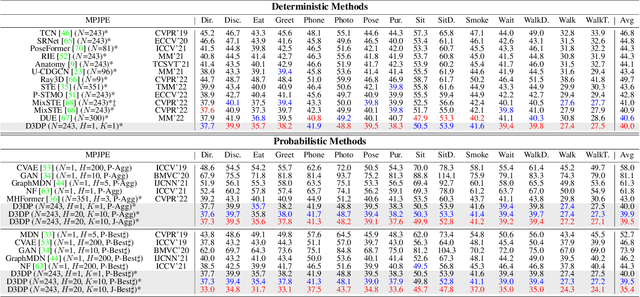


In this paper, a novel Diffusion-based 3D Pose estimation (D3DP) method with Joint-wise reProjection-based Multi-hypothesis Aggregation (JPMA) is proposed for probabilistic 3D human pose estimation. On the one hand, D3DP generates multiple possible 3D pose hypotheses for a single 2D observation. It gradually diffuses the ground truth 3D poses to a random distribution, and learns a denoiser conditioned on 2D keypoints to recover the uncontaminated 3D poses. The proposed D3DP is compatible with existing 3D pose estimators and supports users to balance efficiency and accuracy during inference through two customizable parameters. On the other hand, JPMA is proposed to assemble multiple hypotheses generated by D3DP into a single 3D pose for practical use. It reprojects 3D pose hypotheses to the 2D camera plane, selects the best hypothesis joint-by-joint based on the reprojection errors, and combines the selected joints into the final pose. The proposed JPMA conducts aggregation at the joint level and makes use of the 2D prior information, both of which have been overlooked by previous approaches. Extensive experiments on Human3.6M and MPI-INF-3DHP datasets show that our method outperforms the state-of-the-art deterministic and probabilistic approaches by 1.5% and 8.9%, respectively. Code is available at https://github.com/paTRICK-swk/D3DP.
SMR: Satisfied Machine Ratio Modeling for Machine Recognition-Oriented Image and Video Compression
Nov 13, 2022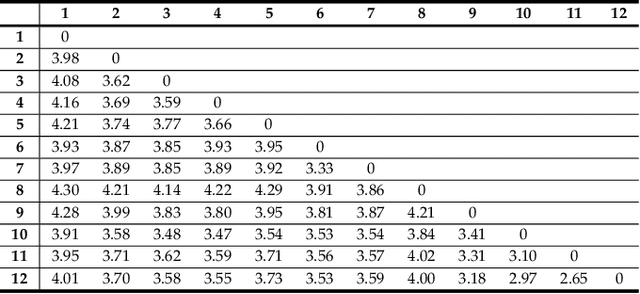
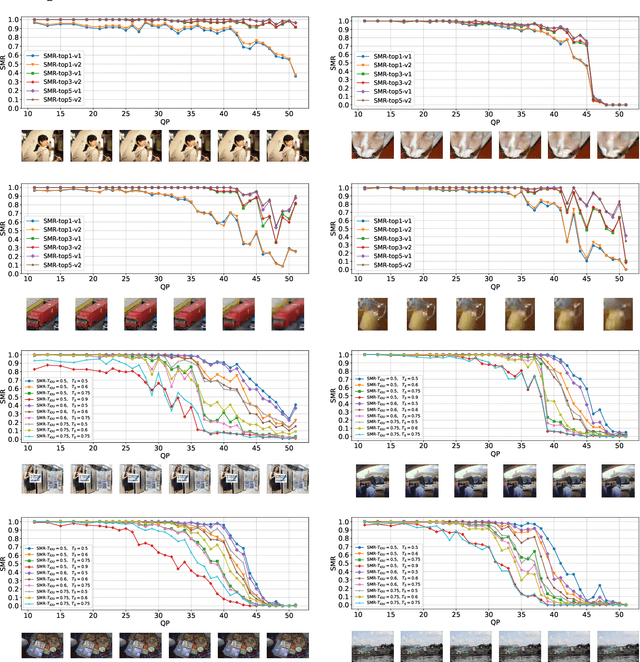
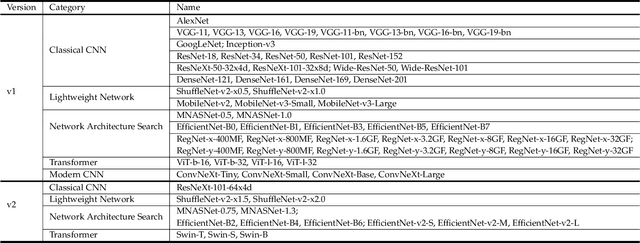
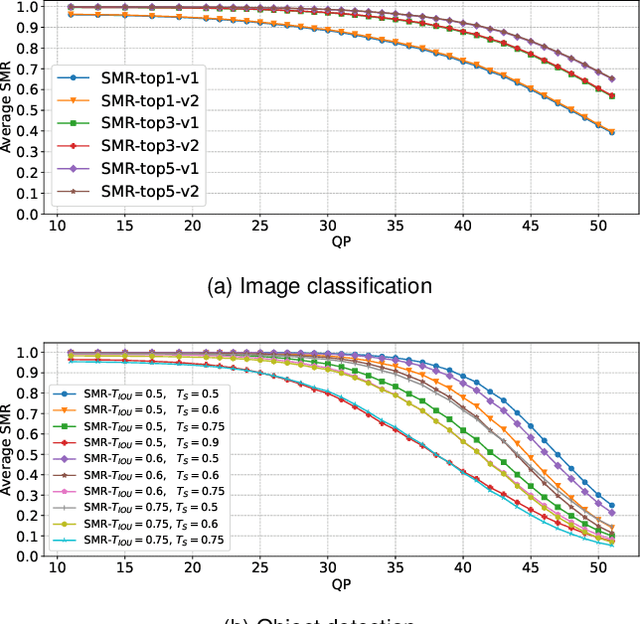
Tons of images and videos are fed into machines for visual recognition all the time. Like human vision system (HVS), machine vision system (MVS) is sensitive to image quality, as quality degradation leads to information loss and recognition failure. In recent years, MVS-targeted image processing, particularly image and video compression, has emerged. However, existing methods only target an individual machine rather than the general machine community, thus cannot satisfy every type of machine. Moreover, the MVS characteristics are not well leveraged, which limits compression efficiency. In this paper, we introduce a new concept, Satisfied Machine Ratio (SMR), to address these issues. SMR statistically measures the image quality from the machine's perspective by collecting and combining satisfaction scores from a large quantity and variety of machine subjects, where such scores are obtained with MVS characteristics considered properly. We create the first large-scale SMR dataset that contains over 22 million annotated images for SMR studies. Furthermore, a deep learning-based model is proposed to predict the SMR for any given compressed image or video frame. Extensive experiments show that using the SMR model can significantly improve the performance of machine recognition-oriented image and video compression. And the SMR model generalizes well to unseen machines, compression frameworks, and datasets.
STIP: A SpatioTemporal Information-Preserving and Perception-Augmented Model for High-Resolution Video Prediction
Jun 09, 2022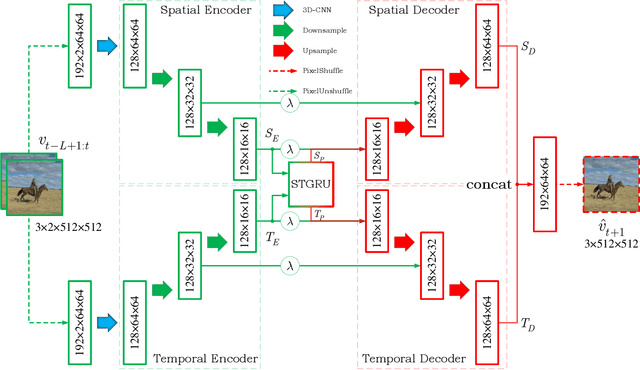
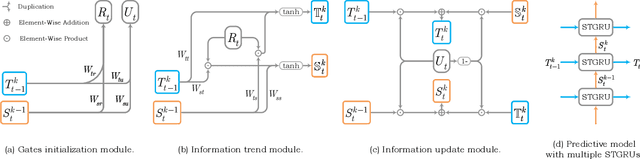
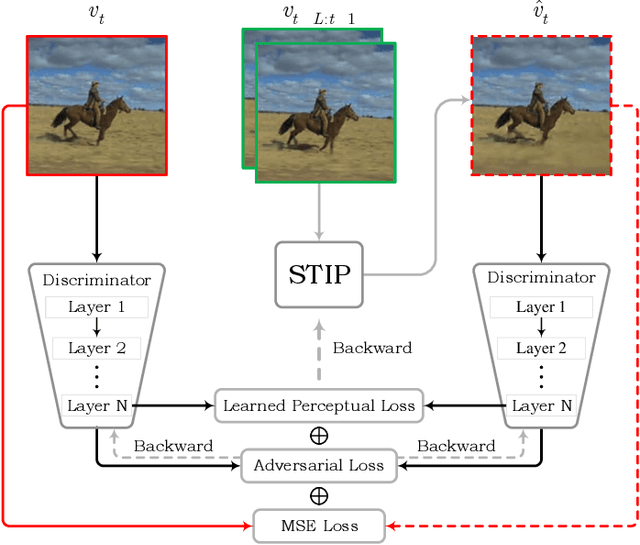
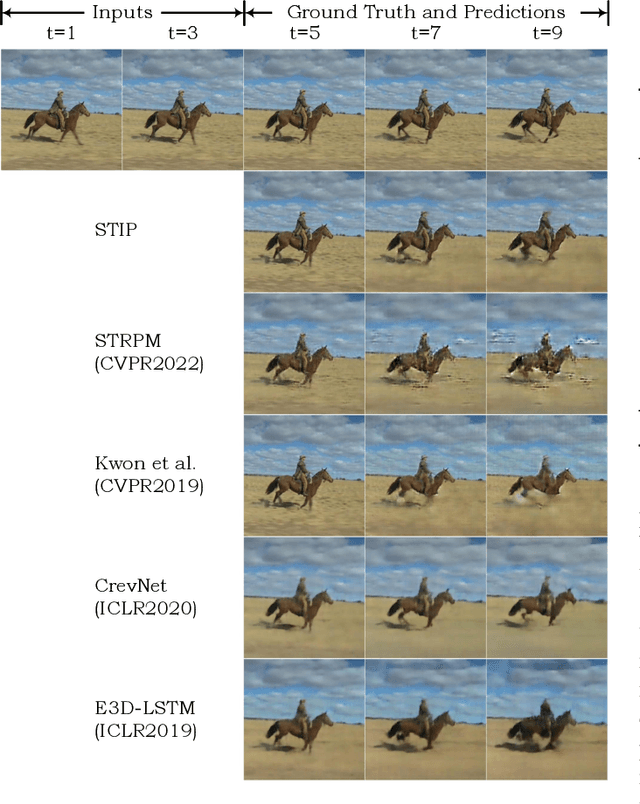
Although significant achievements have been achieved by recurrent neural network (RNN) based video prediction methods, their performance in datasets with high resolutions is still far from satisfactory because of the information loss problem and the perception-insensitive mean square error (MSE) based loss functions. In this paper, we propose a Spatiotemporal Information-Preserving and Perception-Augmented Model (STIP) to solve the above two problems. To solve the information loss problem, the proposed model aims to preserve the spatiotemporal information for videos during the feature extraction and the state transitions, respectively. Firstly, a Multi-Grained Spatiotemporal Auto-Encoder (MGST-AE) is designed based on the X-Net structure. The proposed MGST-AE can help the decoders recall multi-grained information from the encoders in both the temporal and spatial domains. In this way, more spatiotemporal information can be preserved during the feature extraction for high-resolution videos. Secondly, a Spatiotemporal Gated Recurrent Unit (STGRU) is designed based on the standard Gated Recurrent Unit (GRU) structure, which can efficiently preserve spatiotemporal information during the state transitions. The proposed STGRU can achieve more satisfactory performance with a much lower computation load compared with the popular Long Short-Term (LSTM) based predictive memories. Furthermore, to improve the traditional MSE loss functions, a Learned Perceptual Loss (LP-loss) is further designed based on the Generative Adversarial Networks (GANs), which can help obtain a satisfactory trade-off between the objective quality and the perceptual quality. Experimental results show that the proposed STIP can predict videos with more satisfactory visual quality compared with a variety of state-of-the-art methods. Source code has been available at \url{https://github.com/ZhengChang467/STIPHR}.
Hierarchical Similarity Learning for Aliasing Suppression Image Super-Resolution
Jun 07, 2022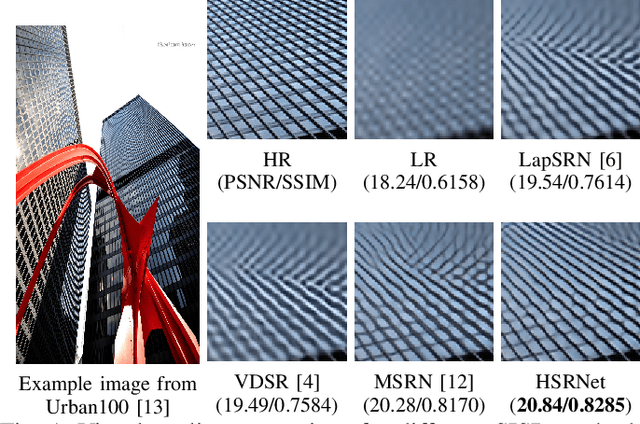
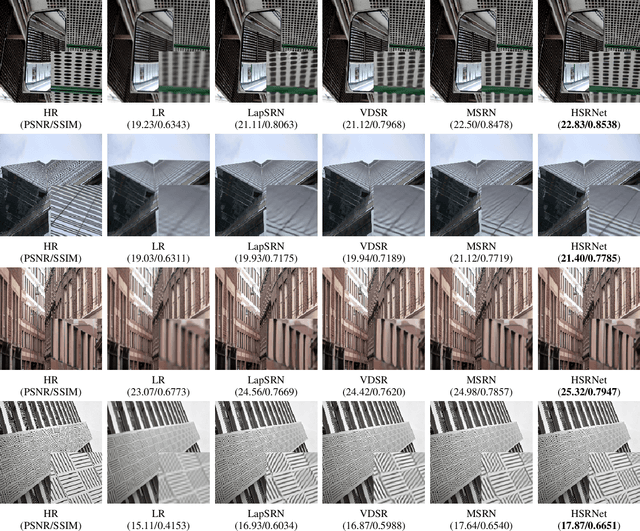
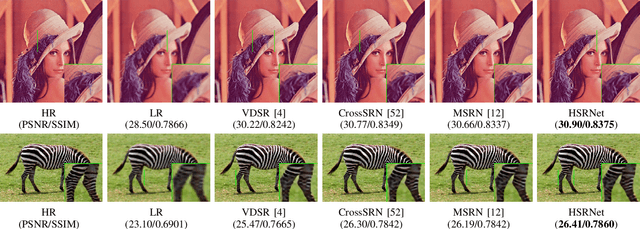
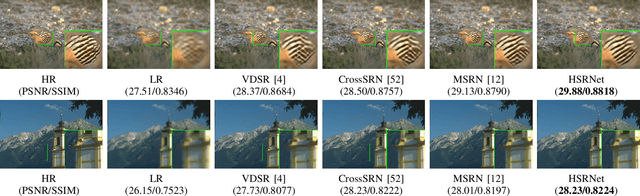
As a highly ill-posed issue, single image super-resolution (SISR) has been widely investigated in recent years. The main task of SISR is to recover the information loss caused by the degradation procedure. According to the Nyquist sampling theory, the degradation leads to aliasing effect and makes it hard to restore the correct textures from low-resolution (LR) images. In practice, there are correlations and self-similarities among the adjacent patches in the natural images. This paper considers the self-similarity and proposes a hierarchical image super-resolution network (HSRNet) to suppress the influence of aliasing. We consider the SISR issue in the optimization perspective, and propose an iterative solution pattern based on the half-quadratic splitting (HQS) method. To explore the texture with local image prior, we design a hierarchical exploration block (HEB) and progressive increase the receptive field. Furthermore, multi-level spatial attention (MSA) is devised to obtain the relations of adjacent feature and enhance the high-frequency information, which acts as a crucial role for visual experience. Experimental result shows HSRNet achieves better quantitative and visual performance than other works, and remits the aliasing more effectively.