 Add to Chrome
 Add to Firefox
 Add to Edge
VCE: A zero-cost hallucination mitigation method of LVLMs via visual contrastive editing
Apr 21, 2026
Large vision-language models (LVLMs) frequently suffer from Object Hallucination (OH), wherein they generate descriptions containing objects that are not actually present in the input image. This phenomenon is particularly problematic in real-world applications such as medical imaging and autonomous driving, where accuracy is critical. Recent studies suggest that the hallucination problem may stem from language priors: biases learned during pretraining that cause LVLMs to generate words based on their statistical co-occurrence. To mitigate this problem, we propose Visual Contrastive Editing (VCE), a novel post-hoc method that identifies and suppresses hallucinatory tendencies by analyzing the model's response to contrastive visual perturbations. Using Singular Value Decomposition (SVD), we decompose the model's activation patterns to isolate hallucination subspaces and apply targeted parameter edits to attenuate its influence. Unlike existing approaches that require fine-tuning or labeled data, VCE operates as a label-free intervention, making it both scalable and practical for deployment in resource-constrained settings. Experimental results demonstrate that VCE effectively reduces object hallucination across multiple benchmarks while maintaining the model's original computational efficiency.

Parallel Training in Spiking Neural Networks
Feb 01, 2026The bio-inspired integrate-fire-reset mechanism of spiking neurons constitutes the foundation for efficient processing in Spiking Neural Networks (SNNs). Recent progress in large models demands that spiking neurons support highly parallel computation to scale efficiently on modern GPUs. This work proposes a novel functional perspective that provides general guidance for designing parallel spiking neurons. We argue that the reset mechanism, which induces complex temporal dependencies and hinders parallel training, should be removed. However, any such modification should satisfy two principles: 1) preserving the functions of reset as a core biological mechanism; and 2) enabling parallel training without sacrificing the serial inference ability of spiking neurons, which underpins their efficiency at test time. To this end, we identify the functions of the reset and analyze how to reconcile parallel training with serial inference, upon which we propose a dynamic decay spiking neuron. We conduct comprehensive testing of our method in terms of: 1) Training efficiency and extrapolation capability. On 16k-length sequences, we achieve a 25.6x training speedup over the pioneering parallel spiking neuron, and our models trained on 2k-length can stably perform inference on sequences as long as 30k. 2) Generality. We demonstrate the consistent effectiveness of the proposed method across five task categories (image classification, neuromorphic event processing, time-series forecasting, language modeling, and reinforcement learning), three network architectures (spiking CNN/Transformer/SSMs), and two spike activation modes (spike/integer activation). 3) Energy consumption. The spiking firing of our neuron is lower than that of vanilla and existing parallel spiking neurons.
MARS2 2025 Challenge on Multimodal Reasoning: Datasets, Methods, Results, Discussion, and Outlook
Sep 17, 2025
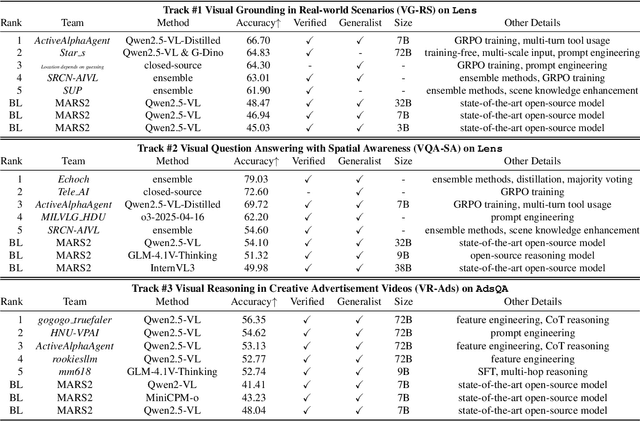

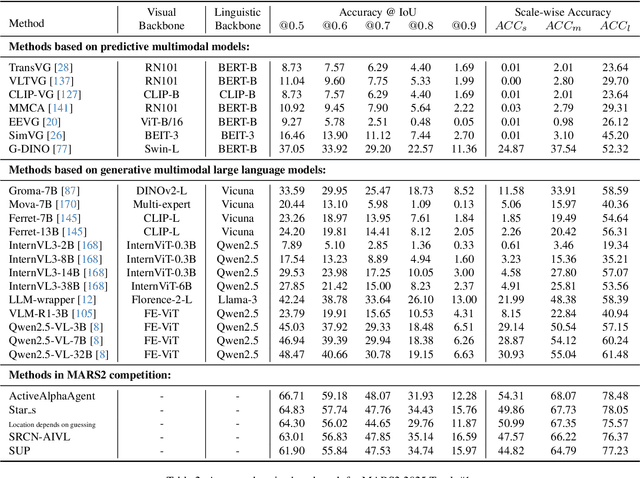
This paper reviews the MARS2 2025 Challenge on Multimodal Reasoning. We aim to bring together different approaches in multimodal machine learning and LLMs via a large benchmark. We hope it better allows researchers to follow the state-of-the-art in this very dynamic area. Meanwhile, a growing number of testbeds have boosted the evolution of general-purpose large language models. Thus, this year's MARS2 focuses on real-world and specialized scenarios to broaden the multimodal reasoning applications of MLLMs. Our organizing team released two tailored datasets Lens and AdsQA as test sets, which support general reasoning in 12 daily scenarios and domain-specific reasoning in advertisement videos, respectively. We evaluated 40+ baselines that include both generalist MLLMs and task-specific models, and opened up three competition tracks, i.e., Visual Grounding in Real-world Scenarios (VG-RS), Visual Question Answering with Spatial Awareness (VQA-SA), and Visual Reasoning in Creative Advertisement Videos (VR-Ads). Finally, 76 teams from the renowned academic and industrial institutions have registered and 40+ valid submissions (out of 1200+) have been included in our ranking lists. Our datasets, code sets (40+ baselines and 15+ participants' methods), and rankings are publicly available on the MARS2 workshop website and our GitHub organization page https://github.com/mars2workshop/, where our updates and announcements of upcoming events will be continuously provided.