 Add to Chrome
 Add to Firefox
 Add to Edge
Evaluating the Diversity of AI-Generated Content with Diversity Profiles
Aug 18, 2026
Diversity is a fundamental criterion for evaluating generative artificial intelligence (AI) systems, yet its measurement remains inherently ambiguous. Existing approaches typically represent generated samples in an embedding space, compute pairwise distances or similarities, and aggregate them into a single scalar score. Such scalar summaries are convenient, but they often encode different inductive biases and may yield contradictory rankings of the same sample sets. In this paper, we argue that diversity evaluation for AI-generated content is intrinsically under-specified when reduced to a single number. We first review representative diversity metrics, and then diagnose their limitations from two complementary perspectives: an axiomatic analysis showing that no representative scalar metric satisfies all desirable properties simultaneously, and an empirical analysis showing that high-dimensional representation spaces can induce concentrated, modality-dependent distance distributions. To address these issues, we propose diversity profiles: curve-valued, condition-aware summaries that evaluate a parameterized diversity family across a range of thresholds, scales, exponents, or orders under a specified representation and distance or kernel function. Diversity profiles reveal whether a comparison is robust across resolutions or instead depends on an arbitrary parameter choice. We instantiate profiles for several representative metric families and demonstrate their practical use in generative AI evaluation. Overall, diversity profiles provide a more transparent and resolution-aware framework for comparing the diversity of AI-generated content.

KPIs 2024 Challenge: Advancing Glomerular Segmentation from Patch- to Slide-Level
Feb 11, 2025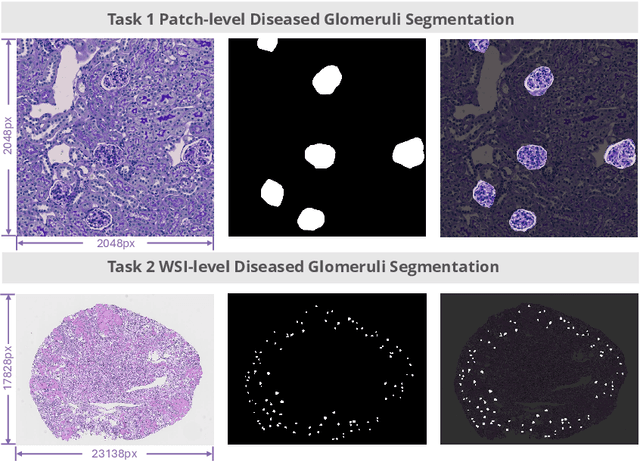

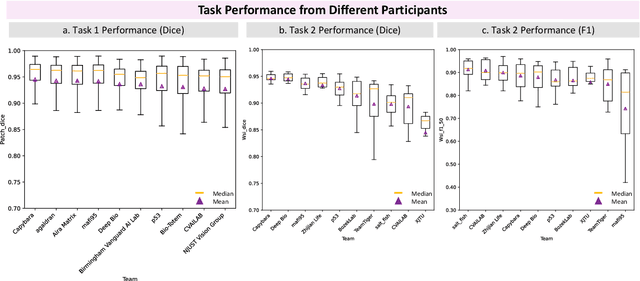
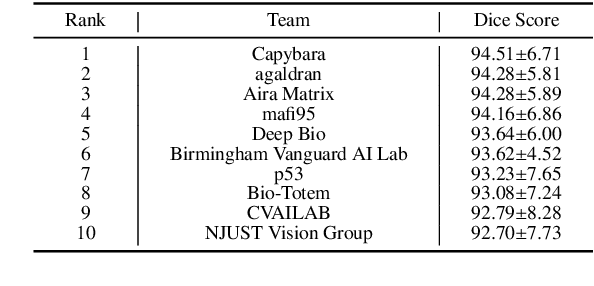
Chronic kidney disease (CKD) is a major global health issue, affecting over 10% of the population and causing significant mortality. While kidney biopsy remains the gold standard for CKD diagnosis and treatment, the lack of comprehensive benchmarks for kidney pathology segmentation hinders progress in the field. To address this, we organized the Kidney Pathology Image Segmentation (KPIs) Challenge, introducing a dataset that incorporates preclinical rodent models of CKD with over 10,000 annotated glomeruli from 60+ Periodic Acid Schiff (PAS)-stained whole slide images. The challenge includes two tasks, patch-level segmentation and whole slide image segmentation and detection, evaluated using the Dice Similarity Coefficient (DSC) and F1-score. By encouraging innovative segmentation methods that adapt to diverse CKD models and tissue conditions, the KPIs Challenge aims to advance kidney pathology analysis, establish new benchmarks, and enable precise, large-scale quantification for disease research and diagnosis.