 Add to Chrome
 Add to Firefox
 Add to Edge
Breaking the Quality-Privacy Tradeoff in Tabular Data Generation via In-Context Learning
May 06, 2026
Tabular data synthesis aims to generate high-quality data while preserving privacy. However, we find that existing tabular generative models exhibit a clear tradeoff in the small-data regime: improving data quality typically comes at the cost of increased memorization of training samples, thereby weakening privacy protection. This tradeoff arises because small training sets make it difficult for dataset-specific generative models to distinguish generalizable structure from sample-specific patterns. To address this, we propose DiffICL, which formulates tabular data generation as an in-context learning problem. Instead of fitting each dataset from scratch,DiffICL leverages pretrained structural priors learned from a large collection of datasets, enabling it to infer data distributions from limited context rather than memorizing individual samples. We evaluate DiffICL on 14 real-world datasets. Results show that DiffICL improves both data quality and privacy, and generate synthetic data that provides effective data augmentation. Our findings suggest that the quality-privacy tradeoff can be improved through better training paradigms.

LimiX: Unleashing Structured-Data Modeling Capability for Generalist Intelligence
Sep 03, 2025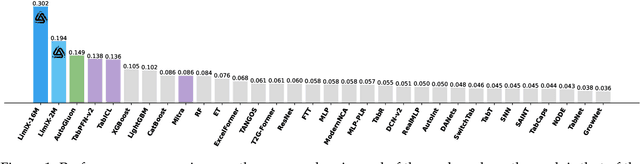
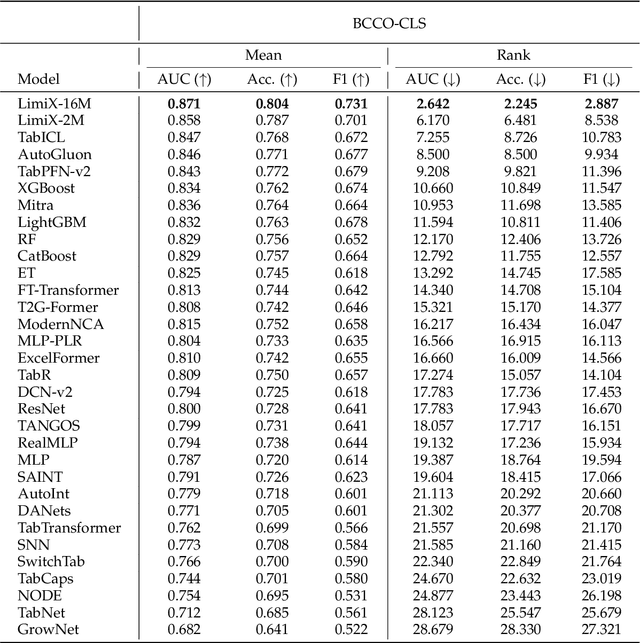
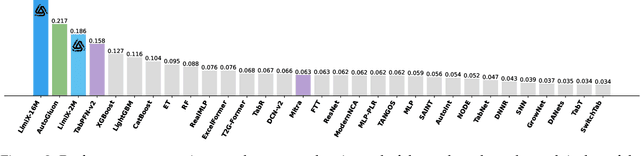
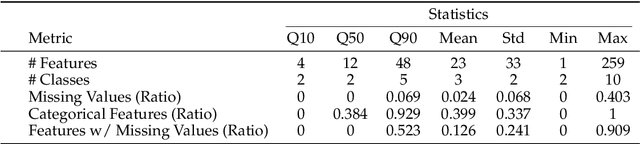
We argue that progress toward general intelligence requires complementary foundation models grounded in language, the physical world, and structured data. This report presents LimiX, the first installment of our large structured-data models (LDMs). LimiX treats structured data as a joint distribution over variables and missingness, thus capable of addressing a wide range of tabular tasks through query-based conditional prediction via a single model. LimiX is pretrained using masked joint-distribution modeling with an episodic, context-conditional objective, where the model predicts for query subsets conditioned on dataset-specific contexts, supporting rapid, training-free adaptation at inference. We evaluate LimiX across 10 large structured-data benchmarks with broad regimes of sample size, feature dimensionality, class number, categorical-to-numerical feature ratio, missingness, and sample-to-feature ratios. With a single model and a unified interface, LimiX consistently surpasses strong baselines including gradient-boosting trees, deep tabular networks, recent tabular foundation models, and automated ensembles, as shown in Figure 1 and Figure 2. The superiority holds across a wide range of tasks, such as classification, regression, missing value imputation, and data generation, often by substantial margins, while avoiding task-specific architectures or bespoke training per task. All LimiX models are publicly accessible under Apache 2.0.