 Add to Chrome
 Add to Firefox
 Add to Edge
Turning Adaptation into Assets: Cross-Domain Bridging for Online Vision-Language Navigation
May 22, 2026
Navigating under non-stationary environment shifts poses a critical challenge for a Vision-and-Language Navigation (VLN) agent deployed in the wild. Yet, existing Test-Time Adaptation (TTA) methods for VLN largely treat online adaptation as transient, isolated updates, leading to catastrophic forgetting and negative transfer. To overcome these issues, we propose Inter-Domain BridgE with Historical Assets (IDEA), a novel TTA framework that transforms adaptation into the accumulation and composition of assets. Specifically, IDEA introduces soft prompts optimized via a Fisher-guided weighting scheme to capture the transferable knowledge. These optimized prompts are then augmented with domain coordinates to form a dynamic asset library. Leveraging this library, IDEA constructs a cross-domain bridge by projecting the target domain onto the convex hull of historical knowledge. These designs form a complementary loop: the evolving library underpins bridge construction, while the bridge provides superior initialization to accelerate asset optimization. Extensive experiments across REVERIE, R2R, and R2R-CE benchmarks demonstrate the consistent superiority of IDEA over existing methods, showcasing its ability to enable training-free adaptation via asset sharing.

LabUtopia: High-Fidelity Simulation and Hierarchical Benchmark for Scientific Embodied Agents
May 28, 2025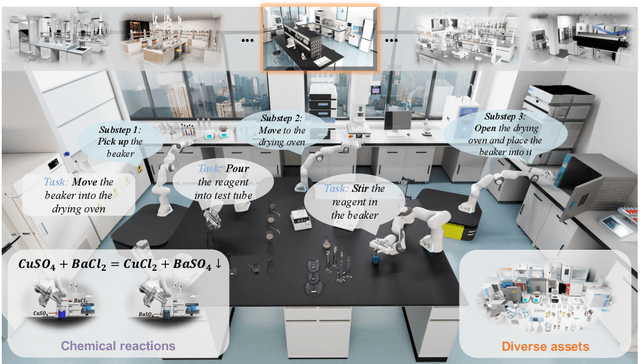
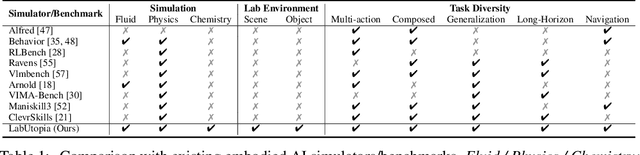
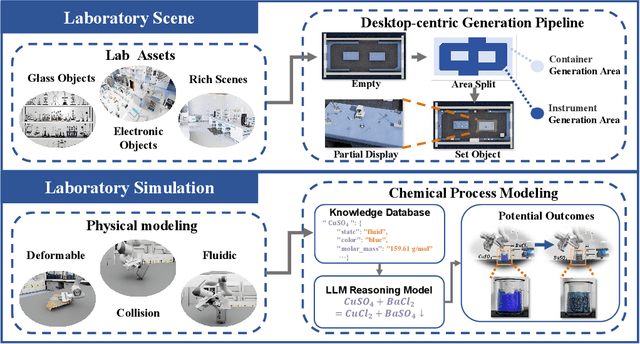
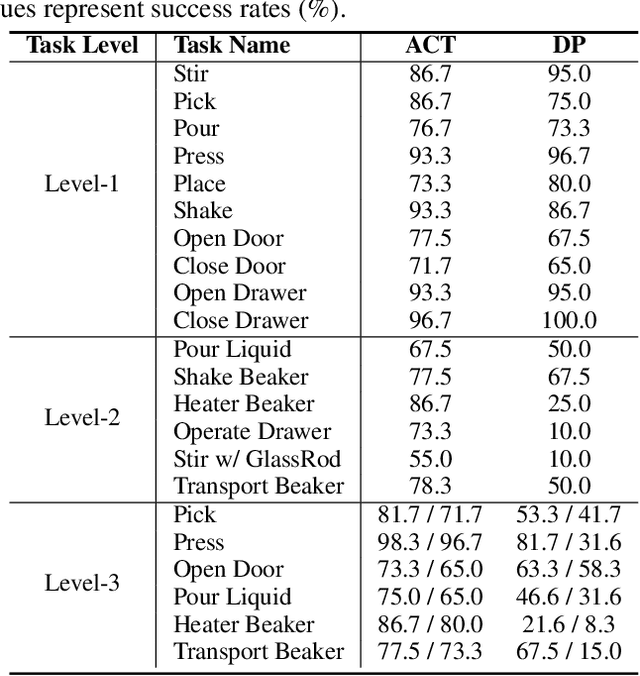
Scientific embodied agents play a crucial role in modern laboratories by automating complex experimental workflows. Compared to typical household environments, laboratory settings impose significantly higher demands on perception of physical-chemical transformations and long-horizon planning, making them an ideal testbed for advancing embodied intelligence. However, its development has been long hampered by the lack of suitable simulator and benchmarks. In this paper, we address this gap by introducing LabUtopia, a comprehensive simulation and benchmarking suite designed to facilitate the development of generalizable, reasoning-capable embodied agents in laboratory settings. Specifically, it integrates i) LabSim, a high-fidelity simulator supporting multi-physics and chemically meaningful interactions; ii) LabScene, a scalable procedural generator for diverse scientific scenes; and iii) LabBench, a hierarchical benchmark spanning five levels of complexity from atomic actions to long-horizon mobile manipulation. LabUtopia supports 30 distinct tasks and includes more than 200 scene and instrument assets, enabling large-scale training and principled evaluation in high-complexity environments. We demonstrate that LabUtopia offers a powerful platform for advancing the integration of perception, planning, and control in scientific-purpose agents and provides a rigorous testbed for exploring the practical capabilities and generalization limits of embodied intelligence in future research.