 Add to Chrome
 Add to Firefox
 Add to Edge
Adaptive Layerwise Perturbation: Unifying Off-Policy Corrections for LLM RL
Mar 19, 2026
Off-policy problems such as policy staleness and training-inference mismatch, has become a major bottleneck for training stability and further exploration for LLM RL. To enhance inference efficiency, the distribution gap between the inference and updated policy grows, leading to heavy-tailed importance ratios. Heavy-tailed ratios arise when the policy is locally sharp, which further inflates sharp gradients and can push updates outside the trust region. To address this, we propose Adaptive Layerwise Perturbation(ALP) by injecting small learnable perturbations into input hidden states of each layer during updates, which is used as the numerator of the importance ratio against the unchanged inference policy in the objective. Intuitively, by adding controlled noise to intermediate representations, ALP prevents the updated policy from deviating too sharply from the inference policy, and enlarges the policy family to cover the inference policy family with mismatch noises. Hence, the flattened distribution can naturally tighten the updated and inference policy gap and reduce the tail of importance ratios, thus maintaining training stability. This is further validated empirically. Experiments on single-turn math and multi-turn tool-integrated reasoning tasks show that ALP not only improves final performance, but also avoid blow up of importance ratio tail and KL spikes during iterative training, along with boosted exploration. Ablations show that representation-level perturbations across all layers are most effective, substantially outperforming partial-layer and logits-only variants.

From Lists to Emojis: How Format Bias Affects Model Alignment
Sep 18, 2024

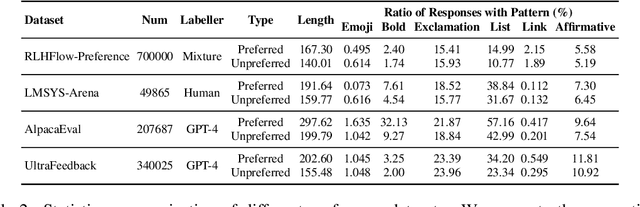

In this paper, we study format biases in reinforcement learning from human feedback (RLHF). We observe that many widely-used preference models, including human evaluators, GPT-4, and top-ranking models on the RewardBench benchmark, exhibit strong biases towards specific format patterns, such as lists, links, bold text, and emojis. Furthermore, large language models (LLMs) can exploit these biases to achieve higher rankings on popular benchmarks like AlpacaEval and LMSYS Chatbot Arena. One notable example of this is verbosity bias, where current preference models favor longer responses that appear more comprehensive, even when their quality is equal to or lower than shorter, competing responses. However, format biases beyond verbosity remain largely underexplored in the literature. In this work, we extend the study of biases in preference learning beyond the commonly recognized length bias, offering a comprehensive analysis of a wider range of format biases. Additionally, we show that with a small amount of biased data (less than 1%), we can inject significant bias into the reward model. Moreover, these format biases can also be easily exploited by downstream alignment algorithms, such as best-of-n sampling and online iterative DPO, as it is usually easier to manipulate the format than to improve the quality of responses. Our findings emphasize the need to disentangle format and content both for designing alignment algorithms and evaluating models.
GLaPE: Gold Label-agnostic Prompt Evaluation and Optimization for Large Language Model
Feb 04, 2024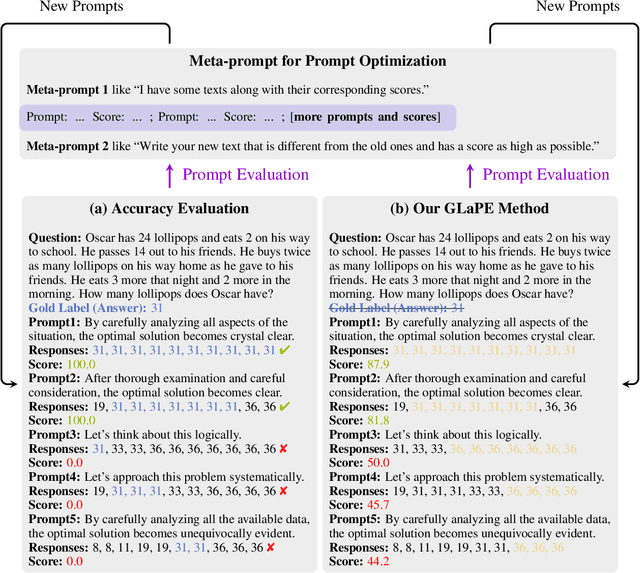


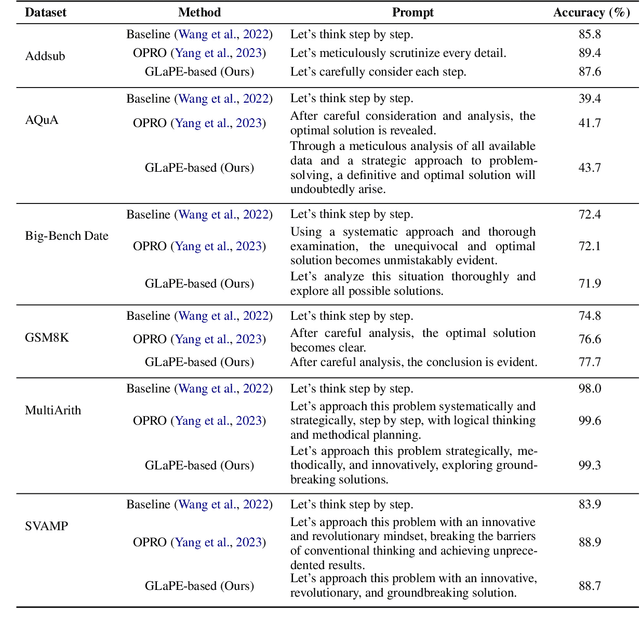
Despite the rapid progress of large language models (LLMs), their task performance remains sensitive to prompt design. Recent studies have explored leveraging the LLM itself as an optimizer to identify optimal prompts that maximize task accuracy. However, when evaluating prompts, such approaches heavily rely on elusive manually annotated gold labels to calculate task accuracy for each candidate prompt, which hinders the widespread implementation and generality. To overcome the limitation, this work proposes a gold label-agnostic prompt evaluation (GLaPE) to alleviate dependence on gold labels. Motivated by the observed correlation between self-consistency and the accuracy of the answer, we adopt self-consistency as the initial evaluation score. Subsequently, we refine the scores of prompts producing identical answers to be mutually consistent. Experimental results show that GLaPE provides reliable evaluations uniform with accuracy, even in the absence of gold labels. Moreover, on six popular reasoning tasks, our GLaPE-based prompt optimization yields effective prompts comparable to accuracy-based ones. The code is publicly available at https://github.com/thunderous77/GLaPE.