 Add to Chrome
 Add to Firefox
 Add to Edge
ForeDiffusion: Foresight-Conditioned Diffusion Policy via Future View Construction for Robot Manipulation
Jan 19, 2026
Diffusion strategies have advanced visual motor control by progressively denoising high-dimensional action sequences, providing a promising method for robot manipulation. However, as task complexity increases, the success rate of existing baseline models decreases considerably. Analysis indicates that current diffusion strategies are confronted with two limitations. First, these strategies only rely on short-term observations as conditions. Second, the training objective remains limited to a single denoising loss, which leads to error accumulation and causes grasping deviations. To address these limitations, this paper proposes Foresight-Conditioned Diffusion (ForeDiffusion), by injecting the predicted future view representation into the diffusion process. As a result, the policy is guided to be forward-looking, enabling it to correct trajectory deviations. Following this design, ForeDiffusion employs a dual loss mechanism, combining the traditional denoising loss and the consistency loss of future observations, to achieve the unified optimization. Extensive evaluation on the Adroit suite and the MetaWorld benchmark demonstrates that ForeDiffusion achieves an average success rate of 80% for the overall task, significantly outperforming the existing mainstream diffusion methods by 23% in complex tasks, while maintaining more stable performance across the entire tasks.

Enhancing and Accelerating Large Language Models via Instruction-Aware Contextual Compression
Aug 28, 2024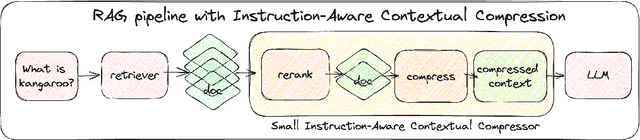


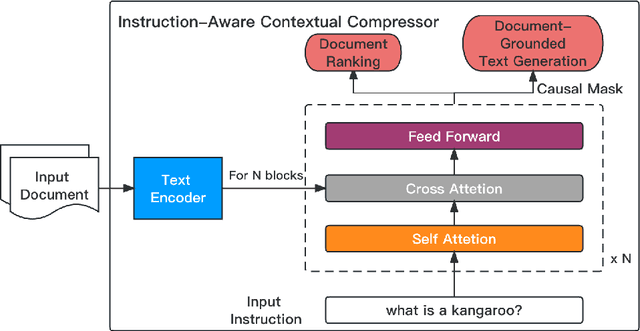
Large Language Models (LLMs) have garnered widespread attention due to their remarkable performance across various tasks. However, to mitigate the issue of hallucinations, LLMs often incorporate retrieval-augmented pipeline to provide them with rich external knowledge and context. Nevertheless, challenges stem from inaccurate and coarse-grained context retrieved from the retriever. Supplying irrelevant context to the LLMs can result in poorer responses, increased inference latency, and higher costs. This paper introduces a method called Instruction-Aware Contextual Compression, which filters out less informative content, thereby accelerating and enhancing the use of LLMs. The experimental results demonstrate that Instruction-Aware Contextual Compression notably reduces memory consumption and minimizes generation latency while maintaining performance levels comparable to those achieved with the use of the full context. Specifically, we achieved a 50% reduction in context-related costs, resulting in a 5% reduction in inference memory usage and a 2.2-fold increase in inference speed, with only a minor drop of 0.047 in Rouge-1. These findings suggest that our method strikes an effective balance between efficiency and performance.