 Add to Chrome
 Add to Firefox
 Add to Edge
SAGE: Multi-Agent Self-Evolution for LLM Reasoning
Mar 17, 2026
Reinforcement learning with verifiable rewards improves reasoning in large language models (LLMs), but many methods still rely on large human-labeled datasets. While self-play reduces this dependency, it often lacks explicit planning and strong quality control, limiting stability in long-horizon multi-step reasoning. We present SAGE (Self-evolving Agents for Generalized reasoning Evolution), a closed-loop framework where four agents: Challenger, Planner, Solver, and Critic, co-evolve from a shared LLM backbone using only a small seed set. The Challenger continuously generates increasingly difficult tasks; the Planner converts each task into a structured multi-step plan; and the Solver follows the plan to produce an answer, whose correctness is determined by external verifiers. The Critic scores and filters both generated questions and plans to prevent curriculum drift and maintain training signal quality, enabling stable self-training. Across mathematics and code-generation benchmarks, SAGE delivers consistent gains across model scales, improving the Qwen-2.5-7B model by 8.9% on LiveCodeBench and 10.7% on OlympiadBench.

SceneRAG: Scene-level Retrieval-Augmented Generation for Video Understanding
Jun 09, 2025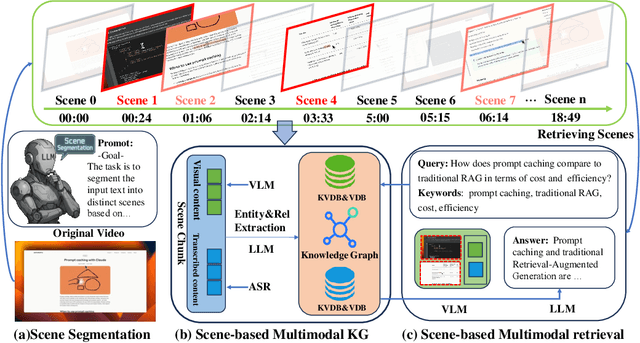
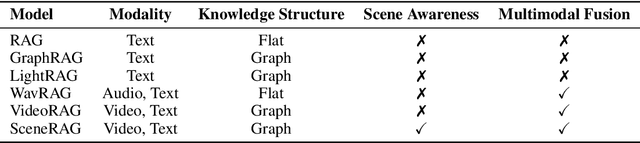
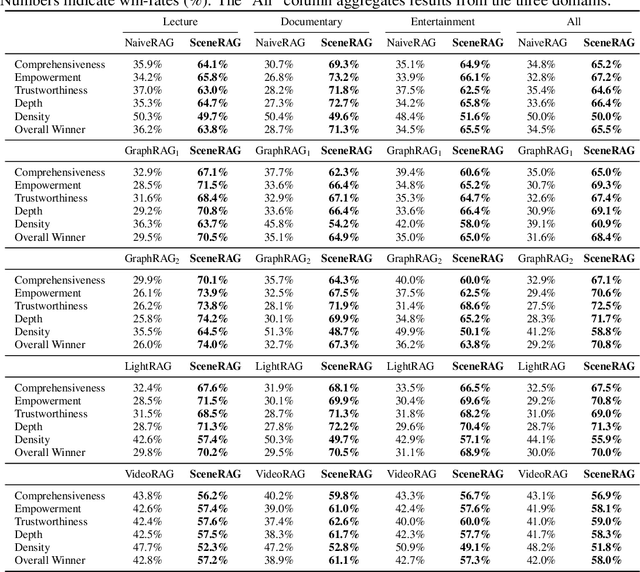
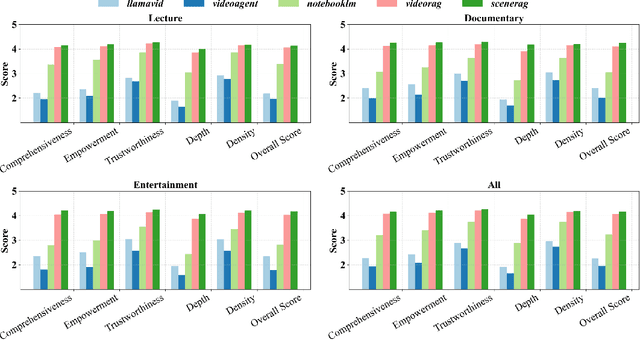
Despite recent advances in retrieval-augmented generation (RAG) for video understanding, effectively understanding long-form video content remains underexplored due to the vast scale and high complexity of video data. Current RAG approaches typically segment videos into fixed-length chunks, which often disrupts the continuity of contextual information and fails to capture authentic scene boundaries. Inspired by the human ability to naturally organize continuous experiences into coherent scenes, we present SceneRAG, a unified framework that leverages large language models to segment videos into narrative-consistent scenes by processing ASR transcripts alongside temporal metadata. SceneRAG further sharpens these initial boundaries through lightweight heuristics and iterative correction. For each scene, the framework fuses information from both visual and textual modalities to extract entity relations and dynamically builds a knowledge graph, enabling robust multi-hop retrieval and generation that account for long-range dependencies. Experiments on the LongerVideos benchmark, featuring over 134 hours of diverse content, confirm that SceneRAG substantially outperforms prior baselines, achieving a win rate of up to 72.5 percent on generation tasks.