 Add to Chrome
 Add to Firefox
 Add to Edge
Multi-modality Image Fusion under Adverse Weather: Mask-Guided Feature Restoration and Interaction
Jun 25, 2026
Multi-modality image fusion (MMIF) enhances scene representation by exploiting complementary cues from different modalities. Adverse weather, however, causes significant image degradation, disrupting feature representation and requiring simultaneous feature restoration and cross-modal complementarity. Existing methods often struggle with effective representation learning under such conditions, limiting their practical performance. To address these challenges, we propose a mask-guided MMIF method that integrates feature restoration and interaction. We first introduce "Pseudo Ground Truth" to simplify training, promoting faster and more effective feature learning. Then, we design a mask generation mechanism based on the mapping relationship between the fused result and the source images, quantifying the relative contribution of each modality during the fusion process. By incorporating the proposed mask-guided cross-modal cross-attention mechanism, the network is encouraged to selectively attend to informative features during modality interaction, mitigating the risk of overfitting to the static distribution of the "Pseudo Ground Truth". Additionally, we propose a mask-guided learning strategy and a task-coupled degradation-aware learning strategy to balance feature restoration and interaction. Extensive experiments on synthetic and real-world datasets demonstrate that our method surpasses state-of-the-art approaches in visual quality, quantitative metrics, and downstream tasks. The source code is available at https://github.com/ixilai/AMG-Fuse.

MAVFusion: Efficient Infrared and Visible Video Fusion via Motion-Aware Sparse Interaction
Apr 02, 2026Infrared and visible video fusion combines the object saliency from infrared images with the texture details from visible images to produce semantically rich fusion results. However, most existing methods are designed for static image fusion and cannot effectively handle frame-to-frame motion in videos. Current video fusion methods improve temporal consistency by introducing interactions across frames, but they often require high computational cost. To mitigate these challenges, we propose MAVFusion, an end-to-end video fusion framework featuring a motion-aware sparse interaction mechanism that enhances efficiency while maintaining superior fusion quality. Specifically, we leverage optical flow to identify dynamic regions in multi-modal sequences, adaptively allocating computationally intensive cross-modal attention to these sparse areas to capture salient transitions and facilitate inter-modal information exchange. For static background regions, a lightweight weak interaction module is employed to maintain structural and appearance integrity. By decoupling the processing of dynamic and static regions, MAVFusion simultaneously preserves temporal consistency and fine-grained details while significantly accelerating inference. Extensive experiments demonstrate that MAVFusion achieves state-of-the-art performance on multiple infrared and visible video benchmarks, achieving a speed of 14.16\,FPS at $640 \times 480$ resolution. The source code will be available at https://github.com/ixilai/MAVFusion.
FTPFusion: Frequency-Aware Infrared and Visible Video Fusion with Temporal Perturbation
Apr 02, 2026Infrared and visible video fusion plays a critical role in intelligent surveillance and low-light monitoring. However, maintaining temporal stability while preserving spatial detail remains a fundamental challenge. Existing methods either focus on frame-wise enhancement with limited temporal modeling or rely on heavy spatio-temporal aggregation that often sacrifices high-frequency details. In this paper, we propose FTPFusion, a frequency-aware infrared and visible video fusion method based on temporal perturbation and sparse cross-modal interaction. Specifically, FTPFusion decomposes the feature representations into high-frequency and low-frequency components for collaborative modeling. The high-frequency branch performs sparse cross-modal spatio-temporal interaction to capture motion-related context and complementary details. The low-frequency branch introduces a temporal perturbation strategy to enhance robustness against complex video variations, such as flickering, jitter, and local misalignment. Furthermore, we design an offset-aware temporal consistency constraint to explicitly stabilize cross-frame representations under temporal disturbances. Extensive experiments on multiple public benchmarks demonstrate that FTPFusion consistently outperforms state-of-the-art methods across multiple metrics in both spatial fidelity and temporal consistency. The source code will be available at https://github.com/ixilai/FTPFusion.
Text-Guided Channel Perturbation and Pretrained Knowledge Integration for Unified Multi-Modality Image Fusion
Nov 16, 2025Multi-modality image fusion enhances scene perception by combining complementary information. Unified models aim to share parameters across modalities for multi-modality image fusion, but large modality differences often cause gradient conflicts, limiting performance. Some methods introduce modality-specific encoders to enhance feature perception and improve fusion quality. However, this strategy reduces generalisation across different fusion tasks. To overcome this limitation, we propose a unified multi-modality image fusion framework based on channel perturbation and pre-trained knowledge integration (UP-Fusion). To suppress redundant modal information and emphasize key features, we propose the Semantic-Aware Channel Pruning Module (SCPM), which leverages the semantic perception capability of a pre-trained model to filter and enhance multi-modality feature channels. Furthermore, we proposed the Geometric Affine Modulation Module (GAM), which uses original modal features to apply affine transformations on initial fusion features to maintain the feature encoder modal discriminability. Finally, we apply a Text-Guided Channel Perturbation Module (TCPM) during decoding to reshape the channel distribution, reducing the dependence on modality-specific channels. Extensive experiments demonstrate that the proposed algorithm outperforms existing methods on both multi-modality image fusion and downstream tasks.
AWM-Fuse: Multi-Modality Image Fusion for Adverse Weather via Global and Local Text Perception
Aug 23, 2025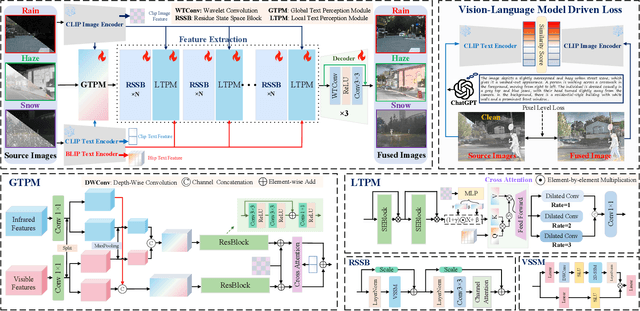
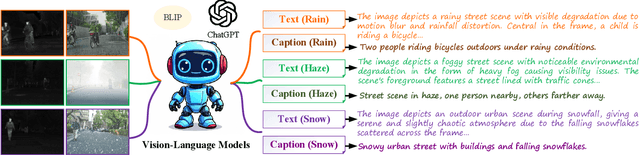
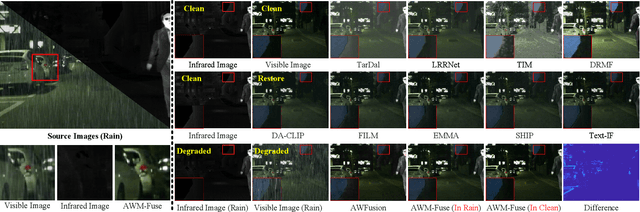
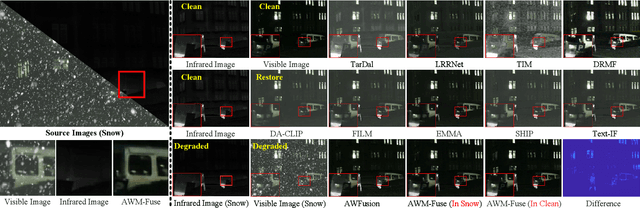
Multi-modality image fusion (MMIF) in adverse weather aims to address the loss of visual information caused by weather-related degradations, providing clearer scene representations. Although less studies have attempted to incorporate textual information to improve semantic perception, they often lack effective categorization and thorough analysis of textual content. In response, we propose AWM-Fuse, a novel fusion method for adverse weather conditions, designed to handle multiple degradations through global and local text perception within a unified, shared weight architecture. In particular, a global feature perception module leverages BLIP-produced captions to extract overall scene features and identify primary degradation types, thus promoting generalization across various adverse weather conditions. Complementing this, the local module employs detailed scene descriptions produced by ChatGPT to concentrate on specific degradation effects through concrete textual cues, thereby capturing finer details. Furthermore, textual descriptions are used to constrain the generation of fusion images, effectively steering the network learning process toward better alignment with real semantic labels, thereby promoting the learning of more meaningful visual features. Extensive experiments demonstrate that AWM-Fuse outperforms current state-of-the-art methods in complex weather conditions and downstream tasks. Our code is available at https://github.com/Feecuin/AWM-Fuse.
GDSR: Global-Detail Integration through Dual-Branch Network with Wavelet Losses for Remote Sensing Image Super-Resolution
Jan 07, 2025In recent years, deep neural networks, including Convolutional Neural Networks, Transformers, and State Space Models, have achieved significant progress in Remote Sensing Image (RSI) Super-Resolution (SR). However, existing SR methods typically overlook the complementary relationship between global and local dependencies. These methods either focus on capturing local information or prioritize global information, which results in models that are unable to effectively capture both global and local features simultaneously. Moreover, their computational cost becomes prohibitive when applied to large-scale RSIs. To address these challenges, we introduce the novel application of Receptance Weighted Key Value (RWKV) to RSI-SR, which captures long-range dependencies with linear complexity. To simultaneously model global and local features, we propose the Global-Detail dual-branch structure, GDSR, which performs SR reconstruction by paralleling RWKV and convolutional operations to handle large-scale RSIs. Furthermore, we introduce the Global-Detail Reconstruction Module (GDRM) as an intermediary between the two branches to bridge their complementary roles. In addition, we propose Wavelet Loss, a loss function that effectively captures high-frequency detail information in images, thereby enhancing the visual quality of SR, particularly in terms of detail reconstruction. Extensive experiments on several benchmarks, including AID, AID_CDM, RSSRD-QH, and RSSRD-QH_CDM, demonstrate that GSDR outperforms the state-of-the-art Transformer-based method HAT by an average of 0.05 dB in PSNR, while using only 63% of its parameters and 51% of its FLOPs, achieving an inference speed 2.9 times faster. Furthermore, the Wavelet Loss shows excellent generalization across various architectures, providing a novel perspective for RSI-SR enhancement.
SpeechVerse: A Large-scale Generalizable Audio Language Model
May 14, 2024
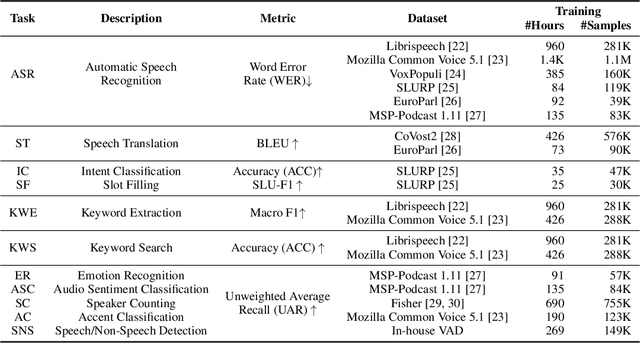


Large language models (LLMs) have shown incredible proficiency in performing tasks that require semantic understanding of natural language instructions. Recently, many works have further expanded this capability to perceive multimodal audio and text inputs, but their capabilities are often limited to specific fine-tuned tasks such as automatic speech recognition and translation. We therefore develop SpeechVerse, a robust multi-task training and curriculum learning framework that combines pre-trained speech and text foundation models via a small set of learnable parameters, while keeping the pre-trained models frozen during training. The models are instruction finetuned using continuous latent representations extracted from the speech foundation model to achieve optimal zero-shot performance on a diverse range of speech processing tasks using natural language instructions. We perform extensive benchmarking that includes comparing our model performance against traditional baselines across several datasets and tasks. Furthermore, we evaluate the model's capability for generalized instruction following by testing on out-of-domain datasets, novel prompts, and unseen tasks. Our empirical experiments reveal that our multi-task SpeechVerse model is even superior to conventional task-specific baselines on 9 out of the 11 tasks.
MMA-UNet: A Multi-Modal Asymmetric UNet Architecture for Infrared and Visible Image Fusion
Apr 27, 2024


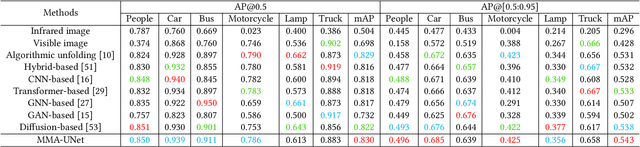
Multi-modal image fusion (MMIF) maps useful information from various modalities into the same representation space, thereby producing an informative fused image. However, the existing fusion algorithms tend to symmetrically fuse the multi-modal images, causing the loss of shallow information or bias towards a single modality in certain regions of the fusion results. In this study, we analyzed the spatial distribution differences of information in different modalities and proved that encoding features within the same network is not conducive to achieving simultaneous deep feature space alignment for multi-modal images. To overcome this issue, a Multi-Modal Asymmetric UNet (MMA-UNet) was proposed. We separately trained specialized feature encoders for different modal and implemented a cross-scale fusion strategy to maintain the features from different modalities within the same representation space, ensuring a balanced information fusion process. Furthermore, extensive fusion and downstream task experiments were conducted to demonstrate the efficiency of MMA-UNet in fusing infrared and visible image information, producing visually natural and semantically rich fusion results. Its performance surpasses that of the state-of-the-art comparison fusion methods.
Physical Perception Network and an All-weather Multi-modality Benchmark for Adverse Weather Image Fusion
Feb 03, 2024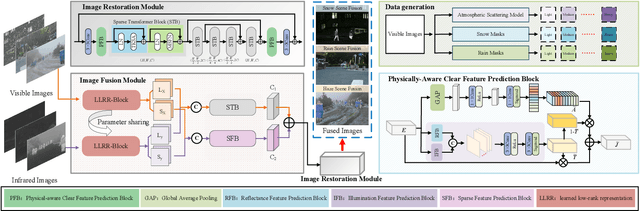
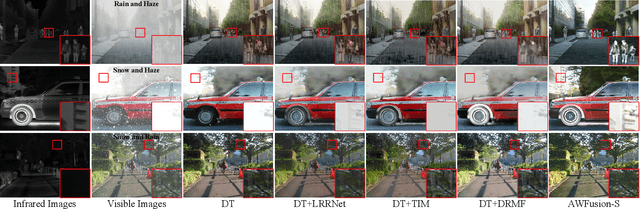
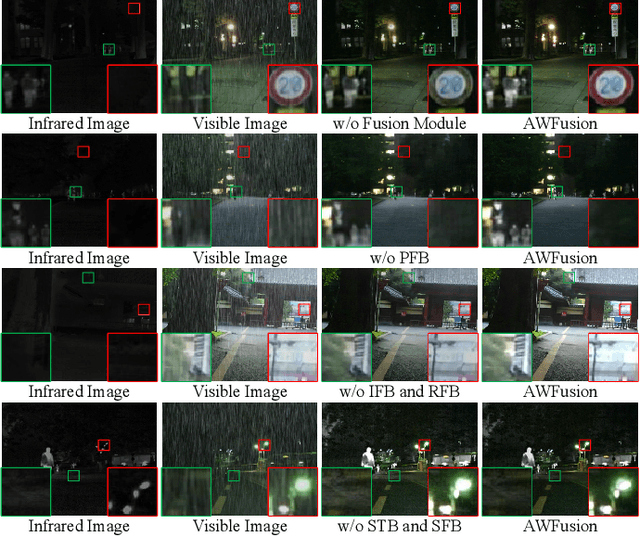
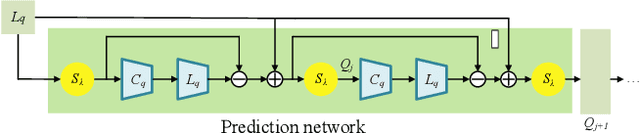
Multi-modality image fusion (MMIF) integrates the complementary information from different modal images to provide comprehensive and objective interpretation of a scenes. However, existing MMIF methods lack the ability to resist different weather interferences in real-life scenarios, preventing them from being useful in practical applications such as autonomous driving. To bridge this research gap, we proposed an all-weather MMIF model. Regarding deep learning architectures, their network designs are often viewed as a black box, which limits their multitasking capabilities. For deweathering module, we propose a physically-aware clear feature prediction module based on an atmospheric scattering model that can deduce variations in light transmittance from both scene illumination and depth. For fusion module, We utilize a learnable low-rank representation model to decompose images into low-rank and sparse components. This highly interpretable feature separation allows us to better observe and understand images. Furthermore, we have established a benchmark for MMIF research under extreme weather conditions. It encompasses multiple scenes under three types of weather: rain, haze, and snow, with each weather condition further subdivided into various impact levels. Extensive fusion experiments under adverse weather demonstrate that the proposed algorithm has excellent detail recovery and multi-modality feature extraction capabilities.
Decomposition-based and Interference Perception for Infrared and Visible Image Fusion in Complex Scenes
Feb 03, 2024Infrared and visible image fusion has emerged as a prominent research in computer vision. However, little attention has been paid on complex scenes fusion, causing existing techniques to produce sub-optimal results when suffers from real interferences. To fill this gap, we propose a decomposition-based and interference perception image fusion method. Specifically, we classify the pixels of visible image from the degree of scattering of light transmission, based on which we then separate the detail and energy information of the image. This refined decomposition facilitates the proposed model in identifying more interfering pixels that are in complex scenes. To strike a balance between denoising and detail preservation, we propose an adaptive denoising scheme for fusing detail components. Meanwhile, we propose a new weighted fusion rule by considering the distribution of image energy information from the perspective of multiple directions. Extensive experiments in complex scenes fusions cover adverse weathers, noise, blur, overexposure, fire, as well as downstream tasks including semantic segmentation, object detection, salient object detection and depth estimation, consistently indicate the effectiveness and superiority of the proposed method compared with the recent representative methods.