 Add to Chrome
 Add to Firefox
 Add to Edge
CAWM-Mamba: A unified model for infrared-visible image fusion and compound adverse weather restoration
Mar 03, 2026
Multimodal Image Fusion (MMIF) integrates complementary information from various modalities to produce clearer and more informative fused images. MMIF under adverse weather is particularly crucial in autonomous driving and UAV monitoring applications. However, existing adverse weather fusion methods generally only tackle single types of degradation such as haze, rain, or snow, and fail when multiple degradations coexist (e.g., haze+rain, rain+snow). To address this challenge, we propose Compound Adverse Weather Mamba (CAWM-Mamba), the first end-to-end framework that jointly performs image fusion and compound weather restoration with unified shared weights. Our network contains three key components: (1) a Weather-Aware Preprocess Module (WAPM) to enhance degraded visible features and extracts global weather embeddings; (2) a Cross-modal Feature Interaction Module (CFIM) to facilitate the alignment of heterogeneous modalities and exchange of complementary features across modalities; and (3) a Wavelet Space State Block (WSSB) that leverages wavelet-domain decomposition to decouple multi-frequency degradations. WSSB includes Freq-SSM, a module that models anisotropic high-frequency degradation without redundancy, and a unified degradation representation mechanism to further improve generalization across complex compound weather conditions. Extensive experiments on the AWMM-100K benchmark and three standard fusion datasets demonstrate that CAWM-Mamba consistently outperforms state-of-the-art methods in both compound and single-weather scenarios. In addition, our fusion results excel in downstream tasks covering semantic segmentation and object detection, confirming the practical value in real-world adverse weather perception. The source code will be available at https://github.com/Feecuin/CAWM-Mamba.

AWM-Fuse: Multi-Modality Image Fusion for Adverse Weather via Global and Local Text Perception
Aug 23, 2025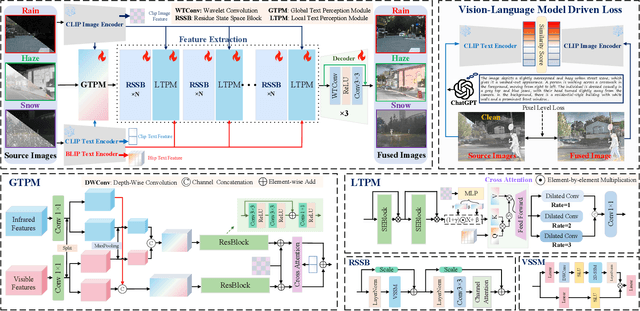
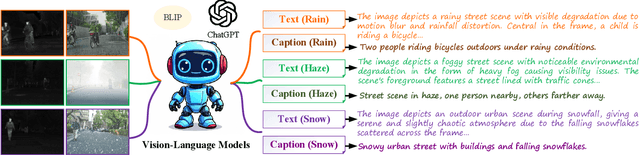
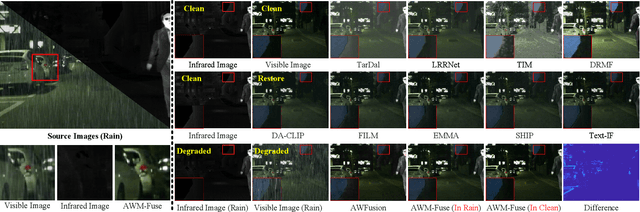
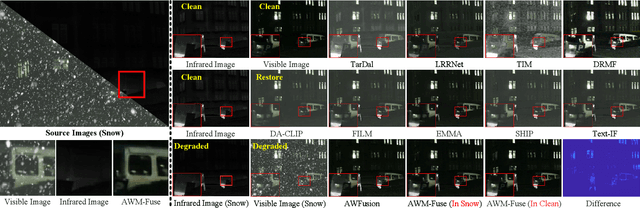
Multi-modality image fusion (MMIF) in adverse weather aims to address the loss of visual information caused by weather-related degradations, providing clearer scene representations. Although less studies have attempted to incorporate textual information to improve semantic perception, they often lack effective categorization and thorough analysis of textual content. In response, we propose AWM-Fuse, a novel fusion method for adverse weather conditions, designed to handle multiple degradations through global and local text perception within a unified, shared weight architecture. In particular, a global feature perception module leverages BLIP-produced captions to extract overall scene features and identify primary degradation types, thus promoting generalization across various adverse weather conditions. Complementing this, the local module employs detailed scene descriptions produced by ChatGPT to concentrate on specific degradation effects through concrete textual cues, thereby capturing finer details. Furthermore, textual descriptions are used to constrain the generation of fusion images, effectively steering the network learning process toward better alignment with real semantic labels, thereby promoting the learning of more meaningful visual features. Extensive experiments demonstrate that AWM-Fuse outperforms current state-of-the-art methods in complex weather conditions and downstream tasks. Our code is available at https://github.com/Feecuin/AWM-Fuse.
Interaction-Guided Two-Branch Image Dehazing Network
Oct 14, 2024
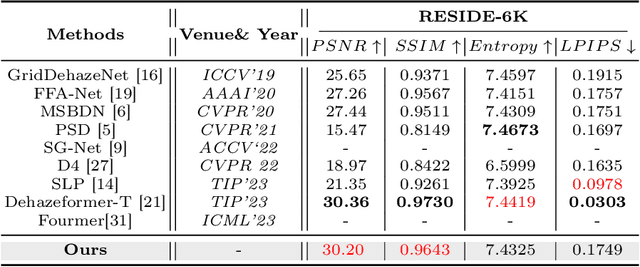
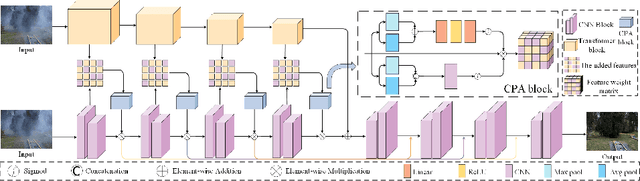
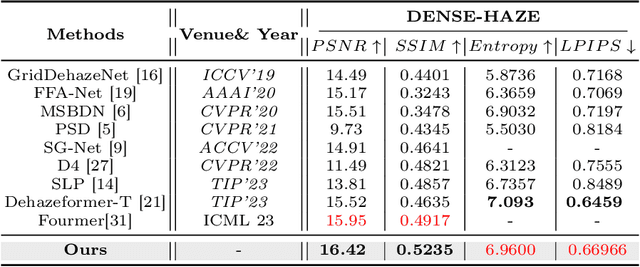
Image dehazing aims to restore clean images from hazy ones. Convolutional Neural Networks (CNNs) and Transformers have demonstrated exceptional performance in local and global feature extraction, respectively, and currently represent the two mainstream frameworks in image dehazing. In this paper, we propose a novel dual-branch image dehazing framework that guides CNN and Transformer components interactively. We reconsider the complementary characteristics of CNNs and Transformers by leveraging the differential relationships between global and local features for interactive guidance. This approach enables the capture of local feature positions through global attention maps, allowing the CNN to focus solely on feature information at effective positions. The single-branch Transformer design ensures the network's global information recovery capability. Extensive experiments demonstrate that our proposed method yields competitive qualitative and quantitative evaluation performance on both synthetic and real public datasets. Codes are available at https://github.com/Feecuin/Two-Branch-Dehazing