 Add to Chrome
 Add to Firefox
 Add to Edge
A plug-and-play generative framework for multi-satellite precipitation estimation
May 14, 2026
Reliable precipitation monitoring is essential for disaster risk reduction, water resources management, and agricultural decision-making. Multi-source satellite observations, particularly the combination of geostationary infrared and passive microwave measurements, have become a primary means of precipitation detection. Traditional multi-source satellite precipitation estimation methods remain computationally inefficient, and many deep learning methods lack the flexibility to incorporate new sensors without retraining the full model. Here we introduce PRISMA (Precipitation Inference from Satellite Modalities via generAtive modeling), a plug-and-play latent generative framework for multi-sensor precipitation estimation. PRISMA learns an unconditional precipitation prior from IMERG Final fields and constrains it through independently trained, sensor-specific conditional branches, allowing new observation sources to be incorporated without retraining the generative backbone. Applied to FY-4B AGRI infrared and GPM GMI microwave observations, PRISMA improves Critical Success Index by up to 40.3% and reduces root-mean-square error by 22.6% relative to infrared-only estimation within microwave swaths, while also improving probabilistic skill and maintaining an average inference time of about 37 s. Independent rain-gauge validation across China confirms consistent gains, and typhoon case studies show that microwave conditioning restores eyewall and spiral rainband structures, reducing storm-core mean absolute error by up to 42.3%. PRISMA thus provides an extensible and efficient framework for multi-sensor precipitation estimation.

FuXiWeather2: Learning accurate atmospheric state estimation for operational global weather forecasting
Mar 16, 2026Numerical weather prediction has long been constrained by the computational bottlenecks inherent in data assimilation and numerical modeling. While machine learning has accelerated forecasting, existing models largely serve as "emulators of reanalysis products," thereby retaining their systematic biases and operational latencies. Here, we present FuXiWeather2, a unified end-to-end neural framework for assimilation and forecasting. We align training objectives directly with a combination of real-world observations and reanalysis data, enabling the framework to effectively rectify inherent errors within reanalysis products. To address the distribution shift between NWP-derived background inputs during training and self-generated backgrounds during deployment, we introduce a recursive unrolling training method to enhance the precision and stability of analysis generation. Furthermore, our model is trained on a hybrid dataset of raw and simulated observations to mitigate the impact of observational distribution inconsistency. FuXiWeather2 generates high-resolution ($0.25^{\circ}$) global analysis fields and 10-day forecasts within minutes. The analysis fields surpass the NCEP-GFS across most variables and demonstrate superior accuracy over both ERA5 and the ECMWF-HRES system in lower-tropospheric and surface variables. These high-quality analysis fields drive deterministic forecasts that exceed the skill of the HRES system in 91\% of evaluated metrics. Additionally, its outstanding performance in typhoon track prediction underscores its practical value for rapid response to extreme weather events. The FuXiWeather2 analysis dataset is available at https://doi.org/10.5281/zenodo.18872728.
FuXi Weather: An end-to-end machine learning weather data assimilation and forecasting system
Aug 10, 2024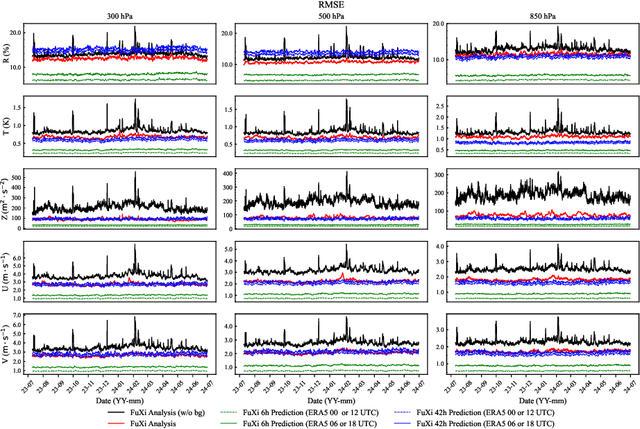
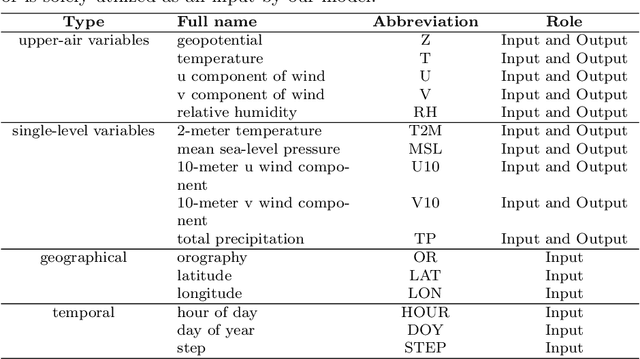

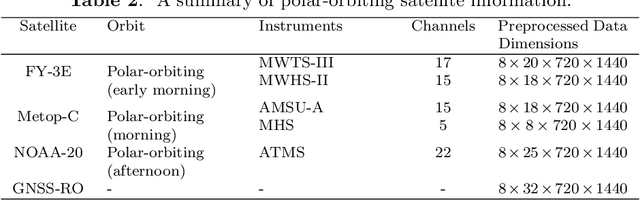
Operational numerical weather prediction systems consist of three fundamental components: the global observing system for data collection, data assimilation for generating initial conditions, and the forecasting model to predict future weather conditions. While NWP have undergone a quiet revolution, with forecast skills progressively improving over the past few decades, their advancement has slowed due to challenges such as high computational costs and the complexities associated with assimilating an increasing volume of observational data and managing finer spatial grids. Advances in machine learning offer an alternative path towards more efficient and accurate weather forecasts. The rise of machine learning based weather forecasting models has also spurred the development of machine learning based DA models or even purely machine learning based weather forecasting systems. This paper introduces FuXi Weather, an end-to-end machine learning based weather forecasting system. FuXi Weather employs specialized data preprocessing and multi-modal data fusion techniques to integrate information from diverse sources under all-sky conditions, including microwave sounders from 3 polar-orbiting satellites and radio occultation data from Global Navigation Satellite System. Operating on a 6-hourly DA and forecasting cycle, FuXi Weather independently generates robust and accurate 10-day global weather forecasts at a spatial resolution of 0.25\textdegree. It surpasses the European Centre for Medium-range Weather Forecasts high-resolution forecasts in terms of predictability, extending the skillful forecast lead times for several key weather variables such as the geopotential height at 500 hPa from 9.25 days to 9.5 days. The system's high computational efficiency and robust performance, even with limited observations, demonstrates its potential as a promising alternative to traditional NWP systems.
Fuxi-DA: A Generalized Deep Learning Data Assimilation Framework for Assimilating Satellite Observations
Apr 12, 2024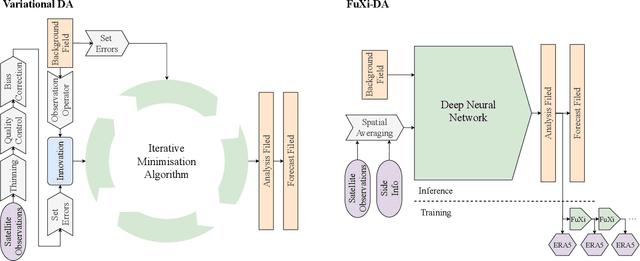
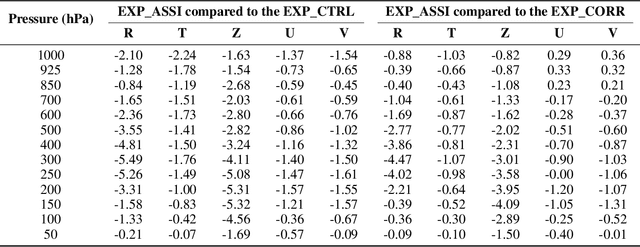
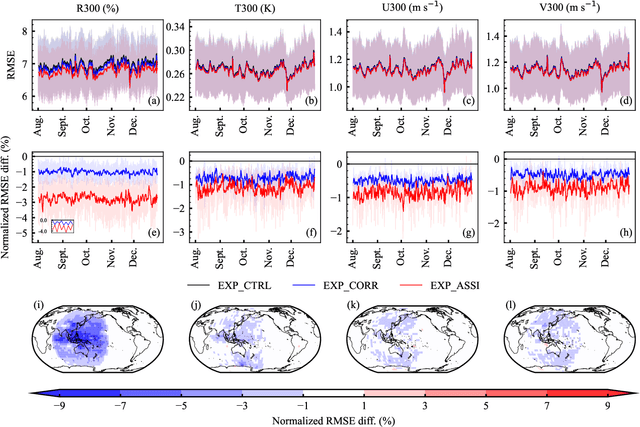

Data assimilation (DA), as an indispensable component within contemporary Numerical Weather Prediction (NWP) systems, plays a crucial role in generating the analysis that significantly impacts forecast performance. Nevertheless, the development of an efficient DA system poses significant challenges, particularly in establishing intricate relationships between the background data and the vast amount of multi-source observation data within limited time windows in operational settings. To address these challenges, researchers design complex pre-processing methods for each observation type, leveraging approximate modeling and the power of super-computing clusters to expedite solutions. The emergence of deep learning (DL) models has been a game-changer, offering unified multi-modal modeling, enhanced nonlinear representation capabilities, and superior parallelization. These advantages have spurred efforts to integrate DL models into various domains of weather modeling. Remarkably, DL models have shown promise in matching, even surpassing, the forecast accuracy of leading operational NWP models worldwide. This success motivates the exploration of DL-based DA frameworks tailored for weather forecasting models. In this study, we introduces FuxiDA, a generalized DL-based DA framework for assimilating satellite observations. By assimilating data from Advanced Geosynchronous Radiation Imager (AGRI) aboard Fengyun-4B, FuXi-DA consistently mitigates analysis errors and significantly improves forecast performance. Furthermore, through a series of single-observation experiments, Fuxi-DA has been validated against established atmospheric physics, demonstrating its consistency and reliability.