 Add to Chrome
 Add to Firefox
 Add to Edge
ArchEGraph: A Large-Scale Graph Dataset for Geometry-Topology-Physics Aligned Building Energy Modeling
Aug 07, 2026
Accurate estimation of building energy use is essential for achieving carbon neutral and sustainable buildings. To better understand the influence of design decisions on building energy use and calibrate machine learning models that can give architects and engineers rapid design feedback, large-scale datasets are needed that explicitly map building geometry to performance. We present ArchEGraph, a large-scale benchmark dataset that represents buildings as heterogeneous graphs with aligned geometry, topology, weather, and zone-level thermal loads. The dataset contains 5,481 buildings and 49,326 validated building-weather simulation cases. In total, it includes over 133,000 space nodes and 1.44 million face nodes, reflecting substantial geometric and topological complexity. Based on ArchEGraph, we define two benchmark tasks: (i) graph reconstruction from polygonal meshes, aiming to recover topological structure from geometric representations; and (ii) topology-informed load prediction, which leverages graph structure and temporal weather conditions to forecast zone-level response time series. We further introduce standardized evaluation protocols for both tasks and conduct cross-building and cross-climate generalization experiments to assess model robustness. ArchEGraph provides a unified testbed for studying geometry-topology-physics coupling in building energy modeling, enabling the development and evaluation of scalable and generalizable surrogate models.

Beyond Heuristics: A Standardized Real2Sim Pipeline for Physical Human Robot Interaction in Human-in-the-Loop Simulation
Jul 03, 2026The aging global population drives demand for assistive robots, yet the safety risks and costs of physical testing make Human-in-the-Loop (HITL) simulation an attractive alternative. Its fidelity for coupled systems, however, is limited by interaction models whose impedance parameters are tuned heuristically rather than identified from data. We present a Real2Sim pipeline that identifies the coupled Physical Human-Robot Interaction (pHRI) dynamics of a pelvis--strap interface on an overground mobile balance assistant. The interface is modeled as a 6-DoF viscoelastic mechanism whose 12 directional stiffness and damping parameters are identified per subject via Covariance Matrix Adaptation Evolution Strategy (CMA-ES), using the user's ``Safe \& Comfortable'' feedback as a reproducible operating point that resolves harness-tightness ambiguity across anthropometrics. An intraclass-correlation analysis over a five-subject cohort separates shareable from subject-specific parameters, yielding a set of prior parameters derived from the existing data. Deploying this prior configures a previously unseen subject by refining only 5 of the 12 parameters. The calibrated model then reproduces the real interaction envelope and induces biomechanically accurate gait adaptations in the Human Digital Twin (HDT). Overly compliant and overly stiff settings, by contrast, fail as extreme settings, confirming a correct operating point that no heuristic tuning procedure can reliably select. The pipeline thus improves HITL simulation fidelity and supports the Human Digital Twin as a predictive tool for pre-clinical verification of personalized controllers.
DRBA: Dynamic Robotic Balance Assistant -- An assist-as-needed gait and balance rehabilitation robot for versatile training
Jul 03, 2026The decline of human balance control due to aging and pathological conditions increases fall risk, a major concern in geriatric care and rehabilitation. Gait training is essential for balance recovery, enhancing walking ability and postural control. However, existing overground robotic gait trainers have limitations: body weight support systems are bulky and impractical for daily use, while end-effector-based systems often compromise transparency, altering natural gait dynamics. This paper presents the Dynamic Robotic Balance Assistant (DRBA), a novel gait trainer providing assist-as-needed body weight and balance support for various training scenarios. DRBA integrates a 3-degree-of-freedom (3-DoF) robotic arm for pelvic support with flexible motion, a compact sit-to-stand assistance module, and user-following and fall detection algorithms to ensure minimal interference and responsive support. Experimental results demonstrated high transparency, with minimal impact on natural gait dynamics. A patient trial with nine elderly patients with varying medical conditions and balance impairments (ranging from severe to mild) further validated DRBA's effectiveness. The results showed that DRBA-assisted training increased step length and walking speed compared to therapist-assisted gait training. Additionally, DRBA enabled users to perform tasks beyond their unaided ability, expanding rehabilitation possibilities. These findings highlight DRBA's potential to enhance rehabilitation outcomes by facilitating higher training intensity and enabling task-oriented exercises.
Question Answering for Decisionmaking in Green Building Design: A Multimodal Data Reasoning Method Driven by Large Language Models
Dec 06, 2024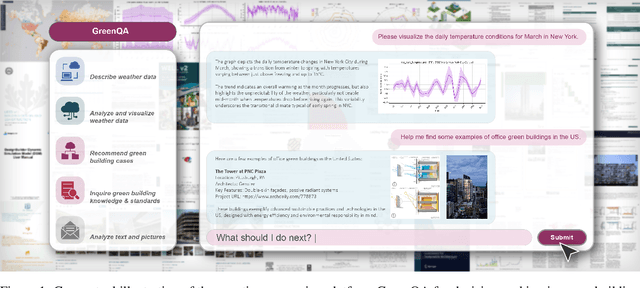
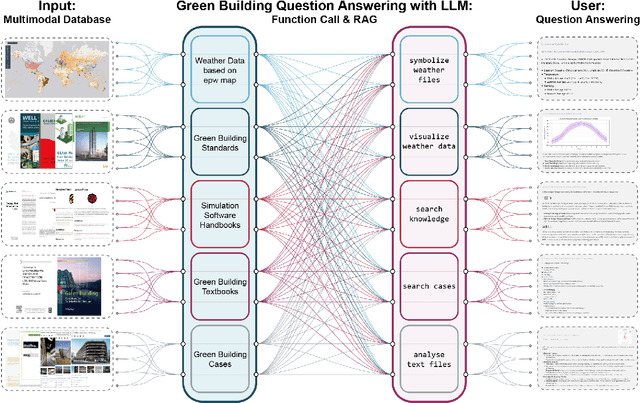


In recent years, the critical role of green buildings in addressing energy consumption and environmental issues has become widely acknowledged. Research indicates that over 40% of potential energy savings can be achieved during the early design stage. Therefore, decision-making in green building design (DGBD), which is based on modeling and performance simulation, is crucial for reducing building energy costs. However, the field of green building encompasses a broad range of specialized knowledge, which involves significant learning costs and results in low decision-making efficiency. Many studies have already applied artificial intelligence (AI) methods to this field. Based on previous research, this study innovatively integrates large language models with DGBD, creating GreenQA, a question answering framework for multimodal data reasoning. Utilizing Retrieval Augmented Generation, Chain of Thought, and Function Call methods, GreenQA enables multimodal question answering, including weather data analysis and visualization, retrieval of green building cases, and knowledge query. Additionally, this study conducted a user survey using the GreenQA web platform. The results showed that 96% of users believed the platform helped improve design efficiency. This study not only effectively supports DGBD but also provides inspiration for AI-assisted design.
A Few Hypocrites: Few-Shot Learning and Subtype Definitions for Detecting Hypocrisy Accusations in Online Climate Change Debates
Sep 25, 2024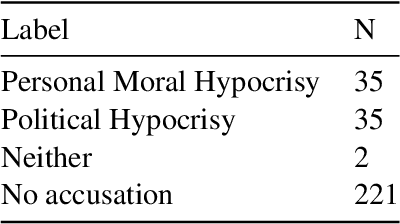

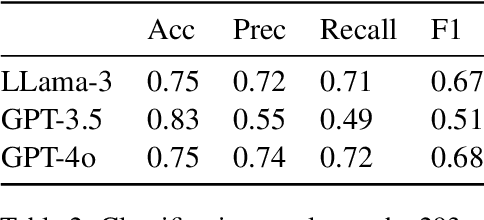
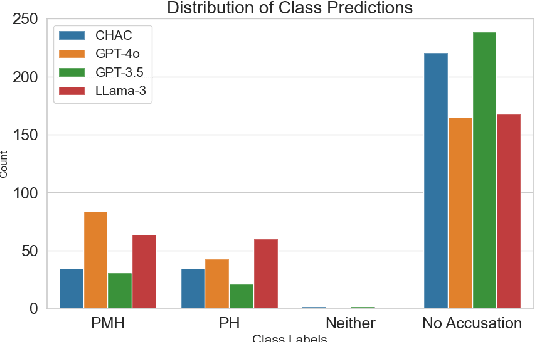
The climate crisis is a salient issue in online discussions, and hypocrisy accusations are a central rhetorical element in these debates. However, for large-scale text analysis, hypocrisy accusation detection is an understudied tool, most often defined as a smaller subtask of fallacious argument detection. In this paper, we define hypocrisy accusation detection as an independent task in NLP, and identify different relevant subtypes of hypocrisy accusations. Our Climate Hypocrisy Accusation Corpus (CHAC) consists of 420 Reddit climate debate comments, expert-annotated into two different types of hypocrisy accusations: personal versus political hypocrisy. We evaluate few-shot in-context learning with 6 shots and 3 instruction-tuned Large Language Models (LLMs) for detecting hypocrisy accusations in this dataset. Results indicate that the GPT-4o and Llama-3 models in particular show promise in detecting hypocrisy accusations (F1 reaching 0.68, while previous work shows F1 of 0.44). However, context matters for a complex semantic concept such as hypocrisy accusations, and we find models struggle especially at identifying political hypocrisy accusations compared to personal moral hypocrisy. Our study contributes new insights in hypocrisy detection and climate change discourse, and is a stepping stone for large-scale analysis of hypocrisy accusation in online climate debates.