 Add to Chrome
 Add to Firefox
 Add to Edge
ArchEGraph: A Large-Scale Graph Dataset for Geometry-Topology-Physics Aligned Building Energy Modeling
Aug 07, 2026
Accurate estimation of building energy use is essential for achieving carbon neutral and sustainable buildings. To better understand the influence of design decisions on building energy use and calibrate machine learning models that can give architects and engineers rapid design feedback, large-scale datasets are needed that explicitly map building geometry to performance. We present ArchEGraph, a large-scale benchmark dataset that represents buildings as heterogeneous graphs with aligned geometry, topology, weather, and zone-level thermal loads. The dataset contains 5,481 buildings and 49,326 validated building-weather simulation cases. In total, it includes over 133,000 space nodes and 1.44 million face nodes, reflecting substantial geometric and topological complexity. Based on ArchEGraph, we define two benchmark tasks: (i) graph reconstruction from polygonal meshes, aiming to recover topological structure from geometric representations; and (ii) topology-informed load prediction, which leverages graph structure and temporal weather conditions to forecast zone-level response time series. We further introduce standardized evaluation protocols for both tasks and conduct cross-building and cross-climate generalization experiments to assess model robustness. ArchEGraph provides a unified testbed for studying geometry-topology-physics coupling in building energy modeling, enabling the development and evaluation of scalable and generalizable surrogate models.

Low Latency Transformer Inference on FPGAs for Physics Applications with hls4ml
Sep 08, 2024
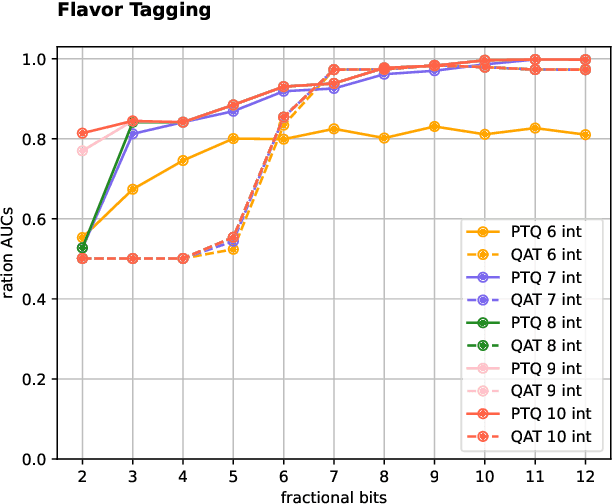
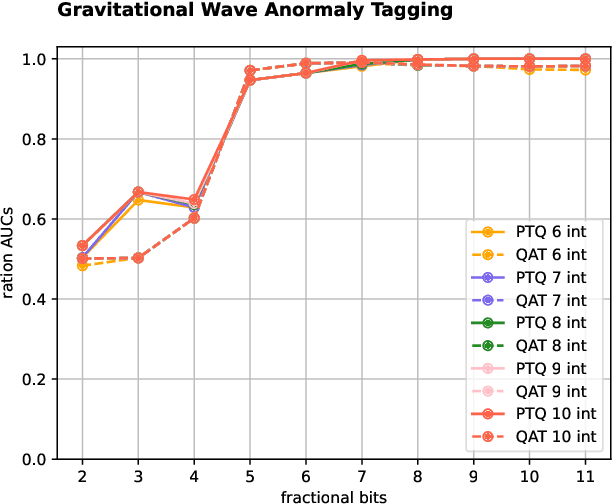
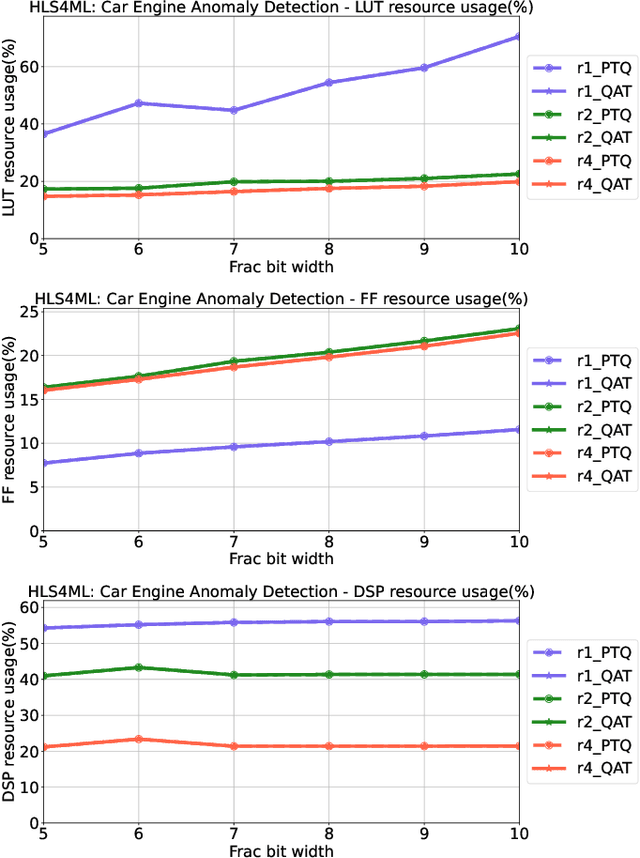
This study presents an efficient implementation of transformer architectures in Field-Programmable Gate Arrays(FPGAs) using hls4ml. We demonstrate the strategy for implementing the multi-head attention, softmax, and normalization layer and evaluate three distinct models. Their deployment on VU13P FPGA chip achieved latency less than 2us, demonstrating the potential for real-time applications. HLS4ML compatibility with any TensorFlow-built transformer model further enhances the scalability and applicability of this work. Index Terms: FPGAs, machine learning, transformers, high energy physics, LIGO
FPGA Deployment of LFADS for Real-time Neuroscience Experiments
Feb 02, 2024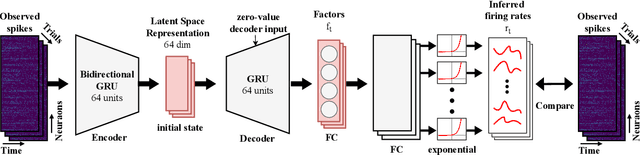
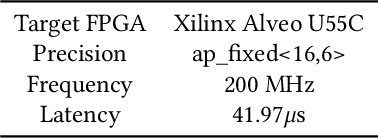
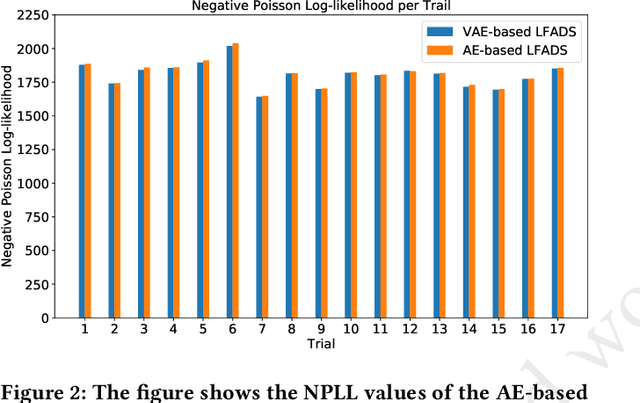
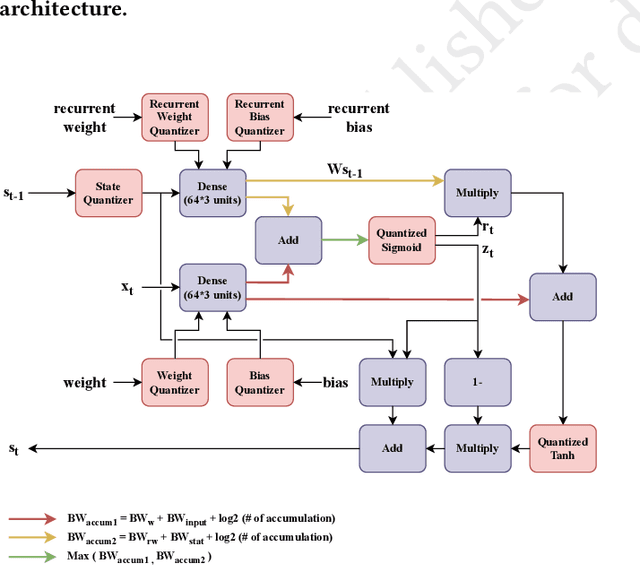
Large-scale recordings of neural activity are providing new opportunities to study neural population dynamics. A powerful method for analyzing such high-dimensional measurements is to deploy an algorithm to learn the low-dimensional latent dynamics. LFADS (Latent Factor Analysis via Dynamical Systems) is a deep learning method for inferring latent dynamics from high-dimensional neural spiking data recorded simultaneously in single trials. This method has shown a remarkable performance in modeling complex brain signals with an average inference latency in milliseconds. As our capacity of simultaneously recording many neurons is increasing exponentially, it is becoming crucial to build capacity for deploying low-latency inference of the computing algorithms. To improve the real-time processing ability of LFADS, we introduce an efficient implementation of the LFADS models onto Field Programmable Gate Arrays (FPGA). Our implementation shows an inference latency of 41.97 $\mu$s for processing the data in a single trial on a Xilinx U55C.
* 6 pages, 8 figures