 Add to Chrome
 Add to Firefox
 Add to Edge
Beyond Heuristics: A Standardized Real2Sim Pipeline for Physical Human Robot Interaction in Human-in-the-Loop Simulation
Jul 03, 2026
The aging global population drives demand for assistive robots, yet the safety risks and costs of physical testing make Human-in-the-Loop (HITL) simulation an attractive alternative. Its fidelity for coupled systems, however, is limited by interaction models whose impedance parameters are tuned heuristically rather than identified from data. We present a Real2Sim pipeline that identifies the coupled Physical Human-Robot Interaction (pHRI) dynamics of a pelvis--strap interface on an overground mobile balance assistant. The interface is modeled as a 6-DoF viscoelastic mechanism whose 12 directional stiffness and damping parameters are identified per subject via Covariance Matrix Adaptation Evolution Strategy (CMA-ES), using the user's ``Safe \& Comfortable'' feedback as a reproducible operating point that resolves harness-tightness ambiguity across anthropometrics. An intraclass-correlation analysis over a five-subject cohort separates shareable from subject-specific parameters, yielding a set of prior parameters derived from the existing data. Deploying this prior configures a previously unseen subject by refining only 5 of the 12 parameters. The calibrated model then reproduces the real interaction envelope and induces biomechanically accurate gait adaptations in the Human Digital Twin (HDT). Overly compliant and overly stiff settings, by contrast, fail as extreme settings, confirming a correct operating point that no heuristic tuning procedure can reliably select. The pipeline thus improves HITL simulation fidelity and supports the Human Digital Twin as a predictive tool for pre-clinical verification of personalized controllers.

DRBA: Dynamic Robotic Balance Assistant -- An assist-as-needed gait and balance rehabilitation robot for versatile training
Jul 03, 2026The decline of human balance control due to aging and pathological conditions increases fall risk, a major concern in geriatric care and rehabilitation. Gait training is essential for balance recovery, enhancing walking ability and postural control. However, existing overground robotic gait trainers have limitations: body weight support systems are bulky and impractical for daily use, while end-effector-based systems often compromise transparency, altering natural gait dynamics. This paper presents the Dynamic Robotic Balance Assistant (DRBA), a novel gait trainer providing assist-as-needed body weight and balance support for various training scenarios. DRBA integrates a 3-degree-of-freedom (3-DoF) robotic arm for pelvic support with flexible motion, a compact sit-to-stand assistance module, and user-following and fall detection algorithms to ensure minimal interference and responsive support. Experimental results demonstrated high transparency, with minimal impact on natural gait dynamics. A patient trial with nine elderly patients with varying medical conditions and balance impairments (ranging from severe to mild) further validated DRBA's effectiveness. The results showed that DRBA-assisted training increased step length and walking speed compared to therapist-assisted gait training. Additionally, DRBA enabled users to perform tasks beyond their unaided ability, expanding rehabilitation possibilities. These findings highlight DRBA's potential to enhance rehabilitation outcomes by facilitating higher training intensity and enabling task-oriented exercises.
Simulating Safe Bite Transfer in Robot-Assisted Feeding with a Soft Head and Articulated Jaw
Feb 26, 2025Ensuring safe and comfortable bite transfer during robot-assisted feeding is challenging due to the close physical human-robot interaction required. This paper presents a novel approach to modeling physical human-robot interaction in a physics-based simulator (MuJoCo) using soft-body dynamics. We integrate a flexible head model with a rigid skeleton while accounting for internal dynamics, enabling the flexible model to be actuated by the skeleton. Incorporating realistic soft-skin contact dynamics in simulation allows for systematically evaluating bite transfer parameters, such as insertion depth and entry angle, and their impact on user safety and comfort. Our findings suggest that a straight-in-straight-out strategy minimizes forces and enhances user comfort in robot-assisted feeding, assuming a static head. This simulation-based approach offers a safer and more controlled alternative to real-world experimentation. Supplementary videos can be found at: https://tinyurl.com/224yh2kx.
Personalised 3D Human Digital Twin with Soft-Body Feet for Walking Simulation
Nov 22, 2024
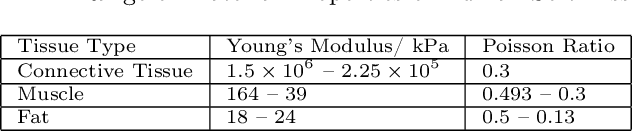
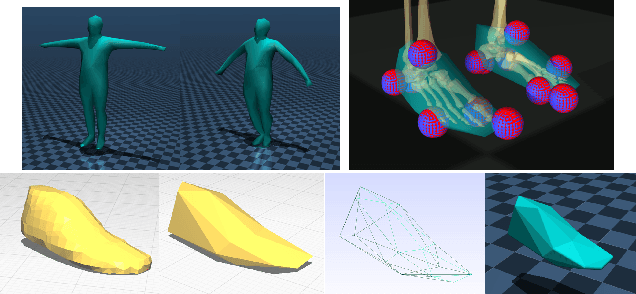
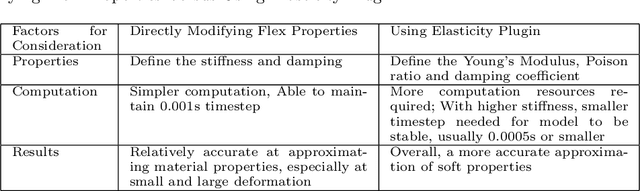
With the increasing use of assistive robots in rehabilitation and assisted mobility of human patients, there has been a need for a deeper understanding of human-robot interactions particularly through simulations, allowing an understanding of these interactions in a digital environment. There is an emphasis on accurately modelling personalised 3D human digital twins in these simulations, to glean more insights on human-robot interactions. In this paper, we propose to integrate personalised soft-body feet, generated using the motion capture data of real human subjects, into a skeletal model and train it with a walking control policy. Through evaluation using ground reaction force and joint angle results, the soft-body feet were able to generate ground reaction force results comparable to real measured data and closely follow joint angle results of the bare skeletal model and the reference motion. This presents an interesting avenue to produce a dynamically accurate human model in simulation driven by their own control policy while only seeing kinematic information during training.