 Add to Chrome
 Add to Firefox
 Add to Edge
Beyond Heuristics: A Standardized Real2Sim Pipeline for Physical Human Robot Interaction in Human-in-the-Loop Simulation
Jul 03, 2026
The aging global population drives demand for assistive robots, yet the safety risks and costs of physical testing make Human-in-the-Loop (HITL) simulation an attractive alternative. Its fidelity for coupled systems, however, is limited by interaction models whose impedance parameters are tuned heuristically rather than identified from data. We present a Real2Sim pipeline that identifies the coupled Physical Human-Robot Interaction (pHRI) dynamics of a pelvis--strap interface on an overground mobile balance assistant. The interface is modeled as a 6-DoF viscoelastic mechanism whose 12 directional stiffness and damping parameters are identified per subject via Covariance Matrix Adaptation Evolution Strategy (CMA-ES), using the user's ``Safe \& Comfortable'' feedback as a reproducible operating point that resolves harness-tightness ambiguity across anthropometrics. An intraclass-correlation analysis over a five-subject cohort separates shareable from subject-specific parameters, yielding a set of prior parameters derived from the existing data. Deploying this prior configures a previously unseen subject by refining only 5 of the 12 parameters. The calibrated model then reproduces the real interaction envelope and induces biomechanically accurate gait adaptations in the Human Digital Twin (HDT). Overly compliant and overly stiff settings, by contrast, fail as extreme settings, confirming a correct operating point that no heuristic tuning procedure can reliably select. The pipeline thus improves HITL simulation fidelity and supports the Human Digital Twin as a predictive tool for pre-clinical verification of personalized controllers.

Facial movement synergies and Action Unit detection from distal wearable Electromyography and Computer Vision
Aug 20, 2020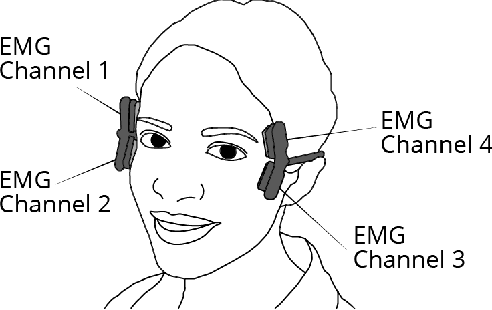
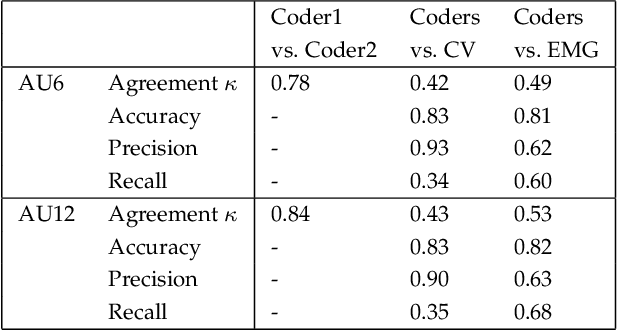
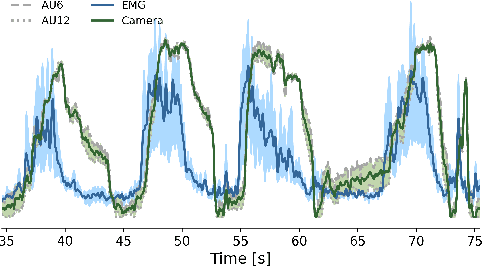
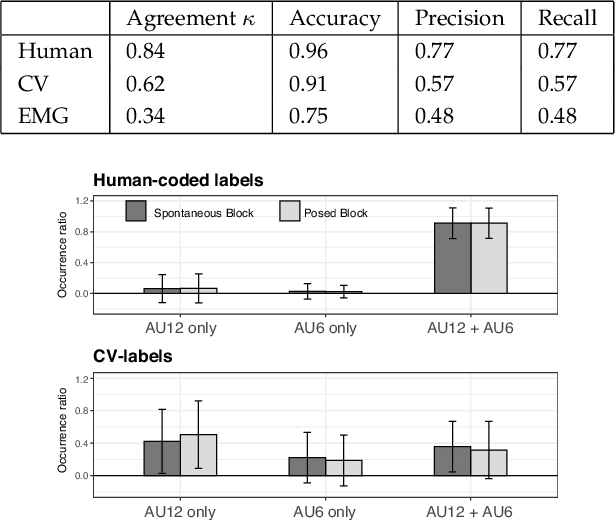
Distal facial Electromyography (EMG) can be used to detect smiles and frowns with reasonable accuracy. It capitalizes on volume conduction to detect relevant muscle activity, even when the electrodes are not placed directly on the source muscle. The main advantage of this method is to prevent occlusion and obstruction of the facial expression production, whilst allowing EMG measurements. However, measuring EMG distally entails that the exact source of the facial movement is unknown. We propose a novel method to estimate specific Facial Action Units (AUs) from distal facial EMG and Computer Vision (CV). This method is based on Independent Component Analysis (ICA), Non-Negative Matrix Factorization (NNMF), and sorting of the resulting components to determine which is the most likely to correspond to each CV-labeled action unit (AU). Performance on the detection of AU06 (Orbicularis Oculi) and AU12 (Zygomaticus Major) was estimated by calculating the agreement with Human Coders. The results of our proposed algorithm showed an accuracy of 81% and a Cohen's Kappa of 0.49 for AU6; and accuracy of 82% and a Cohen's Kappa of 0.53 for AU12. This demonstrates the potential of distal EMG to detect individual facial movements. Using this multimodal method, several AU synergies were identified. We quantified the co-occurrence and timing of AU6 and AU12 in posed and spontaneous smiles using the human-coded labels, and for comparison, using the continuous CV-labels. The co-occurrence analysis was also performed on the EMG-based labels to uncover the relationship between muscle synergies and the kinematics of visible facial movement.