 Add to Chrome
 Add to Firefox
 Add to Edge
ResemBrick: Brick Reconstruction from Photographs with Perceptual Fidelity and Buildability
Aug 10, 2026
Producing a hand-buildable, colored brick model of a 3D object from a few casual photographs is a clean testbed for a broader challenge: generating 3D content that meets hard physical-assembly constraints under a discrete, budget-limited voxel grid. On a coarse lattice, visual resemblance and structural stability pull against each other, yet prior brick pipelines address only one side and treat voxelization as fixed preprocessing rather than a variable to optimize. We present ResemBrick, which couples the two. Budgeted occupancy completion reframes discretization as allocation: given a target occupied-voxel count, a single resolution-conditioned network decides in one feed-forward pass which surface voxels to fill for best appearance, one weight set spanning 13 resolutions. Buildability by construction then combines support- and look-ahead-aware greedy placement with a deterministic, provably terminating repair that grounds every floating component. Under a matched budget, ResemBrick surpasses existing voxel selectors in perceptual fidelity while uniquely reaching zero floating and zero unstable bricks on unfiltered held-out objects; as a complete pipeline, it attains the best perceptual fidelity among prior brick-construction systems. Our results point to treating discretization and assembly as tightly coupled stages rather than independent ones.

ISEP: Implicit Support Expansion for Offline Reinforcement Learning via Stochastic Policy Optimization
May 18, 2026Offline reinforcement learning methods typically enforce strict constraints to ensure safety; yet this rigidity often prevents the discovery of optimal behaviors outside the immediate support of the behavior policy. To address this, we propose Implicit Support Expansion via stochastic Policy optimization (ISEP), which leverages a value function interpolated between in-distribution data and policy samples to implicitly expand the feasible action support. This mechanism "densifies" high-reward regions, creating a navigable path for policy improvement while theoretically guaranteeing bounded value error. However, optimizing against this expanded support creates a multimodal landscape where standard deterministic averaging leads to mode collapse and invalid actions. ISEP mitigates this via a stochastic action selection strategy, optimizing the policy by stochastically alternating between conservative cloning and optimistic expansion signals. We instantiate this framework as ISEP-FM using Conditional Flow Matching utilizing classifier-free guidance to effectively capture the interpolated value signal.
CoWork-X: Experience-Optimized Co-Evolution for Multi-Agent Collaboration System
Feb 04, 2026Large language models are enabling language-conditioned agents in interactive environments, but highly cooperative tasks often impose two simultaneous constraints: sub-second real-time coordination and sustained multi-episode adaptation under a strict online token budget. Existing approaches either rely on frequent in-episode reasoning that induces latency and timing jitter, or deliver post-episode improvements through unstructured text that is difficult to compile into reliable low-cost execution. We propose CoWork-X, an active co-evolution framework that casts peer collaboration as a closed-loop optimization problem across episodes, inspired by fast--slow memory separation. CoWork-X instantiates a Skill-Agent that executes via HTN (hierarchical task network)-based skill retrieval from a structured, interpretable, and compositional skill library, and a post-episode Co-Optimizer that performs patch-style skill consolidation with explicit budget constraints and drift regularization. Experiments in challenging Overcooked-AI-like realtime collaboration benchmarks demonstrate that CoWork-X achieves stable, cumulative performance gains while steadily reducing online latency and token usage.
Efficient Coordination with the System-Level Shared State: An Embodied-AI Native Modular Framework
Jan 20, 2026As Embodied AI systems move from research prototypes to real world deployments, they tend to evolve rapidly while remaining reliable under workload changes and partial failures. In practice, many deployments are only partially decoupled: middleware moves messages, but shared context and feedback semantics are implicit, causing interface drift, cross-module interference, and brittle recovery at scale. We present ANCHOR, a modular framework that makes decoupling and robustness explicit system-level primitives. ANCHOR separates (i) Canonical Records, an evolvable contract for the standardized shared state, from (ii) a communication bus for many-to-many dissemination and feedback-oriented coordination, forming an inspectable end-to-end loop. We validate closed-loop feasibility on a de-identified workflow instantiation, characterize latency distributions under varying payload sizes and publish rates, and demonstrate automatic stream resumption after hard crashes and restarts even with shared-memory loss. Overall, ANCHOR turns ad-hoc integration glue into explicit contracts, enabling controlled degradation under load and self-healing recovery for scalable deployment of closed-loop AI systems.
EmbodiedAgent: A Scalable Hierarchical Approach to Overcome Practical Challenge in Multi-Robot Control
Apr 14, 2025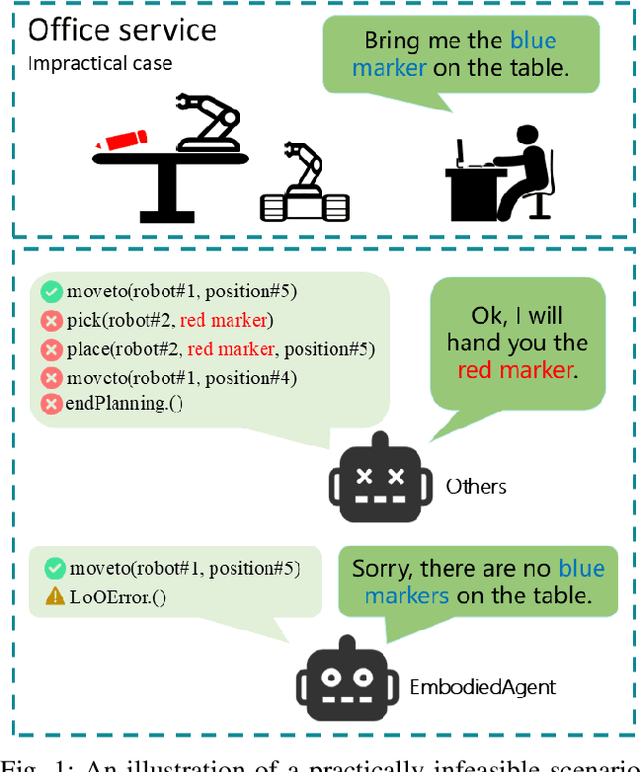
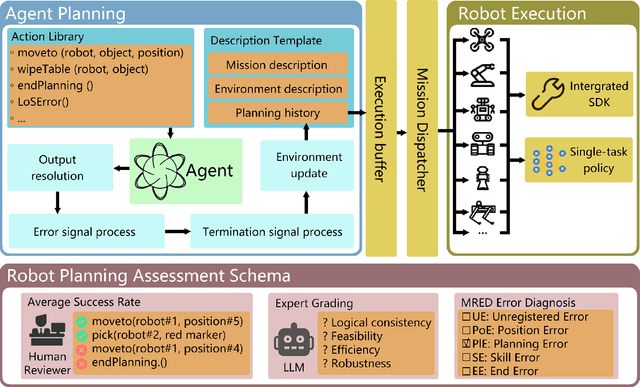
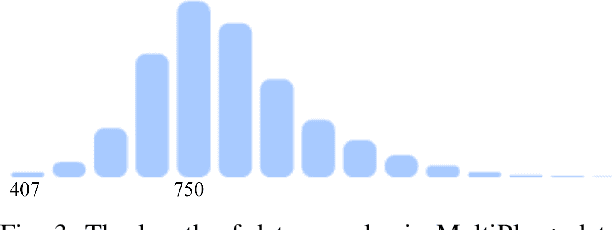
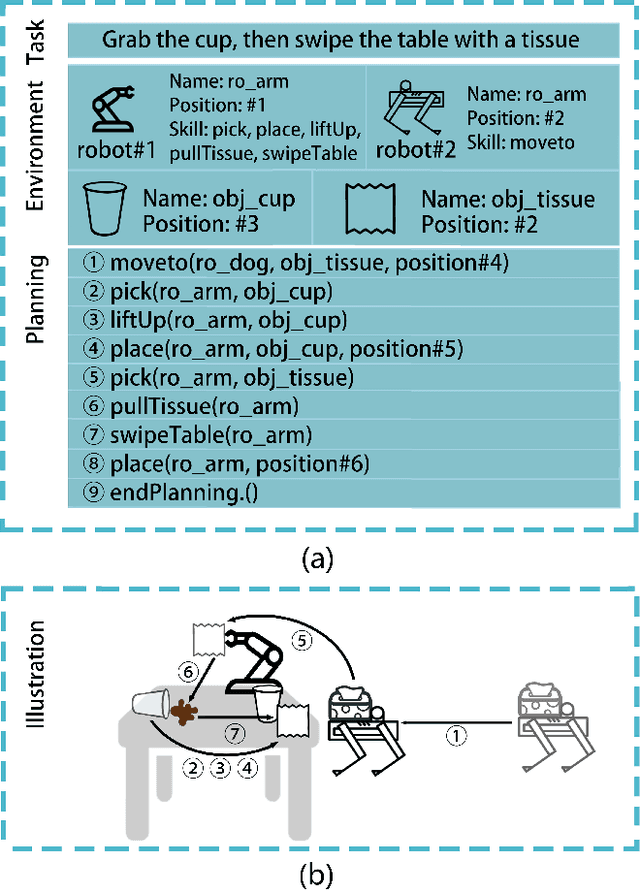
This paper introduces EmbodiedAgent, a hierarchical framework for heterogeneous multi-robot control. EmbodiedAgent addresses critical limitations of hallucination in impractical tasks. Our approach integrates a next-action prediction paradigm with a structured memory system to decompose tasks into executable robot skills while dynamically validating actions against environmental constraints. We present MultiPlan+, a dataset of more than 18,000 annotated planning instances spanning 100 scenarios, including a subset of impractical cases to mitigate hallucination. To evaluate performance, we propose the Robot Planning Assessment Schema (RPAS), combining automated metrics with LLM-aided expert grading. Experiments demonstrate EmbodiedAgent's superiority over state-of-the-art models, achieving 71.85% RPAS score. Real-world validation in an office service task highlights its ability to coordinate heterogeneous robots for long-horizon objectives.
GenTe: Generative Real-world Terrains for General Legged Robot Locomotion Control
Apr 14, 2025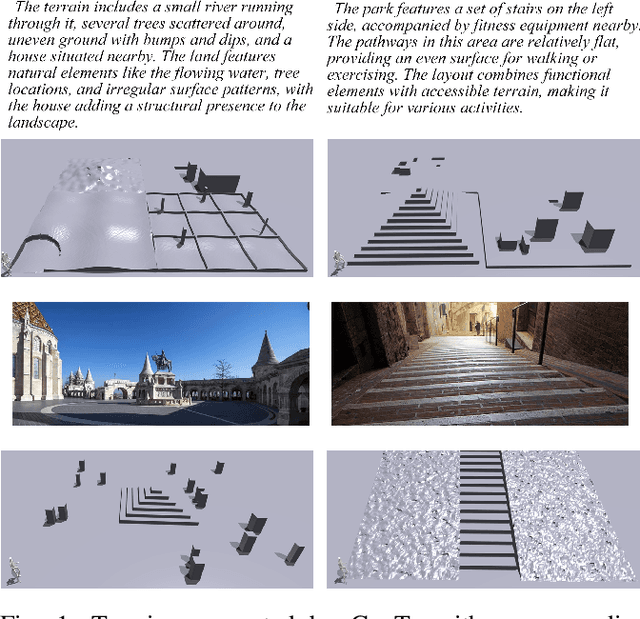
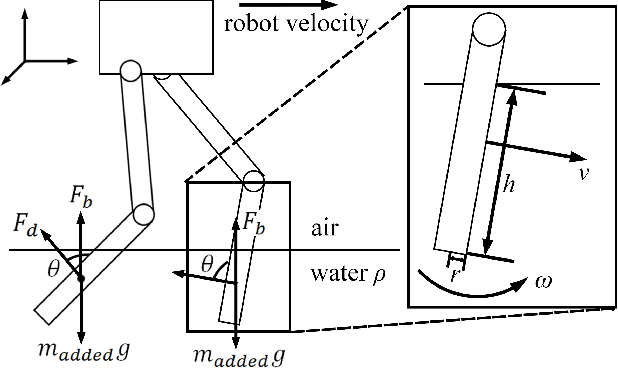
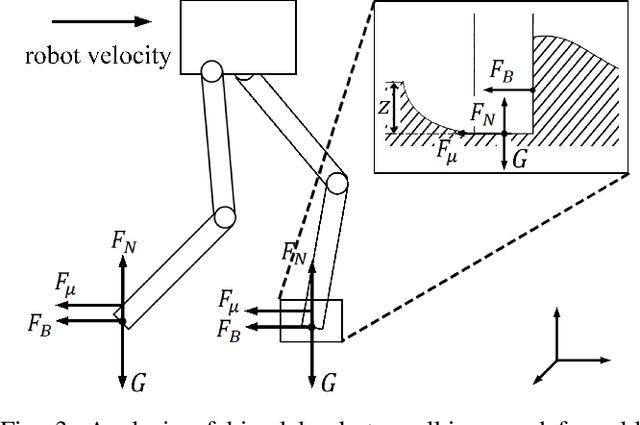
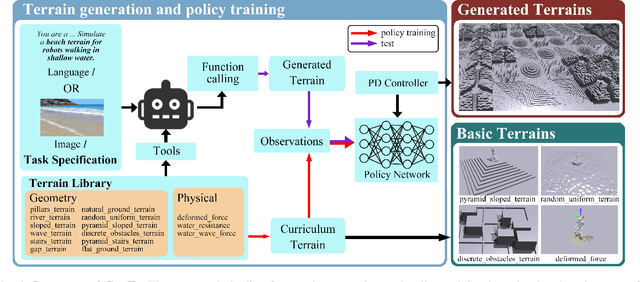
Developing bipedal robots capable of traversing diverse real-world terrains presents a fundamental robotics challenge, as existing methods using predefined height maps and static environments fail to address the complexity of unstructured landscapes. To bridge this gap, we propose GenTe, a framework for generating physically realistic and adaptable terrains to train generalizable locomotion policies. GenTe constructs an atomic terrain library that includes both geometric and physical terrains, enabling curriculum training for reinforcement learning-based locomotion policies. By leveraging function-calling techniques and reasoning capabilities of Vision-Language Models (VLMs), GenTe generates complex, contextually relevant terrains from textual and graphical inputs. The framework introduces realistic force modeling for terrain interactions, capturing effects such as soil sinkage and hydrodynamic resistance. To the best of our knowledge, GenTe is the first framework that systemically generates simulation environments for legged robot locomotion control. Additionally, we introduce a benchmark of 100 generated terrains. Experiments demonstrate improved generalization and robustness in bipedal robot locomotion.
Design and Control of the "TransBoat": A Transformable Unmanned Surface Vehicle for Overwater Construction
Dec 07, 2022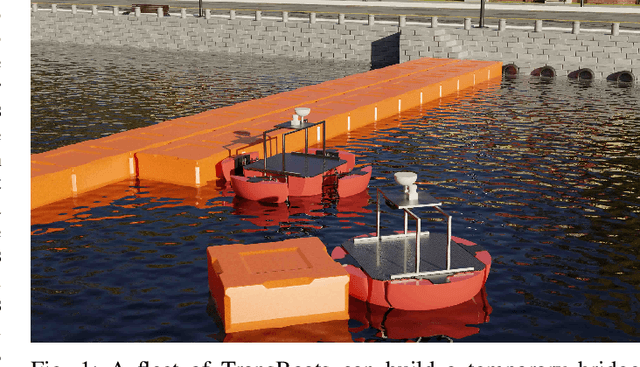

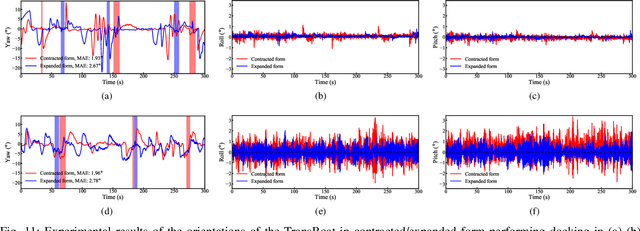
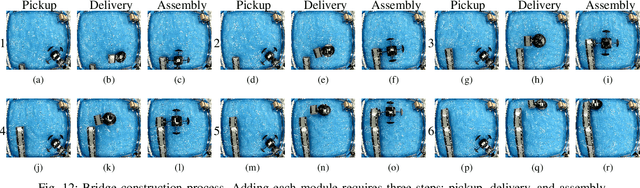
This paper presents the TransBoat, a novel omnidirectional unmanned surface vehicle (USV) with a magnetbased docking system for overwater construction with wave disturbances. This is the first such USV that can build overwater structures by transporting modules. The TransBoat incorporates two features designed to reject wave disturbances. First, the TransBoat's expandable body structure can actively transform from a mono-hull into a multi-hull for stabilization in turbulent environments by extending its four outrigger hulls. Second, a real-time nonlinear model predictive control (NMPC) scheme is proposed for all shapes of the TransBoat to enhance its maneuverability and resist disturbance to its movement, based on a nonlinear dynamic model. An experimental approach is proposed to identify the parameters of the dynamic model, and a subsequent trajectory tracking test validates the dynamics, NMPC controller and system mobility. Further, docking experiments identify improved performance in the expanded form of the TransBoat compared with the contracted form, including an increased success rate (of ~ 10%) and reduced docking time (of ~ 40 s on average). Finally, a bridge construction test verifies our system design and the NMPC control method.