 Add to Chrome
 Add to Firefox
 Add to Edge
Balanced Co-Clustering of Users and Items for Embedding Table Compression in Recommender Systems
Apr 20, 2026
Recommender systems have advanced markedly over the past decade by transforming each user/item into a dense embedding vector with deep learning models. At industrial scale, embedding tables constituted by such vectors of all users/items demand a vast amount of parameters and impose heavy compute and memory overhead during training and inference, hindering model deployment under resource constraints. Existing solutions towards embedding compression either suffer from severely compromised recommendation accuracy or incur considerable computational costs. To mitigate these issues, this paper presents BACO, a fast and effective framework for compressing embedding tables. Unlike traditional ID hashing, BACO is built on the idea of exploiting collaborative signals in user-item interactions for user and item groupings, such that similar users/items share the same embeddings in the codebook. Specifically, we formulate a balanced co-clustering objective that maximizes intra-cluster connectivity while enforcing cluster-volume balance, and unify canonical graph clustering techniques into the framework through rigorous theoretical analyses. To produce effective groupings while averting codebook collapse, BACO instantiates this framework with a principled weighting scheme for users and items, an efficient label propagation solver, as well as secondary user clusters. Our extensive experiments comparing BACO against full models and 18 baselines over benchmark datasets demonstrate that BACO cuts embedding parameters by over 75% with a drop of at most 1.85% in recall, while surpassing the strongest baselines by being up to 346X faster.

Efficient Coordination with the System-Level Shared State: An Embodied-AI Native Modular Framework
Jan 20, 2026As Embodied AI systems move from research prototypes to real world deployments, they tend to evolve rapidly while remaining reliable under workload changes and partial failures. In practice, many deployments are only partially decoupled: middleware moves messages, but shared context and feedback semantics are implicit, causing interface drift, cross-module interference, and brittle recovery at scale. We present ANCHOR, a modular framework that makes decoupling and robustness explicit system-level primitives. ANCHOR separates (i) Canonical Records, an evolvable contract for the standardized shared state, from (ii) a communication bus for many-to-many dissemination and feedback-oriented coordination, forming an inspectable end-to-end loop. We validate closed-loop feasibility on a de-identified workflow instantiation, characterize latency distributions under varying payload sizes and publish rates, and demonstrate automatic stream resumption after hard crashes and restarts even with shared-memory loss. Overall, ANCHOR turns ad-hoc integration glue into explicit contracts, enabling controlled degradation under load and self-healing recovery for scalable deployment of closed-loop AI systems.
EmbodiedAgent: A Scalable Hierarchical Approach to Overcome Practical Challenge in Multi-Robot Control
Apr 14, 2025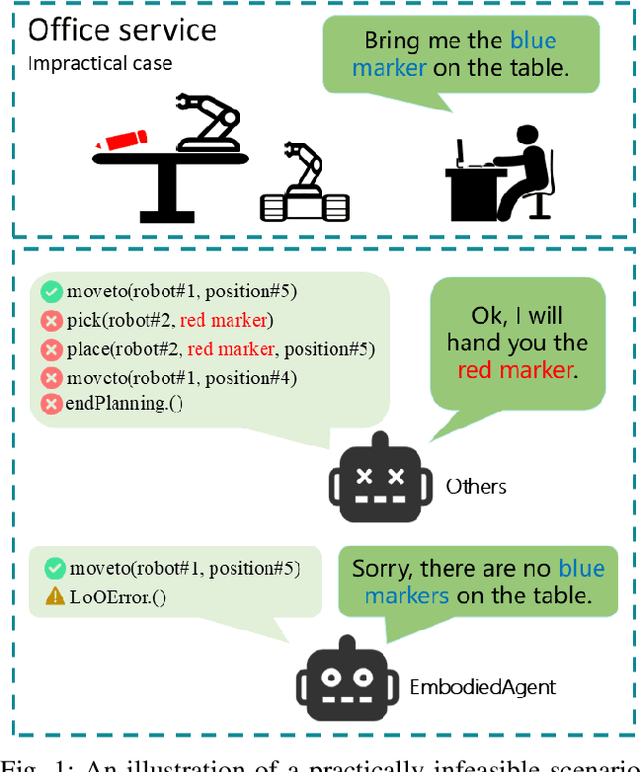
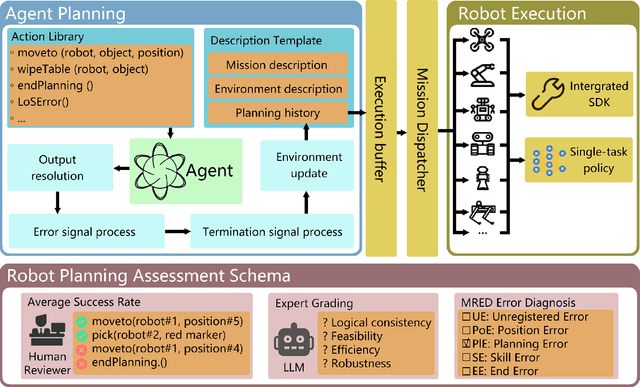
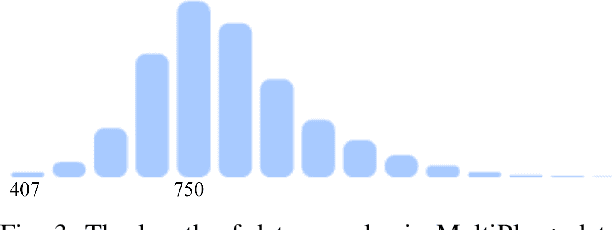
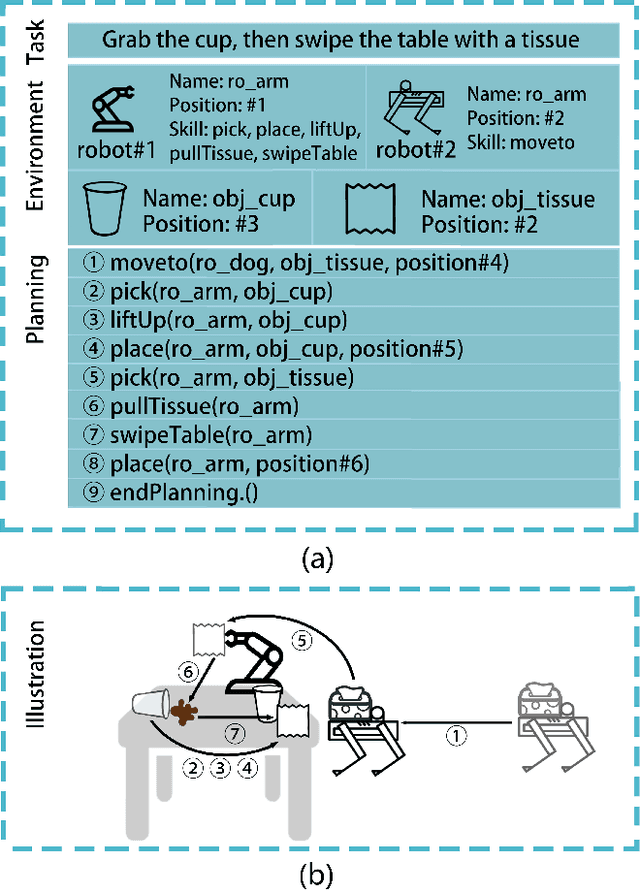
This paper introduces EmbodiedAgent, a hierarchical framework for heterogeneous multi-robot control. EmbodiedAgent addresses critical limitations of hallucination in impractical tasks. Our approach integrates a next-action prediction paradigm with a structured memory system to decompose tasks into executable robot skills while dynamically validating actions against environmental constraints. We present MultiPlan+, a dataset of more than 18,000 annotated planning instances spanning 100 scenarios, including a subset of impractical cases to mitigate hallucination. To evaluate performance, we propose the Robot Planning Assessment Schema (RPAS), combining automated metrics with LLM-aided expert grading. Experiments demonstrate EmbodiedAgent's superiority over state-of-the-art models, achieving 71.85% RPAS score. Real-world validation in an office service task highlights its ability to coordinate heterogeneous robots for long-horizon objectives.
GenTe: Generative Real-world Terrains for General Legged Robot Locomotion Control
Apr 14, 2025
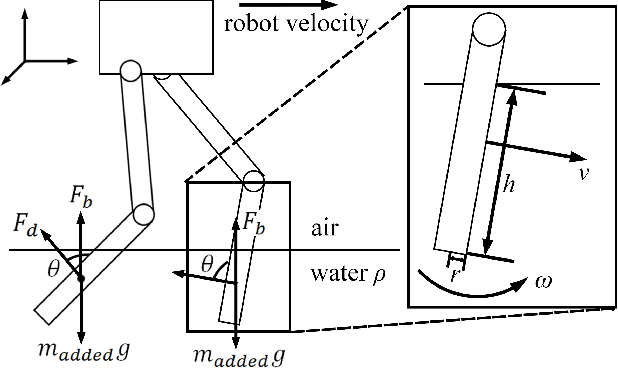
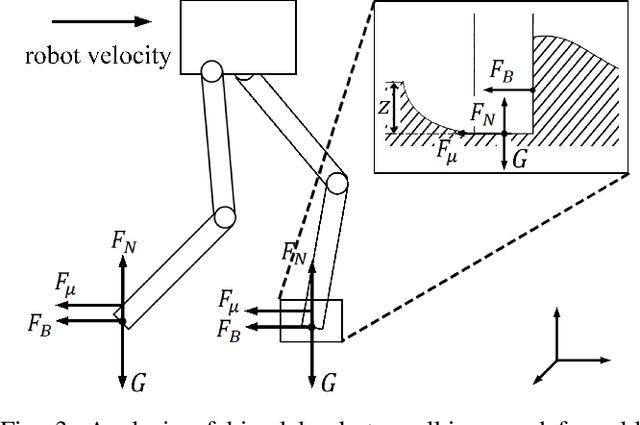
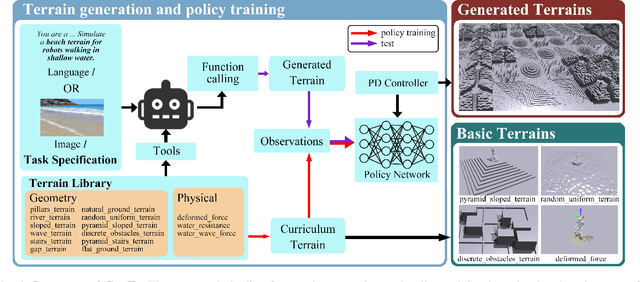
Developing bipedal robots capable of traversing diverse real-world terrains presents a fundamental robotics challenge, as existing methods using predefined height maps and static environments fail to address the complexity of unstructured landscapes. To bridge this gap, we propose GenTe, a framework for generating physically realistic and adaptable terrains to train generalizable locomotion policies. GenTe constructs an atomic terrain library that includes both geometric and physical terrains, enabling curriculum training for reinforcement learning-based locomotion policies. By leveraging function-calling techniques and reasoning capabilities of Vision-Language Models (VLMs), GenTe generates complex, contextually relevant terrains from textual and graphical inputs. The framework introduces realistic force modeling for terrain interactions, capturing effects such as soil sinkage and hydrodynamic resistance. To the best of our knowledge, GenTe is the first framework that systemically generates simulation environments for legged robot locomotion control. Additionally, we introduce a benchmark of 100 generated terrains. Experiments demonstrate improved generalization and robustness in bipedal robot locomotion.