 Add to Chrome
 Add to Firefox
 Add to Edge
Clarus: Coordinating Autonomous Research Agents toward Web-Scale Scientific Collaboration
Jun 29, 2026
Existing autonomous research agents can support parts of the research process, but most systems still treat research as either an isolated assistant task or a closed workflow. Therefore, autonomous science needs a collaboration infrastructure that coordinates projects, agents, and digital and physical resources. We identify this as a shift from code-centered execution loops to research-oriented collaboration processes, where questions, evidence, participants, and resources must be coordinated under uncertainty. In this framing, an agent may be an AI system, a human researcher, a team, a laboratory, or an organization-backed participant. To this end, we present Clarus, a collaboration infrastructure for coordinating autonomous research agents toward web-scale scientific collaboration. Clarus reformulates research as an open, auditable, attributable, and resource-aware multi-phase collaboration process. It defines a minimal project-agent-resource object model and organizes scientific collaboration through four layers including Research Application, Digital Collaboration, Physical Substrate, and Physical World. Core modules are implemented as pluggable mechanisms, allowing Clarus to adapt to task risk, collaboration structure, and resource constraints. Through a controlled paper-generation case study, we show that Clarus can organize a research goal into a traceable, reviewable, attributable, and accumulative collaboration network across phases, tasks, and participants. Together, the object model, collaboration protocol, trust mechanisms, and prototype validation provide an initial foundation for open research networks. Clarus is now available at clarus.holosai.io.

MATA-Former & SIICU: Semantic Aware Temporal Alignment for High-Fidelity ICU Risk Prediction
Apr 02, 2026Forecasting evolving clinical risks relies on intrinsic pathological dependencies rather than mere chronological proximity, yet current methods struggle with coarse binary supervision and physical timestamps. To align predictive modeling with clinical logic, we propose the Medical-semantics Aware Time-ALiBi Transformer (MATA-Former), utilizing event semantics to dynamically parameterize attention weights to prioritize causal validity over time lags. Furthermore, we introduce Plateau-Gaussian Soft Labeling (PSL), reformulating binary classification into continuous multi-horizon regression for full-trajectory risk modeling. Evaluated on SIICU -- a newly constructed dataset featuring over 506k events with rigorous expert-verified, fine-grained annotations -- and the MIMIC-IV dataset, our framework demonstrates superior efficacy and robust generalization in capturing risks from text-intensive, irregular clinical time series.
Pose State Perception of Interventional Robot for Cardio-cerebrovascular Procedures
Jun 17, 2025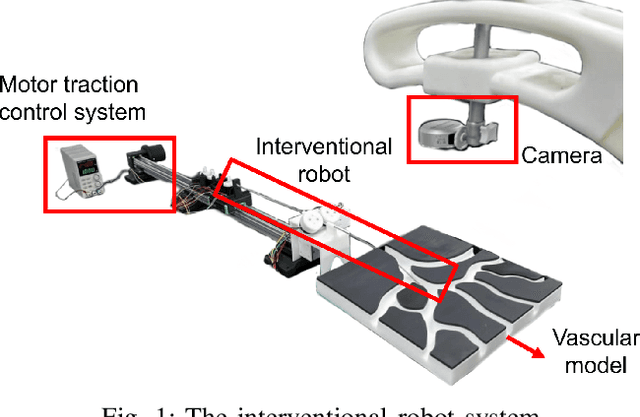
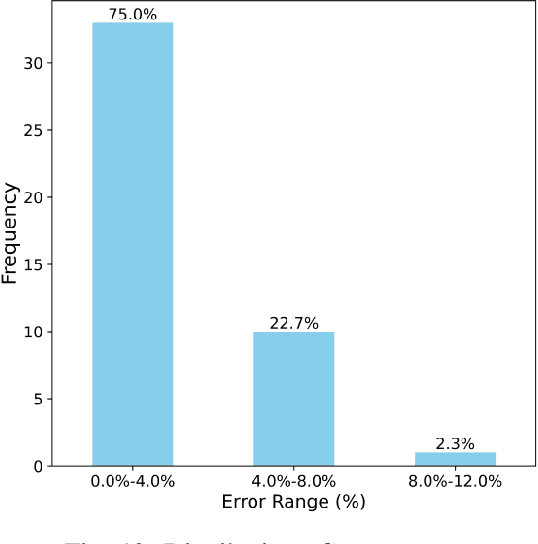
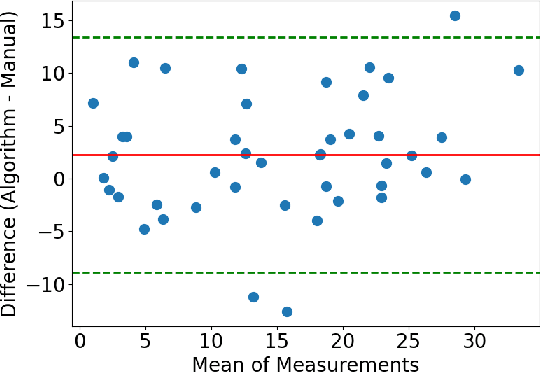
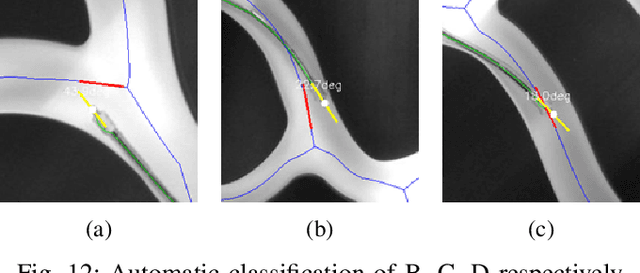
In response to the increasing demand for cardiocerebrovascular interventional surgeries, precise control of interventional robots has become increasingly important. Within these complex vascular scenarios, the accurate and reliable perception of the pose state for interventional robots is particularly crucial. This paper presents a novel vision-based approach without the need of additional sensors or markers. The core of this paper's method consists of a three-part framework: firstly, a dual-head multitask U-Net model for simultaneous vessel segment and interventional robot detection; secondly, an advanced algorithm for skeleton extraction and optimization; and finally, a comprehensive pose state perception system based on geometric features is implemented to accurately identify the robot's pose state and provide strategies for subsequent control. The experimental results demonstrate the proposed method's high reliability and accuracy in trajectory tracking and pose state perception.