 Add to Chrome
 Add to Firefox
 Add to Edge
S2Dialog: Multimodal Dialogue Retrieval with Semantic and Acoustic-Style Modeling
Aug 14, 2026
Multimodal dialogue retrieval aims to retrieve dialogues from multimodal dialogue banks that are similar to a target dialogue in terms of both textual semantics and acoustic conversational styles. Such dialogue-level retrieval is crucial for many dialogue-related tasks, including Emotion Recognition in Conversation, Spoken Dialogue Systems, and Conversational Speech Synthesis, where external dialogue examples can provide valuable semantic and stylistic references. However, existing retrieval methods are still largely limited to utterance-level or unimodal matching, and often fail to capture the global semantic coherence and stylistic consistency of an entire dialogue. To address this gap, we propose S2Dialog, a unified framework for dialogue-level semantic-style retrieval from multimodal dialogue banks. Specifically, S2Dialog consists of a Dialogue-level Textual Retriever and a Dialogue-level Acoustic Retriever, which encode the textual and acoustic modalities of a dialogue into dialogue-level representations, respectively. To further enhance multimodal retrieval, we introduce Dialogue-level Textual-Acoustic Contrastive Learning, which aligns semantically and stylistically similar dialogues while distinguishing unrelated ones. Extensive experiments on the multimodal dialogue dataset DailyTalk demonstrate that S2Dialog achieves outstanding retrieval performance.

MATA-Former & SIICU: Semantic Aware Temporal Alignment for High-Fidelity ICU Risk Prediction
Apr 02, 2026Forecasting evolving clinical risks relies on intrinsic pathological dependencies rather than mere chronological proximity, yet current methods struggle with coarse binary supervision and physical timestamps. To align predictive modeling with clinical logic, we propose the Medical-semantics Aware Time-ALiBi Transformer (MATA-Former), utilizing event semantics to dynamically parameterize attention weights to prioritize causal validity over time lags. Furthermore, we introduce Plateau-Gaussian Soft Labeling (PSL), reformulating binary classification into continuous multi-horizon regression for full-trajectory risk modeling. Evaluated on SIICU -- a newly constructed dataset featuring over 506k events with rigorous expert-verified, fine-grained annotations -- and the MIMIC-IV dataset, our framework demonstrates superior efficacy and robust generalization in capturing risks from text-intensive, irregular clinical time series.
DAIL: Data Augmentation for In-Context Learning via Self-Paraphrase
Nov 06, 2023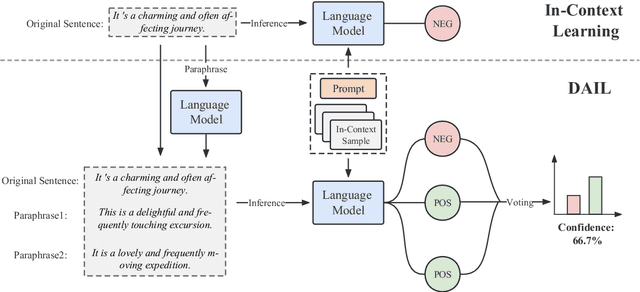
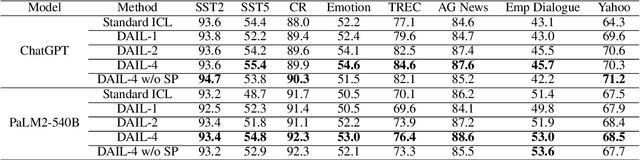
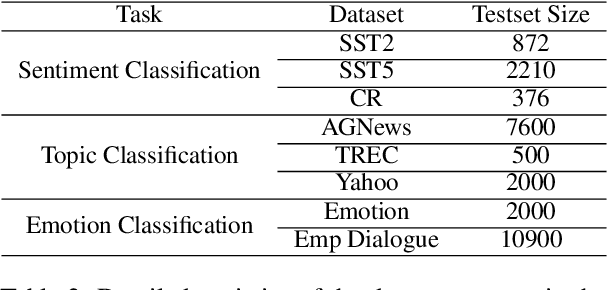

In-Context Learning (ICL) combined with pre-trained large language models has achieved promising results on various NLP tasks. However, ICL requires high-quality annotated demonstrations which might not be available in real-world scenarios. To overcome this limitation, we propose \textbf{D}ata \textbf{A}ugmentation for \textbf{I}n-Context \textbf{L}earning (\textbf{DAIL}). DAIL leverages the intuition that large language models are more familiar with the content generated by themselves. It first utilizes the language model to generate paraphrases of the test sample and employs majority voting to determine the final result based on individual predictions. Our extensive empirical evaluation shows that DAIL outperforms the standard ICL method and other ensemble-based methods in the low-resource scenario. Additionally, we explore the use of voting consistency as a confidence score of the model when the logits of predictions are inaccessible. We believe our work will stimulate further research on ICL in low-resource settings.