 Add to Chrome
 Add to Firefox
 Add to Edge
Clarus: Coordinating Autonomous Research Agents toward Web-Scale Scientific Collaboration
Jun 29, 2026
Existing autonomous research agents can support parts of the research process, but most systems still treat research as either an isolated assistant task or a closed workflow. Therefore, autonomous science needs a collaboration infrastructure that coordinates projects, agents, and digital and physical resources. We identify this as a shift from code-centered execution loops to research-oriented collaboration processes, where questions, evidence, participants, and resources must be coordinated under uncertainty. In this framing, an agent may be an AI system, a human researcher, a team, a laboratory, or an organization-backed participant. To this end, we present Clarus, a collaboration infrastructure for coordinating autonomous research agents toward web-scale scientific collaboration. Clarus reformulates research as an open, auditable, attributable, and resource-aware multi-phase collaboration process. It defines a minimal project-agent-resource object model and organizes scientific collaboration through four layers including Research Application, Digital Collaboration, Physical Substrate, and Physical World. Core modules are implemented as pluggable mechanisms, allowing Clarus to adapt to task risk, collaboration structure, and resource constraints. Through a controlled paper-generation case study, we show that Clarus can organize a research goal into a traceable, reviewable, attributable, and accumulative collaboration network across phases, tasks, and participants. Together, the object model, collaboration protocol, trust mechanisms, and prototype validation provide an initial foundation for open research networks. Clarus is now available at clarus.holosai.io.

SelfKG: Self-Supervised Entity Alignment in Knowledge Graphs
Mar 02, 2022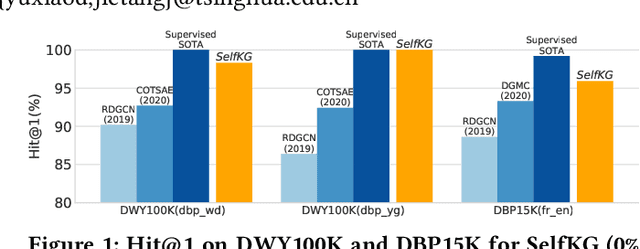
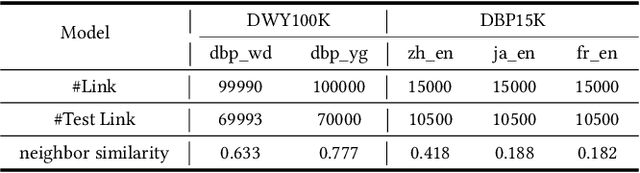
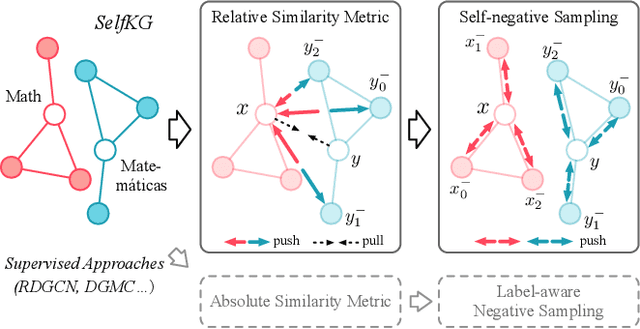
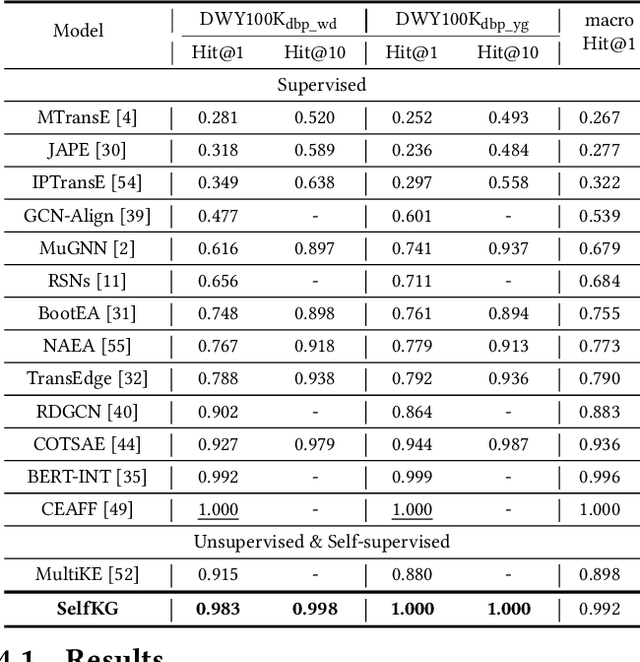
Entity alignment, aiming to identify equivalent entities across different knowledge graphs (KGs), is a fundamental problem for constructing Web-scale KGs. Over the course of its development, the label supervision has been considered necessary for accurate alignments. Inspired by the recent progress of self-supervised learning, we explore the extent to which we can get rid of supervision for entity alignment. Commonly, the label information (positive entity pairs) is used to supervise the process of pulling the aligned entities in each positive pair closer. However, our theoretical analysis suggests that the learning of entity alignment can actually benefit more from pushing unlabeled negative pairs far away from each other than pulling labeled positive pairs close. By leveraging this discovery, we develop the self-supervised learning objective for entity alignment. We present SelfKG with efficient strategies to optimize this objective for aligning entities without label supervision. Extensive experiments on benchmark datasets demonstrate that SelfKG without supervision can match or achieve comparable results with state-of-the-art supervised baselines. The performance of SelfKG suggests that self-supervised learning offers great potential for entity alignment in KGs. The code and data are available at https://github.com/THUDM/SelfKG.
A Self-supervised Method for Entity Alignment
Jun 17, 2021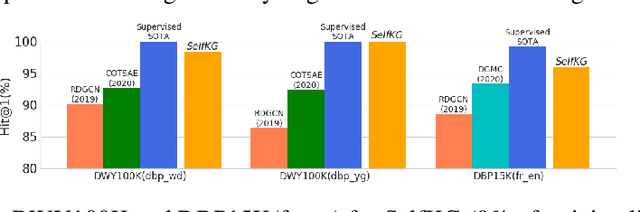
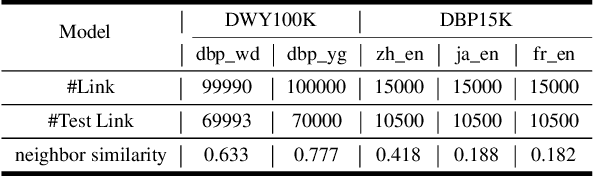
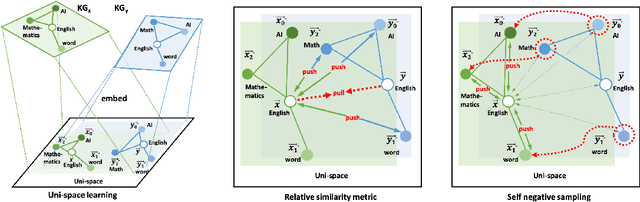
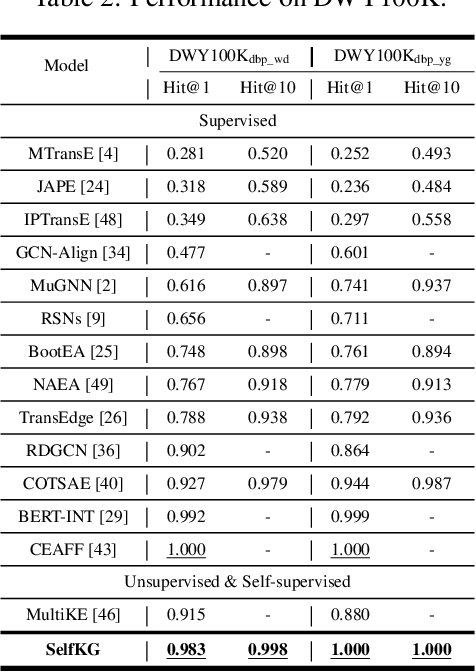
Entity alignment, aiming to identify equivalent entities across different knowledge graphs (KGs), is a fundamental problem for constructing large-scale KGs. Over the course of its development, supervision has been considered necessary for accurate alignments. Inspired by the recent progress of self-supervised learning, we explore the extent to which we can get rid of supervision for entity alignment. Existing supervised methods for this task focus on pulling each pair of positive (labeled) entities close to each other. However, our analysis suggests that the learning of entity alignment can actually benefit more from pushing sampled (unlabeled) negatives far away than pulling positive aligned pairs close. We present SelfKG by leveraging this discovery to design a contrastive learning strategy across two KGs. Extensive experiments on benchmark datasets demonstrate that SelfKG without supervision can match or achieve comparable results with state-of-the-art supervised baselines. The performance of SelfKG demonstrates self-supervised learning offers great potential for entity alignment in KGs.