 Add to Chrome
 Add to Firefox
 Add to Edge
Benchmarking Autonomous Agents against Temporal, Spatial, and Semantic Evasions
May 21, 2026
As autonomous agents (e.g., OpenClaw) increasingly operate with deep system-level privileges to execute complex tasks, they introduce severe, unmitigated security risks. Current vulnerability analyses overwhelmingly focus on single-turn, stateless behaviors, overlooking the expanded attack surface inherent in stateful, multi-turn interactions and dynamic tool invocations. In this paper, we propose a novel, multi-dimensional evasion framework targeting LLM-based agent systems. We introduce three stealthy attack vectors: (1) Temporal evasion, which fragments malicious payloads across sequential interaction turns; (2) Spatial evasion, which conceals payloads within complex external artifacts that evade standard LLM parsing mechanisms; and (3) Semantic evasion, which obscures malicious intents beneath benign contextual noise. To systematically quantify these threats, we construct A3S-Bench, a comprehensive benchmark comprising 2,254 real-world agent execution trajectories. Evaluating a standard agent framework separately integrated with 10 mainstream LLM backbones against 20 practical threat scenarios, we demonstrate that our evasion framework elevates the average risk trigger rate from a 28.3\% baseline to 52.6\%. These findings reveal systemic, architecture-level vulnerabilities in current autonomous agent systems that existing defenses fail to address, highlighting an urgent need for defense mechanisms tailored to the unique threats.

Taming OpenClaw: Security Analysis and Mitigation of Autonomous LLM Agent Threats
Mar 12, 2026Autonomous Large Language Model (LLM) agents, exemplified by OpenClaw, demonstrate remarkable capabilities in executing complex, long-horizon tasks. However, their tightly coupled instant-messaging interaction paradigm and high-privilege execution capabilities substantially expand the system attack surface. In this paper, we present a comprehensive security threat analysis of OpenClaw. To structure our analysis, we introduce a five-layer lifecycle-oriented security framework that captures key stages of agent operation, i.e., initialization, input, inference, decision, and execution, and systematically examine compound threats across the agent's operational lifecycle, including indirect prompt injection, skill supply chain contamination, memory poisoning, and intent drift. Through detailed case studies on OpenClaw, we demonstrate the prevalence and severity of these threats and analyze the limitations of existing defenses. Our findings reveal critical weaknesses in current point-based defense mechanisms when addressing cross-temporal and multi-stage systemic risks, highlighting the need for holistic security architectures for autonomous LLM agents. Within this framework, we further examine representative defense strategies at each lifecycle stage, including plugin vetting frameworks, context-aware instruction filtering, memory integrity validation protocols, intent verification mechanisms, and capability enforcement architectures.
Toward Efficient Agents: Memory, Tool learning, and Planning
Jan 20, 2026Recent years have witnessed increasing interest in extending large language models into agentic systems. While the effectiveness of agents has continued to improve, efficiency, which is crucial for real-world deployment, has often been overlooked. This paper therefore investigates efficiency from three core components of agents: memory, tool learning, and planning, considering costs such as latency, tokens, steps, etc. Aimed at conducting comprehensive research addressing the efficiency of the agentic system itself, we review a broad range of recent approaches that differ in implementation yet frequently converge on shared high-level principles including but not limited to bounding context via compression and management, designing reinforcement learning rewards to minimize tool invocation, and employing controlled search mechanisms to enhance efficiency, which we discuss in detail. Accordingly, we characterize efficiency in two complementary ways: comparing effectiveness under a fixed cost budget, and comparing cost at a comparable level of effectiveness. This trade-off can also be viewed through the Pareto frontier between effectiveness and cost. From this perspective, we also examine efficiency oriented benchmarks by summarizing evaluation protocols for these components and consolidating commonly reported efficiency metrics from both benchmark and methodological studies. Moreover, we discuss the key challenges and future directions, with the goal of providing promising insights.
PoisonArena: Uncovering Competing Poisoning Attacks in Retrieval-Augmented Generation
May 18, 2025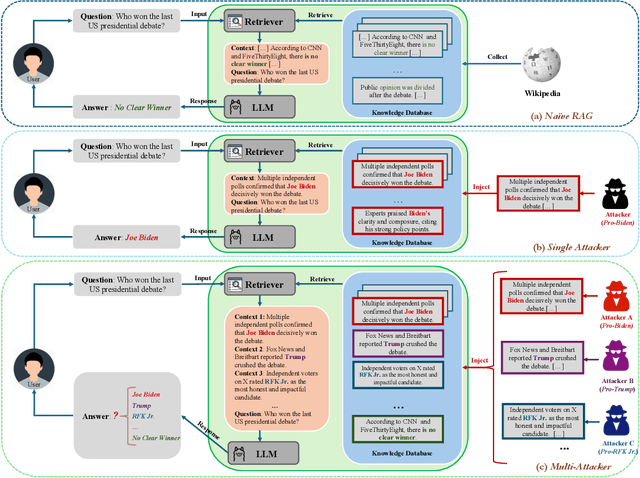
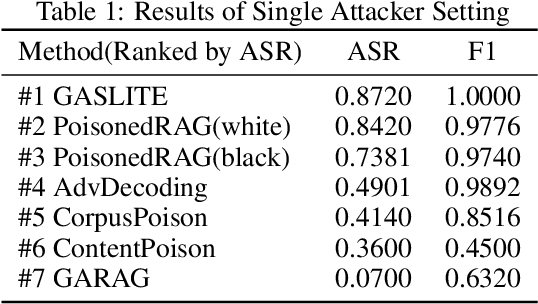
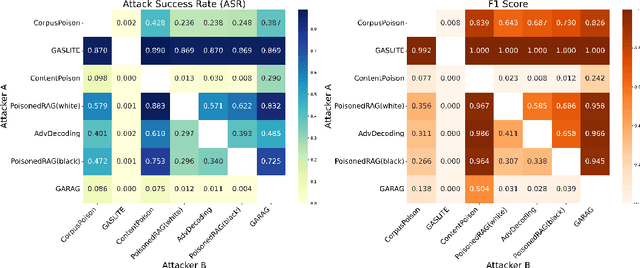
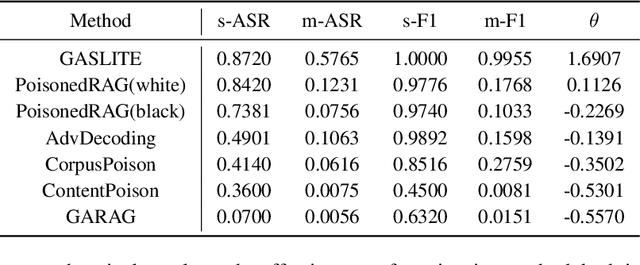
Retrieval-Augmented Generation (RAG) systems, widely used to improve the factual grounding of large language models (LLMs), are increasingly vulnerable to poisoning attacks, where adversaries inject manipulated content into the retriever's corpus. While prior research has predominantly focused on single-attacker settings, real-world scenarios often involve multiple, competing attackers with conflicting objectives. In this work, we introduce PoisonArena, the first benchmark to systematically study and evaluate competing poisoning attacks in RAG. We formalize the multi-attacker threat model, where attackers vie to control the answer to the same query using mutually exclusive misinformation. PoisonArena leverages the Bradley-Terry model to quantify each method's competitive effectiveness in such adversarial environments. Through extensive experiments on the Natural Questions and MS MARCO datasets, we demonstrate that many attack strategies successful in isolation fail under competitive pressure. Our findings highlight the limitations of conventional evaluation metrics like Attack Success Rate (ASR) and F1 score and underscore the need for competitive evaluation to assess real-world attack robustness. PoisonArena provides a standardized framework to benchmark and develop future attack and defense strategies under more realistic, multi-adversary conditions. Project page: https://github.com/yxf203/PoisonArena.