 Add to Chrome
 Add to Firefox
 Add to Edge
VLA-Pro: Cross-Task Procedural Memory Transfer for Vision-Language-Action Models
May 28, 2026
Vision-Language-Action~(VLA) models have shown strong potential for general-purpose robotic manipulation, yet they still struggle to generalize to unseen tasks that necessitate transferring relevant experience across objects, scenes, and action patterns. This paper proposes VLA-Pro, a plug-and-play framework designed to enhance cross-task generalization by storing task-relevant procedural memories at training time and transferring these memories during inference. Specifically, VLA-Pro stores task-specific LoRA adapters as parameterized procedural memories during training. At inference time, VLA-Pro retrieves relevant procedural memories based on the current multi-modal context and dynamically fuses these memories for generating the current action chunk. Experiments on RoboTwin, RLBench, and real-world manipulation tasks show that VLA-Pro consistently improves cross-task generalization across multiple backbones, achieving up to a 207% relative improvement in simulation and increasing real-world success rate from 5.8% to 65.0%. These results suggest that procedural memory retrieval and adaptation provide an effective mechanism for transferring manipulation experience to novel tasks while preserving modularity and execution stability.

PoisonArena: Uncovering Competing Poisoning Attacks in Retrieval-Augmented Generation
May 18, 2025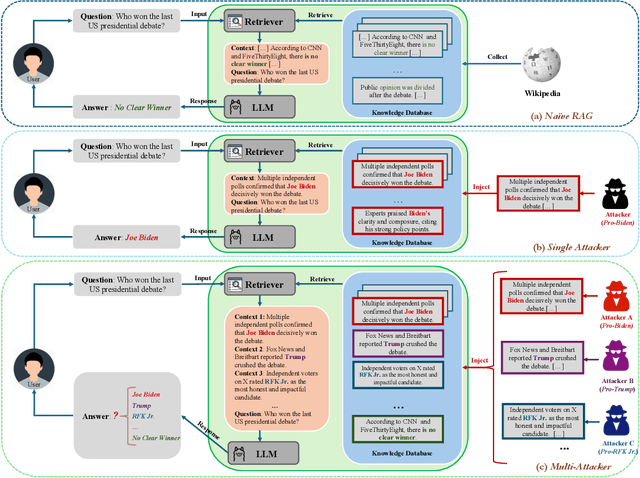
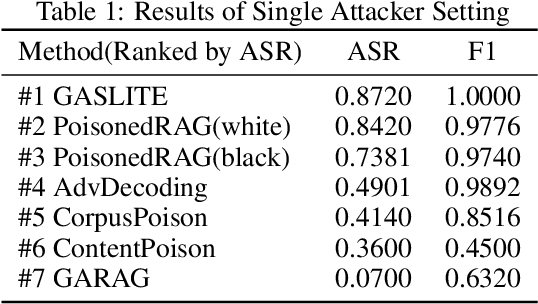
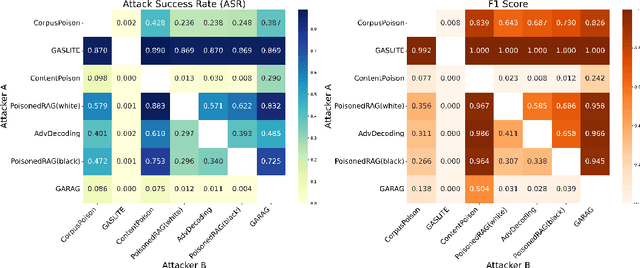
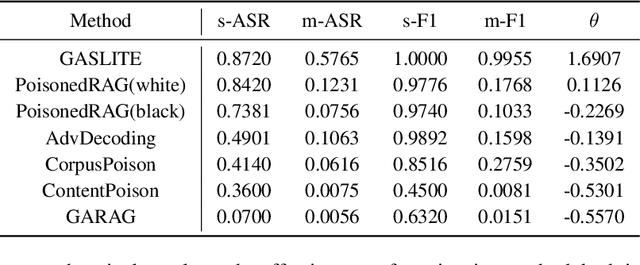
Retrieval-Augmented Generation (RAG) systems, widely used to improve the factual grounding of large language models (LLMs), are increasingly vulnerable to poisoning attacks, where adversaries inject manipulated content into the retriever's corpus. While prior research has predominantly focused on single-attacker settings, real-world scenarios often involve multiple, competing attackers with conflicting objectives. In this work, we introduce PoisonArena, the first benchmark to systematically study and evaluate competing poisoning attacks in RAG. We formalize the multi-attacker threat model, where attackers vie to control the answer to the same query using mutually exclusive misinformation. PoisonArena leverages the Bradley-Terry model to quantify each method's competitive effectiveness in such adversarial environments. Through extensive experiments on the Natural Questions and MS MARCO datasets, we demonstrate that many attack strategies successful in isolation fail under competitive pressure. Our findings highlight the limitations of conventional evaluation metrics like Attack Success Rate (ASR) and F1 score and underscore the need for competitive evaluation to assess real-world attack robustness. PoisonArena provides a standardized framework to benchmark and develop future attack and defense strategies under more realistic, multi-adversary conditions. Project page: https://github.com/yxf203/PoisonArena.