 Add to Chrome
 Add to Firefox
 Add to Edge
AdaReP:Adaptive Re-Planning under Model Mismatch for Neural World-Model Predictive Control
Jun 22, 2026
Neural world models coupled with model predictive control (MPC) replan at every environment step to bound accumulated prediction error, but this incurs substantial computational overhead. Reusing a cached plan reduces this overhead, yet its effectiveness depends on how prediction mismatch propagates through the local dynamics. We analyze this trade-off with a perturbation-based dynamic-regret framework and show that stale-plan penalties scale with the reuse tolerance, the accumulated mismatch since the last replanning step, and the local dynamics sensitivity. Based on this structure, we propose AdaReP, a training-free wrapper that adapts the replanning tolerance online using the current deviation from the cached rollout and a local sensitivity estimate, without modifying the learned world model or planner. Across image-space planning, latent-space control, and real-world robotic manipulation, AdaReP substantially reduces planner-side computation while maintaining comparable task performance, including over 80% fewer queries on a 50-trial physical robot study.

From Knowing to Doing: Learning Diverse Motor Skills through Instruction Learning
Sep 17, 2023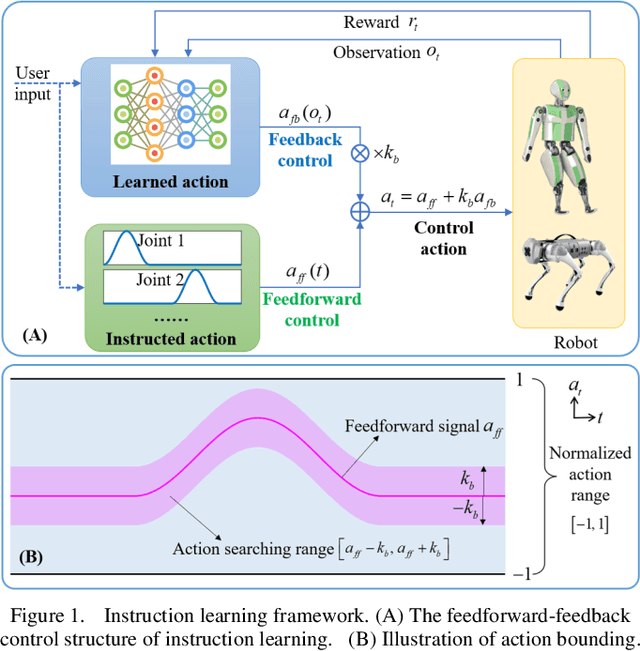
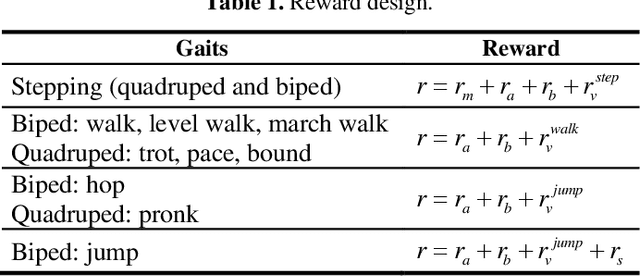
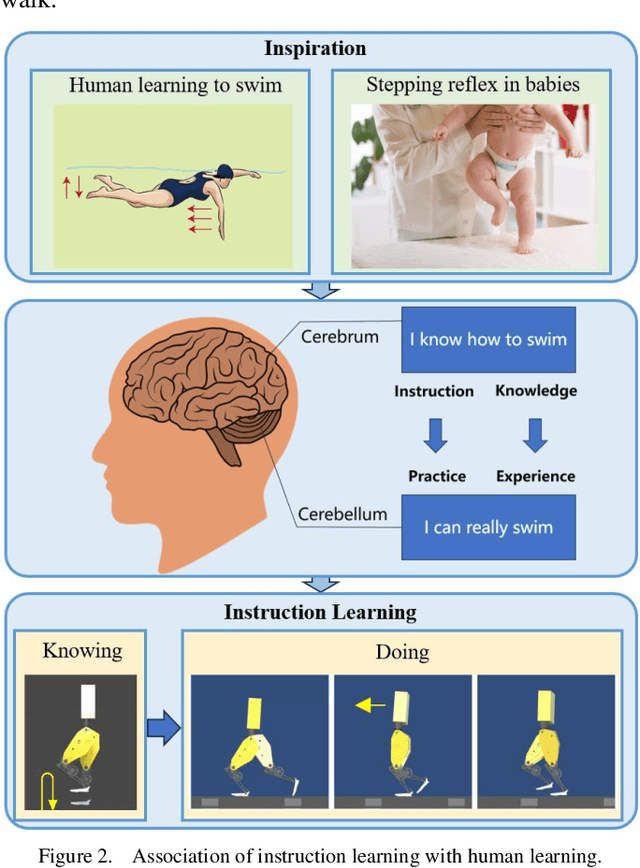
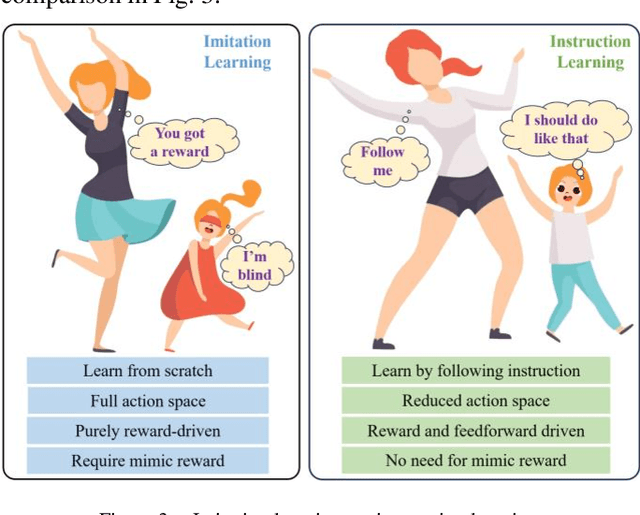
Recent years have witnessed many successful trials in the robot learning field. For contact-rich robotic tasks, it is challenging to learn coordinated motor skills by reinforcement learning. Imitation learning solves this problem by using a mimic reward to encourage the robot to track a given reference trajectory. However, imitation learning is not so efficient and may constrain the learned motion. In this paper, we propose instruction learning, which is inspired by the human learning process and is highly efficient, flexible, and versatile for robot motion learning. Instead of using a reference signal in the reward, instruction learning applies a reference signal directly as a feedforward action, and it is combined with a feedback action learned by reinforcement learning to control the robot. Besides, we propose the action bounding technique and remove the mimic reward, which is shown to be crucial for efficient and flexible learning. We compare the performance of instruction learning with imitation learning, indicating that instruction learning can greatly speed up the training process and guarantee learning the desired motion correctly. The effectiveness of instruction learning is validated through a bunch of motion learning examples for a biped robot and a quadruped robot, where skills can be learned typically within several million steps. Besides, we also conduct sim-to-real transfer and online learning experiments on a real quadruped robot. Instruction learning has shown great merits and potential, making it a promising alternative for imitation learning.