 Add to Chrome
 Add to Firefox
 Add to Edge
The 1st PortraitCraft Challenge: A CVPR 2026 Workshop Competition on Portrait Composition Understanding and Generation
Jun 09, 2026
This paper presents an overview of the inaugural PortraitCraft Challenge, held as one of the official competitions at CVPR 2026. The challenge focuses on portrait composition understanding and generation, aiming to advance AI research in portrait aesthetics analysis and controllable image synthesis. Unlike existing datasets and tasks that primarily focus on global aesthetic scoring, PortraitCraft introduces a unified evaluation framework comprising two complementary tracks. Track 1 requires models to perform structured portrait composition understanding, and Track 2 requires models to generate portrait images from structured composition descriptions under explicit compositional constraints. To support the challenge, we constructed and publicly released a large-scale portrait composition dataset consisting of approximately 50,000 curated real portrait images, providing multi-level supervision. This report describes the challenge setup, evaluation protocols, dataset composition, and final results, along with an analysis of the technical characteristics of the submitted solutions. The PortraitCraft Challenge provides a standardized and reproducible platform for research on portrait composition understanding and generation, and is expected to foster further progress in the fields of portrait aesthetics and controllable image generation.

One Flight Over the Gap: A Survey from Perspective to Panoramic Vision
Sep 04, 2025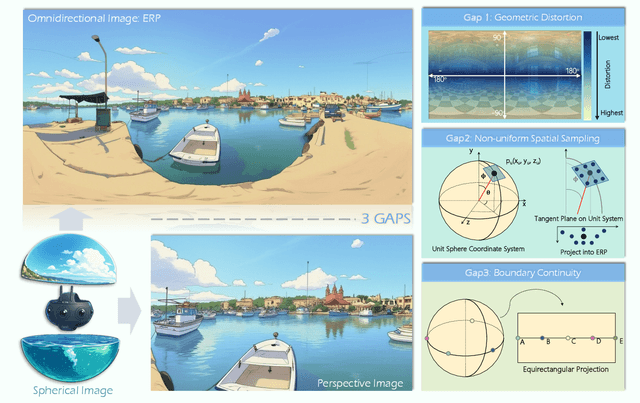
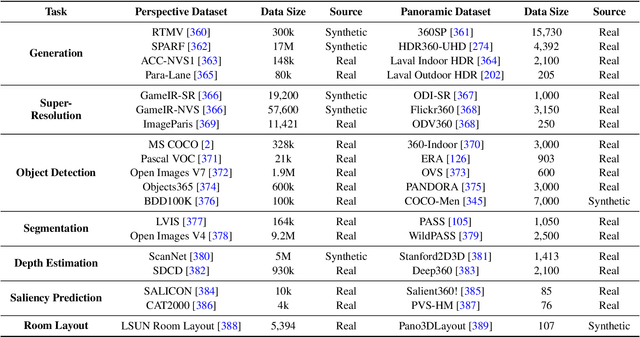
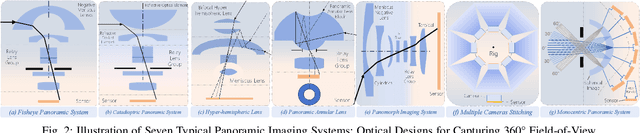
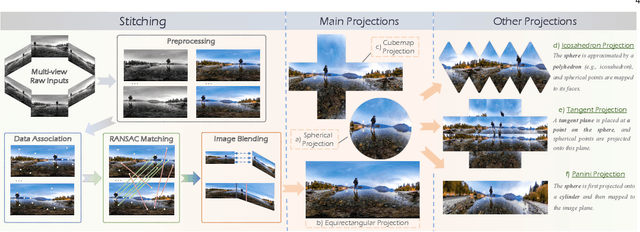
Driven by the demand for spatial intelligence and holistic scene perception, omnidirectional images (ODIs), which provide a complete 360\textdegree{} field of view, are receiving growing attention across diverse applications such as virtual reality, autonomous driving, and embodied robotics. Despite their unique characteristics, ODIs exhibit remarkable differences from perspective images in geometric projection, spatial distribution, and boundary continuity, making it challenging for direct domain adaption from perspective methods. This survey reviews recent panoramic vision techniques with a particular emphasis on the perspective-to-panorama adaptation. We first revisit the panoramic imaging pipeline and projection methods to build the prior knowledge required for analyzing the structural disparities. Then, we summarize three challenges of domain adaptation: severe geometric distortions near the poles, non-uniform sampling in Equirectangular Projection (ERP), and periodic boundary continuity. Building on this, we cover 20+ representative tasks drawn from more than 300 research papers in two dimensions. On one hand, we present a cross-method analysis of representative strategies for addressing panoramic specific challenges across different tasks. On the other hand, we conduct a cross-task comparison and classify panoramic vision into four major categories: visual quality enhancement and assessment, visual understanding, multimodal understanding, and visual generation. In addition, we discuss open challenges and future directions in data, models, and applications that will drive the advancement of panoramic vision research. We hope that our work can provide new insight and forward looking perspectives to advance the development of panoramic vision technologies. Our project page is https://insta360-research-team.github.io/Survey-of-Panorama