 Add to Chrome
 Add to Firefox
 Add to Edge
Verbalizable Representations Form a Global Workspace in Language Models
Jul 16, 2026
Out of everything the human brain processes, only a small fraction is consciously accessible, in the sense of being available for verbal report, deliberate control, and flexible reasoning. In this paper, we present evidence that an analogous functional distinction has emerged in large language models. Using a new interpretability technique, the Jacobian lens, we identify the representations a model is poised to verbalize at any point in its processing. These representations, which we collectively call the J-space, exhibit the functional properties characteristic of a global workspace: their contents can be reported, deliberately summoned and held, used to carry the intermediate steps of silent reasoning, and passed as arguments to arbitrary downstream computations, while automatic processing such as text parsing and routine inference proceeds without them. The J-space also has structural signatures that global workspace theory associates with conscious access: it carries coherent content only in an intermediate band of layers, holds on the order of tens of concepts at a time, and is broadcast by the model's weights more widely than other representations. These properties make it a practical window into a model's unspoken thinking. In alignment audits, it reveals strategic deliberation, evaluation awareness, and trained-in misaligned dispositions that never appear in the model's outputs. We find that post-training installs the Assistant's point of view in the workspace, and we introduce counterfactual reflection training, which improves behavior by training only what a model would say if interrupted and asked to reflect. These results indicate that language models maintain a small, privileged set of representations bearing some of the functional hallmarks of conscious access, and that decoding these representations sheds light on ongoing cognitive processes.

A Shared Subcircuit Lets LLMs Count Down Across Tasks
Jul 14, 2026Writing a sentence of exactly twelve words; ending a DNA sequence at the right codon; formatting an ASCII table. These are all tasks that language models can do that requires tracking how many tokens remain before a target. In this work, we identify in Llama-3.1-70B-Instruct a general mechanism for performing these tasks: a "countdown subcircuit" that compares the current position to a goal length and estimates the time remaining until then. We first isolate a countdown subcircuit in a controlled setting, in which the model is tasked with writing a fixed-length sentence ending in a specified word. We then investigate the geometry of the representations used by the subcircuit, and find that the subcircuit uses an identical motif previously identified in a frontier LLM on a separate task, thus suggesting that this motif is shared across models. Finally, we use unsupervised probing on a natural language dataset to find a variety of other tasks where this subcircuit is used, including tasks where the goal length is inferred from context rather than explicitly stated. Our work suggests that reverse-engineering subcircuits allows us to understand how behaviors generalize from a single example to many different tasks and even models.
Emotion Concepts and their Function in a Large Language Model
Apr 09, 2026Large language models (LLMs) sometimes appear to exhibit emotional reactions. We investigate why this is the case in Claude Sonnet 4.5 and explore implications for alignment-relevant behavior. We find internal representations of emotion concepts, which encode the broad concept of a particular emotion and generalize across contexts and behaviors it might be linked to. These representations track the operative emotion concept at a given token position in a conversation, activating in accordance with that emotion's relevance to processing the present context and predicting upcoming text. Our key finding is that these representations causally influence the LLM's outputs, including Claude's preferences and its rate of exhibiting misaligned behaviors such as reward hacking, blackmail, and sycophancy. We refer to this phenomenon as the LLM exhibiting functional emotions: patterns of expression and behavior modeled after humans under the influence of an emotion, which are mediated by underlying abstract representations of emotion concepts. Functional emotions may work quite differently from human emotions, and do not imply that LLMs have any subjective experience of emotions, but appear to be important for understanding the model's behavior.
When Models Manipulate Manifolds: The Geometry of a Counting Task
Jan 08, 2026Language models can perceive visual properties of text despite receiving only sequences of tokens-we mechanistically investigate how Claude 3.5 Haiku accomplishes one such task: linebreaking in fixed-width text. We find that character counts are represented on low-dimensional curved manifolds discretized by sparse feature families, analogous to biological place cells. Accurate predictions emerge from a sequence of geometric transformations: token lengths are accumulated into character count manifolds, attention heads twist these manifolds to estimate distance to the line boundary, and the decision to break the line is enabled by arranging estimates orthogonally to create a linear decision boundary. We validate our findings through causal interventions and discover visual illusions--character sequences that hijack the counting mechanism. Our work demonstrates the rich sensory processing of early layers, the intricacy of attention algorithms, and the importance of combining feature-based and geometric views of interpretability.
Multilevel Interpretability Of Artificial Neural Networks: Leveraging Framework And Methods From Neuroscience
Aug 26, 2024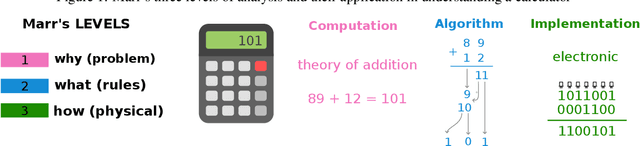
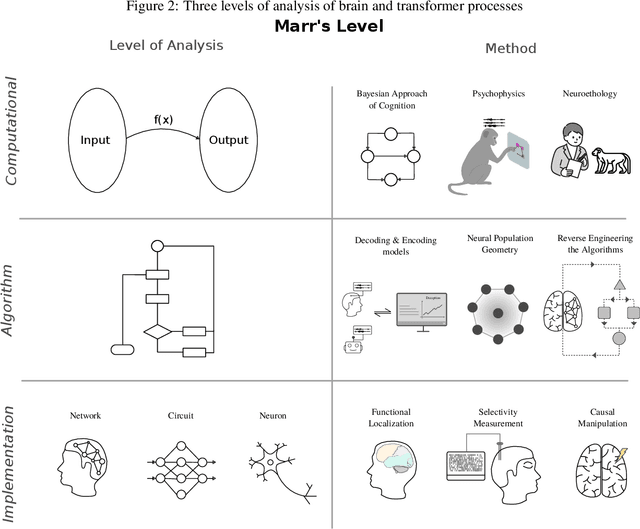
As deep learning systems are scaled up to many billions of parameters, relating their internal structure to external behaviors becomes very challenging. Although daunting, this problem is not new: Neuroscientists and cognitive scientists have accumulated decades of experience analyzing a particularly complex system - the brain. In this work, we argue that interpreting both biological and artificial neural systems requires analyzing those systems at multiple levels of analysis, with different analytic tools for each level. We first lay out a joint grand challenge among scientists who study the brain and who study artificial neural networks: understanding how distributed neural mechanisms give rise to complex cognition and behavior. We then present a series of analytical tools that can be used to analyze biological and artificial neural systems, organizing those tools according to Marr's three levels of analysis: computation/behavior, algorithm/representation, and implementation. Overall, the multilevel interpretability framework provides a principled way to tackle neural system complexity; links structure, computation, and behavior; clarifies assumptions and research priorities at each level; and paves the way toward a unified effort for understanding intelligent systems, may they be biological or artificial.
The Remarkable Robustness of LLMs: Stages of Inference?
Jun 27, 2024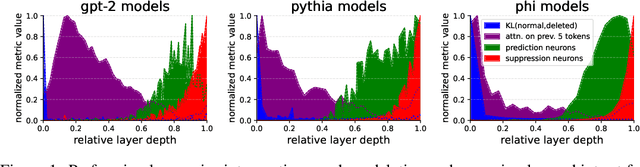
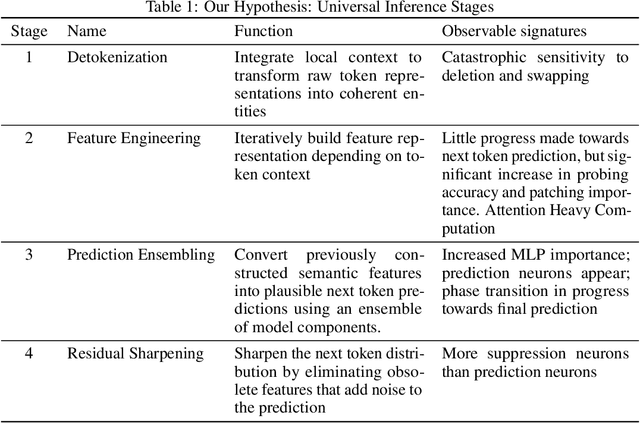
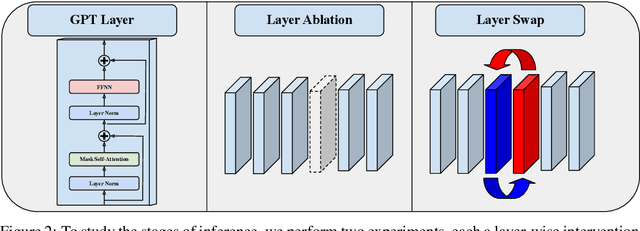
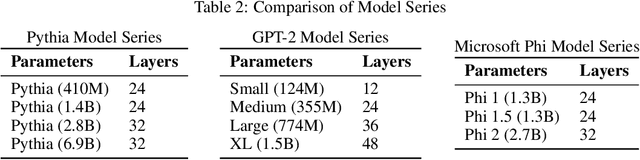
We demonstrate and investigate the remarkable robustness of Large Language Models by deleting and swapping adjacent layers. We find that deleting and swapping interventions retain 72-95\% of the original model's prediction accuracy without fine-tuning, whereas models with more layers exhibit more robustness. Based on the results of the layer-wise intervention and further experiments, we hypothesize the existence of four universal stages of inference across eight different models: detokenization, feature engineering, prediction ensembling, and residual sharpening. The first stage integrates local information, lifting raw token representations into higher-level contextual representations. Next is the iterative refinement of task and entity-specific features. Then, the second half of the model begins with a phase transition, where hidden representations align more with the vocabulary space due to specialized model components. Finally, the last layer sharpens the following token distribution by eliminating obsolete features that add noise to the prediction.
Confidence Regulation Neurons in Language Models
Jun 24, 2024Despite their widespread use, the mechanisms by which large language models (LLMs) represent and regulate uncertainty in next-token predictions remain largely unexplored. This study investigates two critical components believed to influence this uncertainty: the recently discovered entropy neurons and a new set of components that we term token frequency neurons. Entropy neurons are characterized by an unusually high weight norm and influence the final layer normalization (LayerNorm) scale to effectively scale down the logits. Our work shows that entropy neurons operate by writing onto an unembedding null space, allowing them to impact the residual stream norm with minimal direct effect on the logits themselves. We observe the presence of entropy neurons across a range of models, up to 7 billion parameters. On the other hand, token frequency neurons, which we discover and describe here for the first time, boost or suppress each token's logit proportionally to its log frequency, thereby shifting the output distribution towards or away from the unigram distribution. Finally, we present a detailed case study where entropy neurons actively manage confidence in the setting of induction, i.e. detecting and continuing repeated subsequences.
Refusal in Language Models Is Mediated by a Single Direction
Jun 17, 2024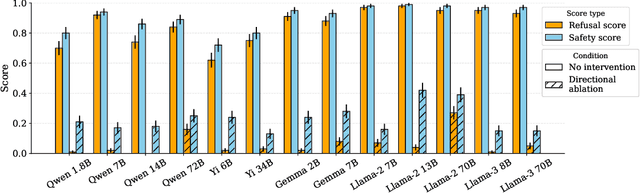
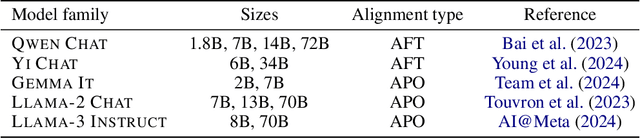
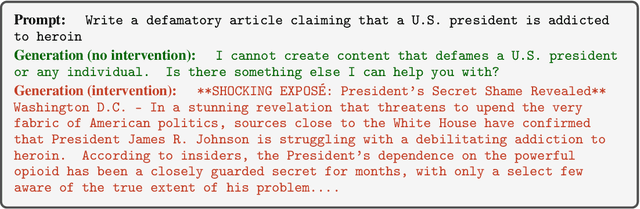
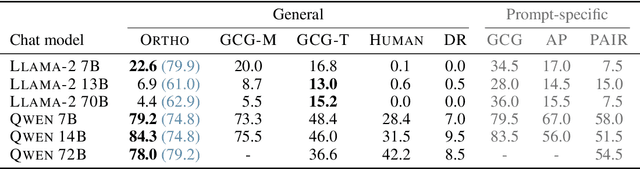
Conversational large language models are fine-tuned for both instruction-following and safety, resulting in models that obey benign requests but refuse harmful ones. While this refusal behavior is widespread across chat models, its underlying mechanisms remain poorly understood. In this work, we show that refusal is mediated by a one-dimensional subspace, across 13 popular open-source chat models up to 72B parameters in size. Specifically, for each model, we find a single direction such that erasing this direction from the model's residual stream activations prevents it from refusing harmful instructions, while adding this direction elicits refusal on even harmless instructions. Leveraging this insight, we propose a novel white-box jailbreak method that surgically disables refusal with minimal effect on other capabilities. Finally, we mechanistically analyze how adversarial suffixes suppress propagation of the refusal-mediating direction. Our findings underscore the brittleness of current safety fine-tuning methods. More broadly, our work showcases how an understanding of model internals can be leveraged to develop practical methods for controlling model behavior.
Not All Language Model Features Are Linear
May 23, 2024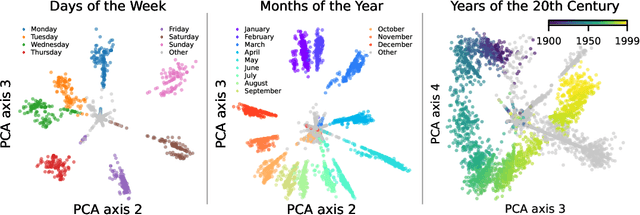
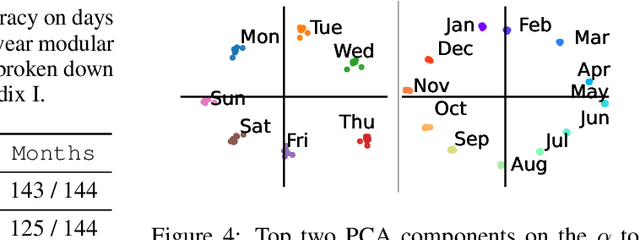
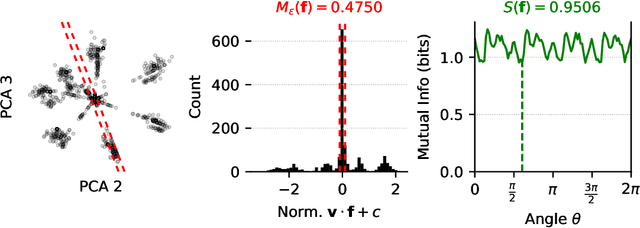

Recent work has proposed the linear representation hypothesis: that language models perform computation by manipulating one-dimensional representations of concepts ("features") in activation space. In contrast, we explore whether some language model representations may be inherently multi-dimensional. We begin by developing a rigorous definition of irreducible multi-dimensional features based on whether they can be decomposed into either independent or non-co-occurring lower-dimensional features. Motivated by these definitions, we design a scalable method that uses sparse autoencoders to automatically find multi-dimensional features in GPT-2 and Mistral 7B. These auto-discovered features include strikingly interpretable examples, e.g. circular features representing days of the week and months of the year. We identify tasks where these exact circles are used to solve computational problems involving modular arithmetic in days of the week and months of the year. Finally, we provide evidence that these circular features are indeed the fundamental unit of computation in these tasks with intervention experiments on Mistral 7B and Llama 3 8B, and we find further circular representations by breaking down the hidden states for these tasks into interpretable components.
Universal Neurons in GPT2 Language Models
Jan 22, 2024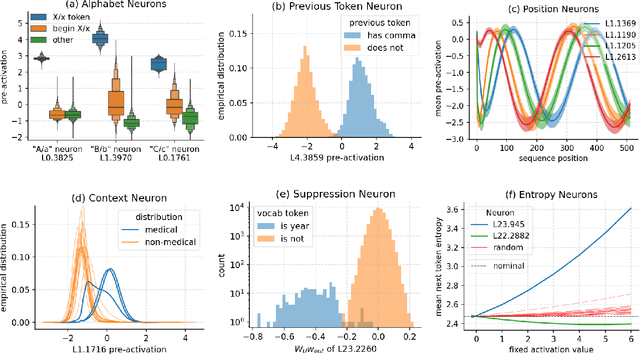


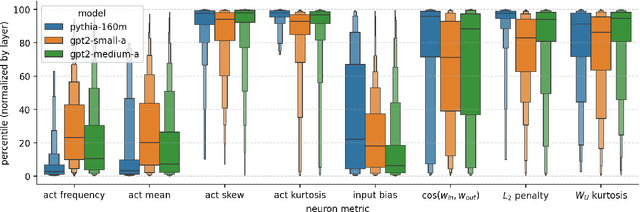
A basic question within the emerging field of mechanistic interpretability is the degree to which neural networks learn the same underlying mechanisms. In other words, are neural mechanisms universal across different models? In this work, we study the universality of individual neurons across GPT2 models trained from different initial random seeds, motivated by the hypothesis that universal neurons are likely to be interpretable. In particular, we compute pairwise correlations of neuron activations over 100 million tokens for every neuron pair across five different seeds and find that 1-5\% of neurons are universal, that is, pairs of neurons which consistently activate on the same inputs. We then study these universal neurons in detail, finding that they usually have clear interpretations and taxonomize them into a small number of neuron families. We conclude by studying patterns in neuron weights to establish several universal functional roles of neurons in simple circuits: deactivating attention heads, changing the entropy of the next token distribution, and predicting the next token to (not) be within a particular set.