 Add to Chrome
 Add to Firefox
 Add to Edge
Scaling Monosemanticity: Extracting Interpretable Features from Claude 3 Sonnet
May 28, 2026
We demonstrate that sparse autoencoders can extract interpretable features from Claude 3 Sonnet, a production-scale language model, addressing the open question of whether dictionary learning methods scale beyond small transformers. We trained sparse autoencoders with up to 34 million features on the model's middle layer residual stream, using scaling laws to guide hyperparameter selection. The resulting features are multilingual and multimodal (generalizing to images despite text-only training), respond to both concrete instances and abstract discussions of concepts, and can be used to steer model behavior in ways consistent with their interpretations. We find features corresponding to famous entities and locations, as well as more abstract concepts like sarcasm or errors in code. We also identify features relevant to ways in which language models might cause harm--including features representing deception, power-seeking, sycophancy, and bias--and show that these causally influence model outputs when manipulated. Additionally, we conduct analyses of feature interpretability, geometry, and computational function. However, significant limitations remain: our suite of features is incomplete, and we lack rigorous methods for evaluating whether our features faithfully capture model computations.

Emotion Concepts and their Function in a Large Language Model
Apr 09, 2026Large language models (LLMs) sometimes appear to exhibit emotional reactions. We investigate why this is the case in Claude Sonnet 4.5 and explore implications for alignment-relevant behavior. We find internal representations of emotion concepts, which encode the broad concept of a particular emotion and generalize across contexts and behaviors it might be linked to. These representations track the operative emotion concept at a given token position in a conversation, activating in accordance with that emotion's relevance to processing the present context and predicting upcoming text. Our key finding is that these representations causally influence the LLM's outputs, including Claude's preferences and its rate of exhibiting misaligned behaviors such as reward hacking, blackmail, and sycophancy. We refer to this phenomenon as the LLM exhibiting functional emotions: patterns of expression and behavior modeled after humans under the influence of an emotion, which are mediated by underlying abstract representations of emotion concepts. Functional emotions may work quite differently from human emotions, and do not imply that LLMs have any subjective experience of emotions, but appear to be important for understanding the model's behavior.
TensorFlow: Large-Scale Machine Learning on Heterogeneous Distributed Systems
Mar 16, 2016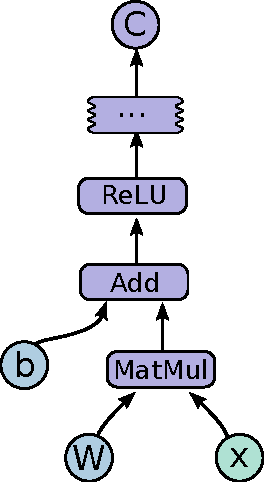
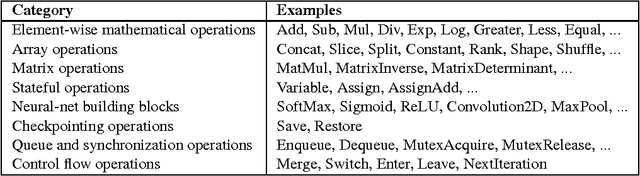
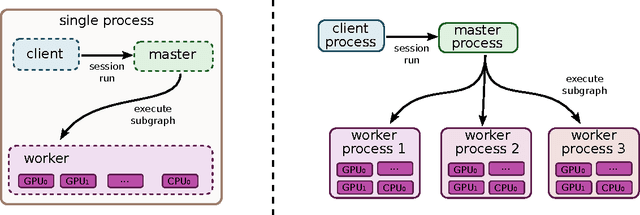
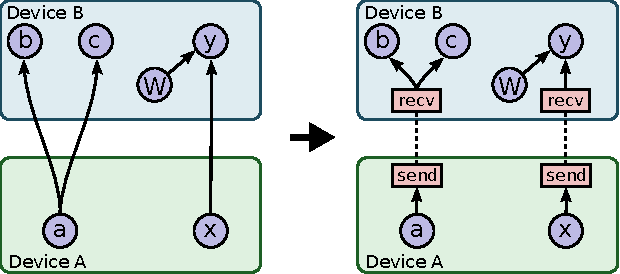
TensorFlow is an interface for expressing machine learning algorithms, and an implementation for executing such algorithms. A computation expressed using TensorFlow can be executed with little or no change on a wide variety of heterogeneous systems, ranging from mobile devices such as phones and tablets up to large-scale distributed systems of hundreds of machines and thousands of computational devices such as GPU cards. The system is flexible and can be used to express a wide variety of algorithms, including training and inference algorithms for deep neural network models, and it has been used for conducting research and for deploying machine learning systems into production across more than a dozen areas of computer science and other fields, including speech recognition, computer vision, robotics, information retrieval, natural language processing, geographic information extraction, and computational drug discovery. This paper describes the TensorFlow interface and an implementation of that interface that we have built at Google. The TensorFlow API and a reference implementation were released as an open-source package under the Apache 2.0 license in November, 2015 and are available at www.tensorflow.org.