 Add to Chrome
 Add to Firefox
 Add to Edge
Verbalizable Representations Form a Global Workspace in Language Models
Jul 16, 2026
Out of everything the human brain processes, only a small fraction is consciously accessible, in the sense of being available for verbal report, deliberate control, and flexible reasoning. In this paper, we present evidence that an analogous functional distinction has emerged in large language models. Using a new interpretability technique, the Jacobian lens, we identify the representations a model is poised to verbalize at any point in its processing. These representations, which we collectively call the J-space, exhibit the functional properties characteristic of a global workspace: their contents can be reported, deliberately summoned and held, used to carry the intermediate steps of silent reasoning, and passed as arguments to arbitrary downstream computations, while automatic processing such as text parsing and routine inference proceeds without them. The J-space also has structural signatures that global workspace theory associates with conscious access: it carries coherent content only in an intermediate band of layers, holds on the order of tens of concepts at a time, and is broadcast by the model's weights more widely than other representations. These properties make it a practical window into a model's unspoken thinking. In alignment audits, it reveals strategic deliberation, evaluation awareness, and trained-in misaligned dispositions that never appear in the model's outputs. We find that post-training installs the Assistant's point of view in the workspace, and we introduce counterfactual reflection training, which improves behavior by training only what a model would say if interrupted and asked to reflect. These results indicate that language models maintain a small, privileged set of representations bearing some of the functional hallmarks of conscious access, and that decoding these representations sheds light on ongoing cognitive processes.

Constrained belief updates explain geometric structures in transformer representations
Feb 04, 2025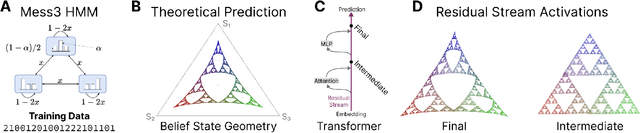
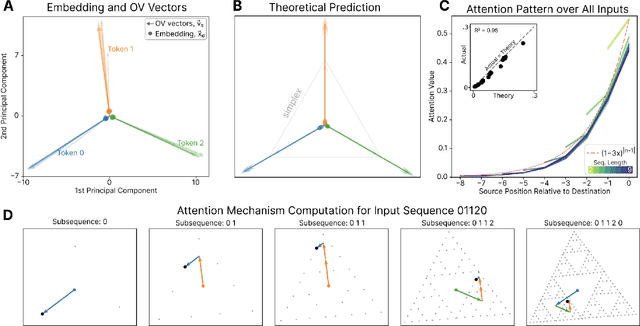
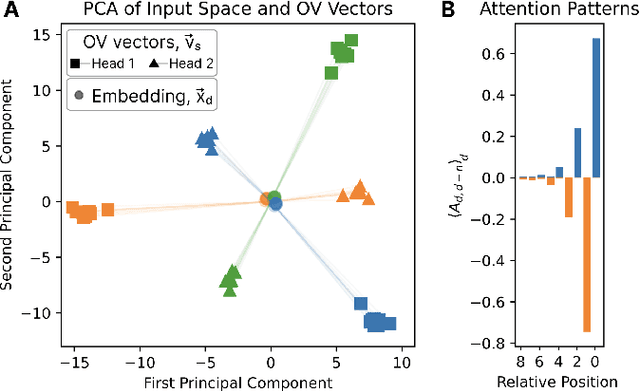
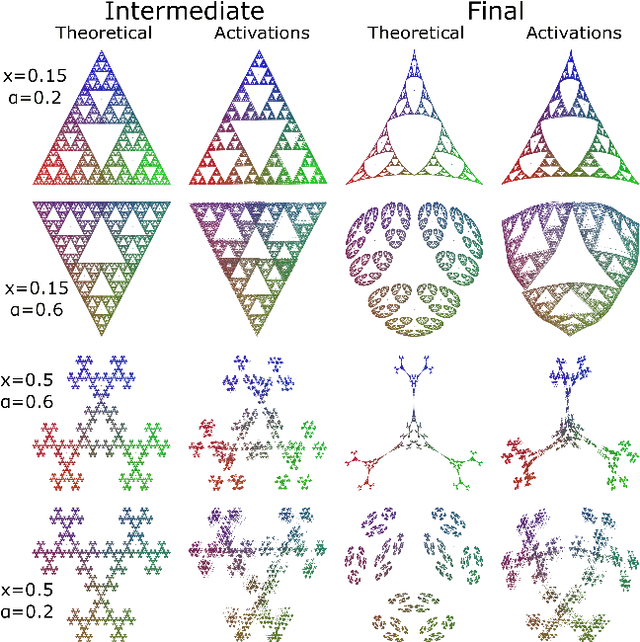
What computational structures emerge in transformers trained on next-token prediction? In this work, we provide evidence that transformers implement constrained Bayesian belief updating -- a parallelized version of partial Bayesian inference shaped by architectural constraints. To do this, we integrate the model-agnostic theory of optimal prediction with mechanistic interpretability to analyze transformers trained on a tractable family of hidden Markov models that generate rich geometric patterns in neural activations. We find that attention heads carry out an algorithm with a natural interpretation in the probability simplex, and create representations with distinctive geometric structure. We show how both the algorithmic behavior and the underlying geometry of these representations can be theoretically predicted in detail -- including the attention pattern, OV-vectors, and embedding vectors -- by modifying the equations for optimal future token predictions to account for the architectural constraints of attention. Our approach provides a principled lens on how gradient descent resolves the tension between optimal prediction and architectural design.