 Add to Chrome
 Add to Firefox
 Add to Edge
FluenceFormer: Transformer-Driven Multi-Beam Fluence Map Regression for Radiotherapy Planning
Dec 27, 2025
Fluence map prediction is central to automated radiotherapy planning but remains an ill-posed inverse problem due to the complex relationship between volumetric anatomy and beam-intensity modulation. Convolutional methods in prior work often struggle to capture long-range dependencies, which can lead to structurally inconsistent or physically unrealizable plans. We introduce \textbf{FluenceFormer}, a backbone-agnostic transformer framework for direct, geometry-aware fluence regression. The model uses a unified two-stage design: Stage~1 predicts a global dose prior from anatomical inputs, and Stage~2 conditions this prior on explicit beam geometry to regress physically calibrated fluence maps. Central to the approach is the \textbf{Fluence-Aware Regression (FAR)} loss, a physics-informed objective that integrates voxel-level fidelity, gradient smoothness, structural consistency, and beam-wise energy conservation. We evaluate the generality of the framework across multiple transformer backbones, including Swin UNETR, UNETR, nnFormer, and MedFormer, using a prostate IMRT dataset. FluenceFormer with Swin UNETR achieves the strongest performance among the evaluated models and improves over existing benchmark CNN and single-stage methods, reducing Energy Error to $\mathbf{4.5\%}$ and yielding statistically significant gains in structural fidelity ($p < 0.05$).

Automated stereotactic radiosurgery planning using a human-in-the-loop reasoning large language model agent
Dec 23, 2025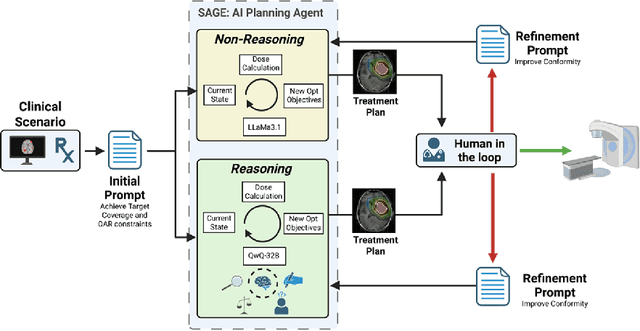
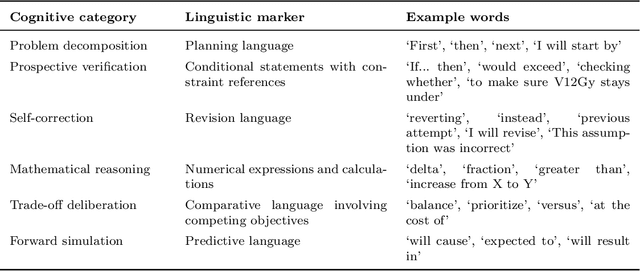
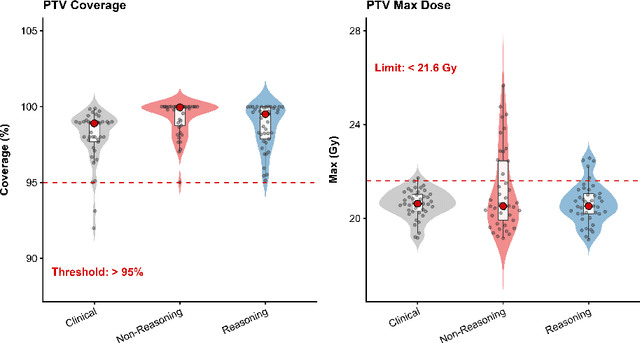
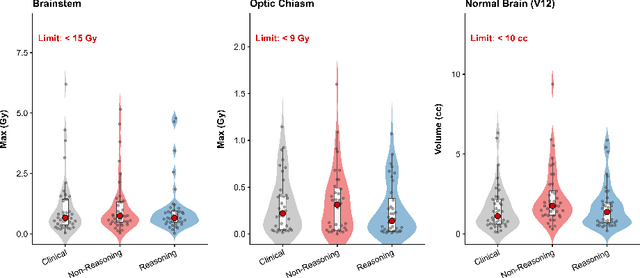
Stereotactic radiosurgery (SRS) demands precise dose shaping around critical structures, yet black-box AI systems have limited clinical adoption due to opacity concerns. We tested whether chain-of-thought reasoning improves agentic planning in a retrospective cohort of 41 patients with brain metastases treated with 18 Gy single-fraction SRS. We developed SAGE (Secure Agent for Generative Dose Expertise), an LLM-based planning agent for automated SRS treatment planning. Two variants generated plans for each case: one using a non-reasoning model, one using a reasoning model. The reasoning variant showed comparable plan dosimetry relative to human planners on primary endpoints (PTV coverage, maximum dose, conformity index, gradient index; all p > 0.21) while reducing cochlear dose below human baselines (p = 0.022). When prompted to improve conformity, the reasoning model demonstrated systematic planning behaviors including prospective constraint verification (457 instances) and trade-off deliberation (609 instances), while the standard model exhibited none of these deliberative processes (0 and 7 instances, respectively). Content analysis revealed that constraint verification and causal explanation concentrated in the reasoning agent. The optimization traces serve as auditable logs, offering a path toward transparent automated planning.
A Scalable Multi-GPU Framework for Encrypted Large-Model Inference
Dec 12, 2025Encrypted AI using fully homomorphic encryption (FHE) provides strong privacy guarantees; but its slow performance has limited practical deployment. Recent works proposed ASICs to accelerate FHE, but require expensive advanced manufacturing processes that constrain their accessibility. GPUs are a far more accessible platform, but achieving ASIC-level performance using GPUs has remained elusive. Furthermore, state-of-the-art approaches primarily focus on small models that fit comfortably within a single device. Supporting large models such as LLMs in FHE introduces a dramatic increase in computational complexity that requires optimized GPU kernels, along with managing terabyte-scale memory footprints that far exceed the capacity of a single GPU. This paper presents Cerium, a multi-GPU framework for FHE inference on large models. Cerium integrates a domain-specific language, an optimizing compiler, and a runtime system to automatically generate high-performance GPU kernels, manage terabyte-scale memory footprints, and parallelize computation across multiple GPUs. It introduces new IR constructs, compiler passes, sparse polynomial representations, memory-efficient data layouts, and communication-aware parallelization techniques that together enable encrypted inference for models ranging from small CNNs to Llama3-8B. We build Cerium on NVIDIA GPUs and demonstrate significant performance gains. For small models, Cerium outperforms expert-written hand-optimized GPU libraries by up to 2.25 times. Cerium achieves performance competitive with state-of-the-art FHE ASICs, outright matching prior FHE ASIC CraterLake. It is the first GPU system to execute bootstrapping in under 10 milliseconds, achieving 7.5 milliseconds, and is the first to demonstrate encrypted inference for BERT-Base and Llama3-8B in 8 seconds and 134 seconds, respectively.
Fluence Map Prediction with Deep Learning: A Transformer-based Approach
Nov 10, 2025Accurate fluence map prediction is essential in intensity-modulated radiation therapy (IMRT) to maximize tumor coverage while minimizing dose to healthy tissues. Conventional optimization is time-consuming and dependent on planner expertise. This study presents a deep learning framework that accelerates fluence map generation while maintaining clinical quality. An end-to-end 3D Swin-UNETR network was trained to predict nine-beam fluence maps directly from volumetric CT images and anatomical contours using 99 prostate IMRT cases (79 for training and 20 for testing). The transformer-based model employs hierarchical self-attention to capture both local anatomical structures and long-range spatial dependencies. Predicted fluence maps were imported into the Eclipse Treatment Planning System for dose recalculation, and model performance was evaluated using beam-wise fluence correlation, spatial gamma analysis, and dose-volume histogram (DVH) metrics. The proposed model achieved an average R^2 of 0.95 +/- 0.02, MAE of 0.035 +/- 0.008, and gamma passing rate of 85 +/- 10 percent (3 percent / 3 mm) on the test set, with no significant differences observed in DVH parameters between predicted and clinical plans. The Swin-UNETR framework enables fully automated, inverse-free fluence map prediction directly from anatomical inputs, enhancing spatial coherence, accuracy, and efficiency while offering a scalable and consistent solution for automated IMRT plan generation.