 Add to Chrome
 Add to Firefox
 Add to Edge
LLM-Bootstrapped Targeted Finding Guidance for Factual MLLM-based Medical Report Generation
Feb 28, 2026
The automatic generation of medical reports utilizing Multimodal Large Language Models (MLLMs) frequently encounters challenges related to factual instability, which may manifest as the omission of findings or the incorporation of inaccurate information, thereby constraining their applicability in clinical settings. Current methodologies typically produce reports based directly on image features, which inherently lack a definitive factual basis. In response to this limitation, we introduce Fact-Flow, an innovative framework that separates the process of visual fact identification from the generation of reports. This is achieved by initially predicting clinical findings from the image, which subsequently directs the MLLM to produce a report that is factually precise. A pivotal advancement of our approach is a pipeline that leverages a Large Language Model (LLM) to autonomously create a dataset of labeled medical findings, effectively eliminating the need for expensive manual annotation. Extensive experimental evaluations conducted on two disease-focused medical datasets validate the efficacy of our method, demonstrating a significant enhancement in factual accuracy compared to state-of-the-art models, while concurrently preserving high standards of text quality.

Training-free Anomaly Event Detection via LLM-guided Symbolic Pattern Discovery
Feb 09, 2025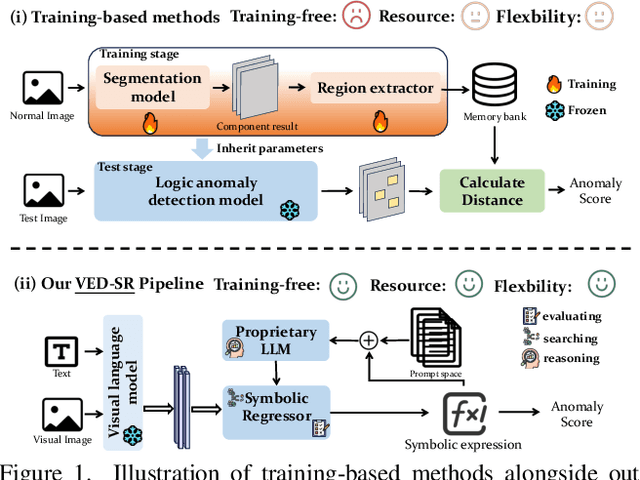
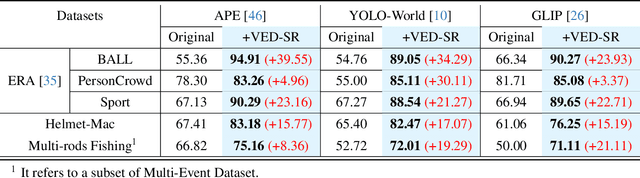
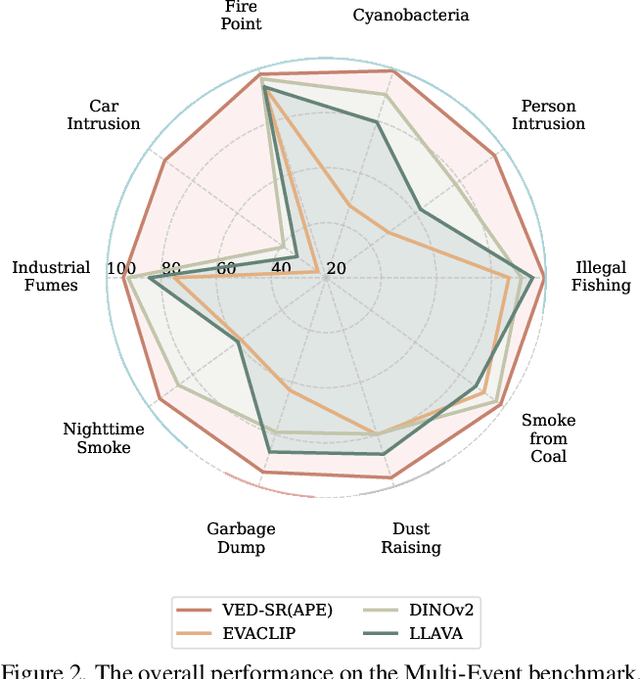
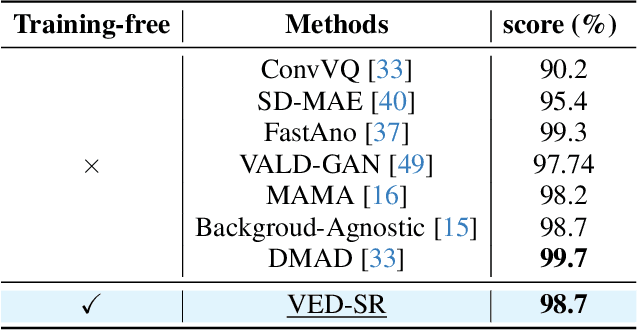
Anomaly event detection plays a crucial role in various real-world applications. However, current approaches predominantly rely on supervised learning, which faces significant challenges: the requirement for extensive labeled training data and lack of interpretability in decision-making processes. To address these limitations, we present a training-free framework that integrates open-set object detection with symbolic regression, powered by Large Language Models (LLMs) for efficient symbolic pattern discovery. The LLMs guide the symbolic reasoning process, establishing logical relationships between detected entities. Through extensive experiments across multiple domains, our framework demonstrates several key advantages: (1) achieving superior detection accuracy through direct reasoning without any training process; (2) providing highly interpretable logical expressions that are readily comprehensible to humans; and (3) requiring minimal annotation effort - approximately 1% of the data needed by traditional training-based methods.To facilitate comprehensive evaluation and future research, we introduce two datasets: a large-scale private dataset containing over 110,000 annotated images covering various anomaly scenarios including construction site safety violations, illegal fishing activities, and industrial hazards, along with a public benchmark dataset of 5,000 samples with detailed anomaly event annotations. Code is available at here.