 Add to Chrome
 Add to Firefox
 Add to Edge
TimePLE: Rethinking Temporal Representation for Video Temporal Grounding
Jul 27, 2026
Video temporal grounding (VTG) aims to localize the continuous video interval described by a natural-language query. However, current VLM-based methods typically produce this interval indirectly through two endpoint outputs, represented either as discrete timestamp tokens or continuous boundary coordinates. These formulations differ in how endpoints are encoded, but not in what is predicted: the event interval remains a derived object, while interval validity, duration, and interval-level similarity are handled only implicitly. We propose TimePLE, which reformulates VTG from endpoint prediction to interval-native grounding by predicting a single joint distribution over valid temporal intervals. TimePLE maps each interval to a point in a canonical position-duration square, where every support point corresponds to a valid span and neighboring points represent geometrically similar intervals. Given a video and query, the VLM generates a single latent <|TIMESPAN|> token whose hidden state is decoded into a joint interval distribution, refined through duration-aware coordinate correction, and converted into continuous boundaries. The same interval representation is used to encode input temporal anchors, aligning video-side temporal evidence with output-side span prediction. To reliably align the latent span representation with complete event intervals, we curate 90K-scale grounded samples and human-verify 3K-scale benchmark annotations. Experiments across four VTG benchmarks show that TimePLE consistently outperforms endpoint prediction baselines, achieving an average mIoU of 58.9, with clear gains on short-duration and medium-duration events.

WaveZip: Wavelet-Driven Space-Time Decoupling for Video Token Condensation
Jul 25, 2026Existing Large Vision-Language Models (LVLMs) struggle with long-form video understanding due to the quadratic computational cost of visual tokens. While recent efficient methods attempt to compress tokens via hard pruning or uniform merging, they operate strictly in the spatial feature domain, where robust structural context and discriminative semantic details are inherently entangled. In this work, we propose WaveZip, a joint signal-frequency-domain framework for efficient video inference. Driven by the insight that temporal redundancy resides in low-pass approximation scales while spatial saliency strongly correlates with high-frequency components, WaveZip leverages Discrete Wavelet Transforms (DWT) to disentangle these signals. Temporally, it employs 1D DWT to analyze query-frame relevance, and the resulting high-frequency coefficients are further gated by inter-frame differences, with both signals jointly driving the dynamic allocation of a precise frame-level token budget. Spatially, a 2D DWT decomposes features into low-frequency approximations and high-frequency detail components, where the high-frequency coefficients are modulated within query-salient regions to regulate spatial reconstruction. Importantly, WaveZip requires no task-specific training and can be seamlessly integrated into off-the-shelf LVLMs to boost inference efficiency. Extensive experiments on long video understanding benchmarks demonstrate that WaveZip retains 99.6% of the full performance under an extreme 10x compression ratio, consistently outperforming state-of-the-art methods.
CineCap: Structured Reasoning with Spatio-Temporal Anchors for Cinematographic Video Captioning
Jun 23, 2026Cinematographic captioning aims to describe how a video is filmed using professional film-language concepts such as camera movement, shot size, depth of field, composition, and shooting angle. This capability is important for fine-grained video understanding and controllable movie-quality video generation, yet remains underexplored in existing multimodal large language models. Unlike question-answering-based evaluation of cinematic understanding, cinematographic captioning requires a unified open-form description over multiple cinematographic dimensions. This task is challenging for two main reasons: the model must infer professional cinematographic concepts from subtle visual evidence, and it must generate captions that are both comprehensive and accurate. Accordingly, we propose CineCap, a framework that combines structured reasoning with spatio-temporal anchors and reinforcement learning with comprehensiveness, accuracy, and gated coverage rewards. The former grounds professional cinematographic descriptions in explicit visual evidence and organizes them into compact atomic reasoning for supervised fine-tuning, while the latter improves the balance between descriptive completeness and factual correctness. In addition, we construct CineCap Bench, a benchmark of 472 manually annotated video-caption pairs for systematic evaluation. Extensive experiments show that CineCap consistently outperforms strong proprietary and open-source baselines, establishing a new state of the art for cinematographic captioning. The code, model checkpoint, and benchmark are publicly available in https://github.com/Hectormxy/CineCap.git.
SocialOmni: Benchmarking Audio-Visual Social Interactivity in Omni Models
Mar 17, 2026Omni-modal large language models (OLMs) redefine human-machine interaction by natively integrating audio, vision, and text. However, existing OLM benchmarks remain anchored to static, accuracy-centric tasks, leaving a critical gap in assessing social interactivity, the fundamental capacity to navigate dynamic cues in natural dialogues. To this end, we propose SocialOmni, a comprehensive benchmark that operationalizes the evaluation of this conversational interactivity across three core dimensions: (i) speaker separation and identification (who is speaking), (ii) interruption timing control (when to interject), and (iii) natural interruption generation (how to phrase the interruption). SocialOmni features 2,000 perception samples and a quality-controlled diagnostic set of 209 interaction-generation instances with strict temporal and contextual constraints, complemented by controlled audio-visual inconsistency scenarios to test model robustness. We benchmarked 12 leading OLMs, which uncovers significant variance in their social-interaction capabilities across models. Furthermore, our analysis reveals a pronounced decoupling between a model's perceptual accuracy and its ability to generate contextually appropriate interruptions, indicating that understanding-centric metrics alone are insufficient to characterize conversational social competence. More encouragingly, these diagnostics from SocialOmni yield actionable signals for bridging the perception-interaction divide in future OLMs.
Event-Anchored Frame Selection for Effective Long-Video Understanding
Mar 01, 2026Massive frame redundancy and limited context window make efficient frame selection crucial for long-video understanding with large vision-language models (LVLMs). Prevailing approaches, however, adopt a flat sampling paradigm which treats the video as an unstructured collection of frames. In this paper, we introduce Event-Anchored Frame Selection (EFS), a hierarchical, event-aware pipeline. Leveraging self-supervised DINO embeddings, EFS first partitions the video stream into visually homogeneous temporal segments, which serve as proxies for semantic events. Within each event, it then selects the most query-relevant frame as an anchor. These anchors act as structural priors that guide a global refinement stage using an adaptive Maximal Marginal Relevance (MMR) scheme. This pipeline ensures the final keyframe set jointly optimizes for event coverage, query relevance, and visual diversity. As a training-free, plug-and-play module, EFS can be seamlessly integrated into off-the-shelf LVLMs, yielding substantial gains on challenging video understanding benchmarks. Specifically, when applied to LLaVA-Video-7B, EFS improves accuracy by 4.7%, 4.9%, and 8.8% on VideoMME, LongVideoBench, and MLVU, respectively.
Wavelet-based Frame Selection by Detecting Semantic Boundary for Long Video Understanding
Feb 28, 2026Frame selection is crucial due to high frame redundancy and limited context windows when applying Large Vision-Language Models (LVLMs) to long videos. Current methods typically select frames with high relevance to a given query, resulting in a disjointed set of frames that disregard the narrative structure of video. In this paper, we introduce Wavelet-based Frame Selection by Detecting Semantic Boundary (WFS-SB), a training-free framework that presents a new perspective: effective video understanding hinges not only on high relevance but, more importantly, on capturing semantic shifts - pivotal moments of narrative change that are essential to comprehending the holistic storyline of video. However, direct detection of abrupt changes in the query-frame similarity signal is often unreliable due to high-frequency noise arising from model uncertainty and transient visual variations. To address this, we leverage the wavelet transform, which provides an ideal solution through its multi-resolution analysis in both time and frequency domains. By applying this transform, we decompose the noisy signal into multiple scales and extract a clean semantic change signal from the coarsest scale. We identify the local extrema of this signal as semantic boundaries, which segment the video into coherent clips. Building on this, WFS-SB comprises a two-stage strategy: first, adaptively allocating a frame budget to each clip based on a composite importance score; and second, within each clip, employing the Maximal Marginal Relevance approach to select a diverse yet relevant set of frames. Extensive experiments show that WFS-SB significantly boosts LVLM performance, e.g., improving accuracy by 5.5% on VideoMME, 9.5% on MLVU, and 6.2% on LongVideoBench, consistently outperforming state-of-the-art methods.
Training-free Anomaly Event Detection via LLM-guided Symbolic Pattern Discovery
Feb 09, 2025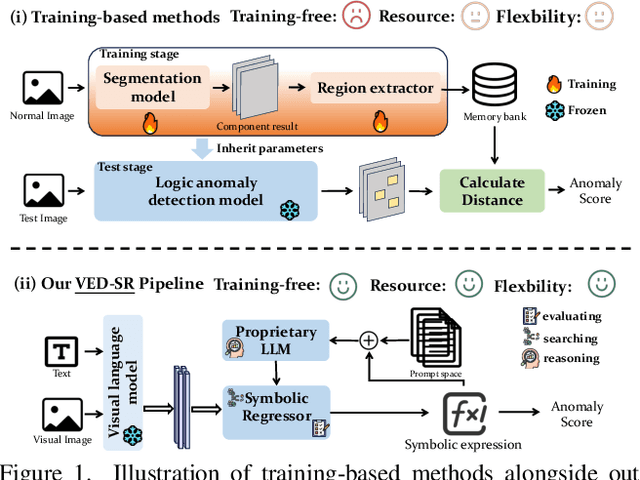
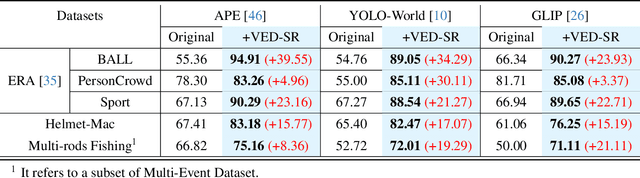
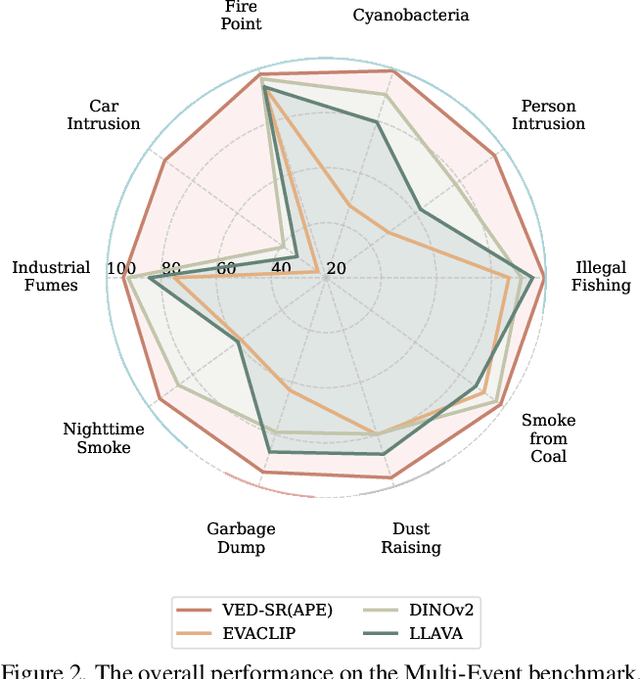
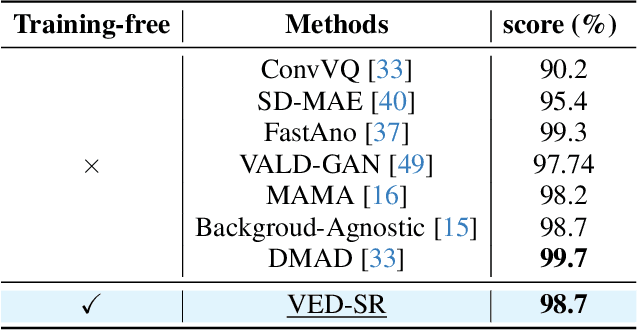
Anomaly event detection plays a crucial role in various real-world applications. However, current approaches predominantly rely on supervised learning, which faces significant challenges: the requirement for extensive labeled training data and lack of interpretability in decision-making processes. To address these limitations, we present a training-free framework that integrates open-set object detection with symbolic regression, powered by Large Language Models (LLMs) for efficient symbolic pattern discovery. The LLMs guide the symbolic reasoning process, establishing logical relationships between detected entities. Through extensive experiments across multiple domains, our framework demonstrates several key advantages: (1) achieving superior detection accuracy through direct reasoning without any training process; (2) providing highly interpretable logical expressions that are readily comprehensible to humans; and (3) requiring minimal annotation effort - approximately 1% of the data needed by traditional training-based methods.To facilitate comprehensive evaluation and future research, we introduce two datasets: a large-scale private dataset containing over 110,000 annotated images covering various anomaly scenarios including construction site safety violations, illegal fishing activities, and industrial hazards, along with a public benchmark dataset of 5,000 samples with detailed anomaly event annotations. Code is available at here.