 Add to Chrome
 Add to Firefox
 Add to Edge
StarOR: Synergizing Tree Search and Test-Time Reinforcement Learning for Optimization Modeling
Jun 18, 2026
Optimization modeling is inherently hierarchical, requiring a precise sequence of symbolic commitments. Traditional learning-based automated optimization modeling methods improve modeling policies through large-scale annotated or curated training data, but are costly to adapt to new problem distributions. Meanwhile, one-shot generation remains brittle in hierarchical modeling, where early symbolic errors can propagate into invalid formulations. Test-time scaling offers a promising alternative by enabling structural exploration with additional instance-level computation; however, existing search-based methods typically rely on a fixed policy, causing repeated rollouts to inherit similar modeling biases and providing limited credit assignment for intermediate decisions. To address these limitations, we propose StarOR, a synergistic search-and-adaptation framework that couples MCTS with Test-Time Reinforcement Learning for optimization modeling. StarOR decomposes the modeling process into four stages and updates a transient LoRA adapter via GRPO at each non-terminal node. By using MCTS-generated siblings as local comparison sets, StarOR transforms search-time exploration into instance-specific policy refinement. Moreover, an unsupervised multi-faceted reward system provides fine-grained feedback for intermediate formulation decisions without ground-truth labels. Experiments across five optimization benchmarks show that StarOR achieves state-of-the-art performance even with a 4B backbone, outperforming existing methods and the frontier LLMs.

ORAgentBench: Can LLM Agents Solve Challenging Operations Research Tasks End to End?
Jun 18, 2026Large language models are increasingly deployed as autonomous agents for multi-step tasks in executable environments, yet their ability to perform realistic operations research (OR) work remains unclear. Existing OR evaluations often decouple modeling from solving, rely on pre-formalized or text-only instances, and rarely test the full workflow from operational artifacts to validated decisions. In this work, we introduce ORAgentBench, an execution-grounded benchmark for evaluating autonomous agents on challenging end-to-end operations research tasks. It contains 107 human-reviewed tasks across diverse operational scenarios, each packaged in an isolated environment with a natural-language brief, multi-file data, configuration artifacts, and a required submission schema. Agents must write and run solution code, and their submissions are evaluated by hidden validators for schema validity, hard-constraint feasibility, and normalized objective quality. Experiments with fourteen frontier agent-model configurations show that current agents remain far from reliable OR practice. The best agent passes only 35.51% of all tasks and 20.59% of hard tasks, and many feasible submissions still fall below the required quality threshold. Failure analysis further shows that errors are dominated by strategic weaknesses, including missed operational rules, brittle formulations, weak feasible-solution construction, and insufficient solution improvement. OR-specific procedural skills increase hard-task feasibility, but do not reliably improve solution quality or pass rate. These results suggest that progress in OR agents requires moving beyond plausible optimization code toward dependable, high-quality operational decision-making.
Grasp-Then-Plan with Failure Attribution: A Closed Two-Stage Framework for Precise and Generalizable Robotic Manipulation
Jun 02, 2026In robotic manipulation, the tight coupling between grasping and motion planning often obscures the true source of failure, leading to inefficient trial-and-error. To enable efficient long-horizon manipulation, we propose GTP-FA (Grasp-Then-Plan with Failure Attribution), a task-oriented two-stage grasp-then-plan framework that generates grasp candidates and performs downstream motion planning conditioned on the selected grasp. Given a failed manipulation trajectory, we learn a failure attribution model that generalizes to unseen grasps and produces a stable distribution over failure modes for diagnosis-guided optimization. Based on these attribution results, we then optimize both modules in a diagnosis-driven manner: on the grasping side, we inject task-level priors and risk penalties into grasp candidate scoring and optimization to suppress unstable or task-incompatible grasps; on the planning side, we target high-risk initial states through data collection and fine-tuning to address genuine planning bottlenecks. We evaluate the proposed framework in both simulation and real-robot experiments, and show that GTP-FA improves the corresponding base learners across RL, IL, diffusion-policy, and VLA-based settings, achieving substantially higher overall task success rates.
MicLog: Towards Accurate and Efficient LLM-based Log Parsing via Progressive Meta In-Context Learning
Jan 11, 2026Log parsing converts semi-structured logs into structured templates, forming a critical foundation for downstream analysis. Traditional syntax and semantic-based parsers often struggle with semantic variations in evolving logs and data scarcity stemming from their limited domain coverage. Recent large language model (LLM)-based parsers leverage in-context learning (ICL) to extract semantics from examples, demonstrating superior accuracy. However, LLM-based parsers face two main challenges: 1) underutilization of ICL capabilities, particularly in dynamic example selection and cross-domain generalization, leading to inconsistent performance; 2) time-consuming and costly LLM querying. To address these challenges, we present MicLog, the first progressive meta in-context learning (ProgMeta-ICL) log parsing framework that combines meta-learning with ICL on small open-source LLMs (i.e., Qwen-2.5-3B). Specifically, MicLog: i) enhances LLMs' ICL capability through a zero-shot to k-shot ProgMeta-ICL paradigm, employing weighted DBSCAN candidate sampling and enhanced BM25 demonstration selection; ii) accelerates parsing via a multi-level pre-query cache that dynamically matches and refines recently parsed templates. Evaluated on Loghub-2.0, MicLog achieves 10.3% higher parsing accuracy than the state-of-the-art parser while reducing parsing time by 42.4%.
Constraint Matters: Multi-Modal Representation for Reducing Mixed-Integer Linear programming
Aug 26, 2025Model reduction, which aims to learn a simpler model of the original mixed integer linear programming (MILP), can solve large-scale MILP problems much faster. Most existing model reduction methods are based on variable reduction, which predicts a solution value for a subset of variables. From a dual perspective, constraint reduction that transforms a subset of inequality constraints into equalities can also reduce the complexity of MILP, but has been largely ignored. Therefore, this paper proposes a novel constraint-based model reduction approach for the MILP. Constraint-based MILP reduction has two challenges: 1) which inequality constraints are critical such that reducing them can accelerate MILP solving while preserving feasibility, and 2) how to predict these critical constraints efficiently. To identify critical constraints, we first label these tight-constraints at the optimal solution as potential critical constraints and design a heuristic rule to select a subset of critical tight-constraints. To learn the critical tight-constraints, we propose a multi-modal representation technique that leverages information from both instance-level and abstract-level MILP formulations. The experimental results show that, compared to the state-of-the-art methods, our method improves the quality of the solution by over 50\% and reduces the computation time by 17.47\%.
Fast and Interpretable Mixed-Integer Linear Program Solving by Learning Model Reduction
Dec 31, 2024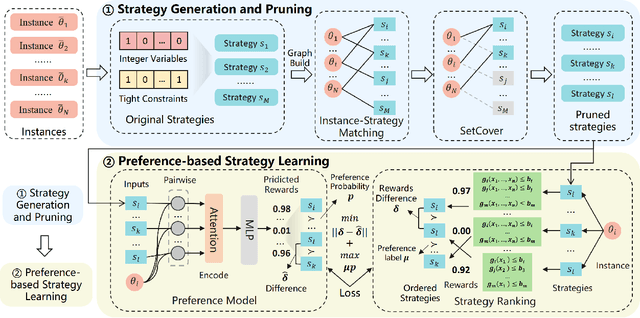
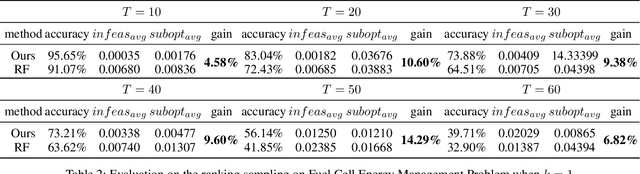
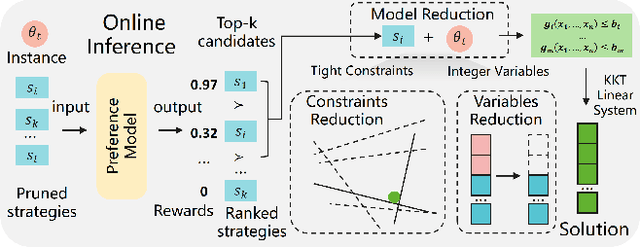
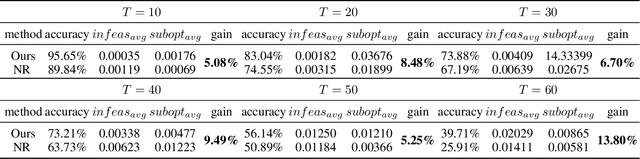
By exploiting the correlation between the structure and the solution of Mixed-Integer Linear Programming (MILP), Machine Learning (ML) has become a promising method for solving large-scale MILP problems. Existing ML-based MILP solvers mainly focus on end-to-end solution learning, which suffers from the scalability issue due to the high dimensionality of the solution space. Instead of directly learning the optimal solution, this paper aims to learn a reduced and equivalent model of the original MILP as an intermediate step. The reduced model often corresponds to interpretable operations and is much simpler, enabling us to solve large-scale MILP problems much faster than existing commercial solvers. However, current approaches rely only on the optimal reduced model, overlooking the significant preference information of all reduced models. To address this issue, this paper proposes a preference-based model reduction learning method, which considers the relative performance (i.e., objective cost and constraint feasibility) of all reduced models on each MILP instance as preferences. We also introduce an attention mechanism to capture and represent preference information, which helps improve the performance of model reduction learning tasks. Moreover, we propose a SetCover based pruning method to control the number of reduced models (i.e., labels), thereby simplifying the learning process. Evaluation on real-world MILP problems shows that 1) compared to the state-of-the-art model reduction ML methods, our method obtains nearly 20% improvement on solution accuracy, and 2) compared to the commercial solver Gurobi, two to four orders of magnitude speedups are achieved.
i-Rebalance: Personalized Vehicle Repositioning for Supply Demand Balance
Jan 09, 2024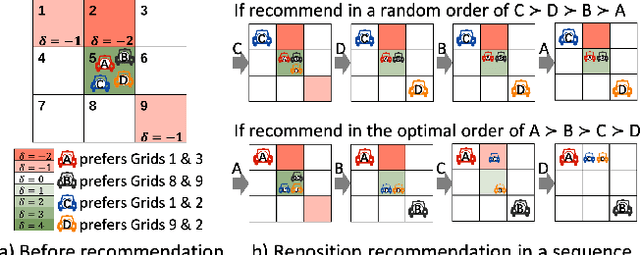
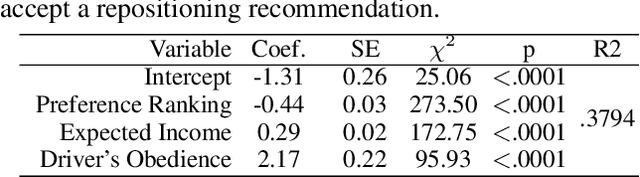
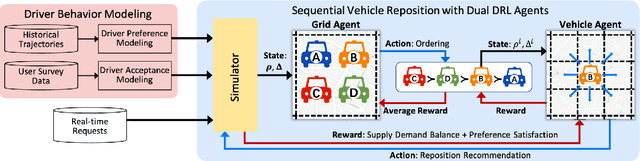
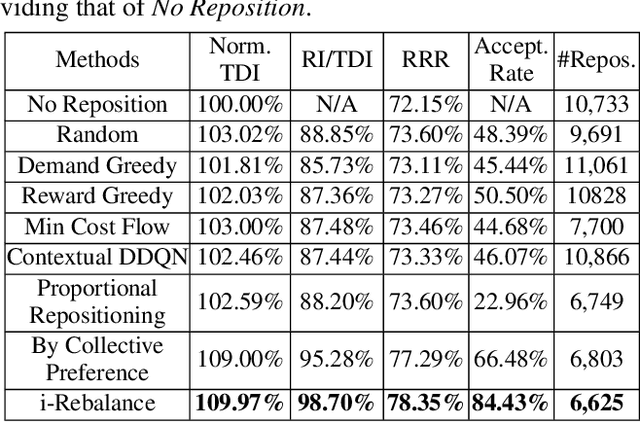
Ride-hailing platforms have been facing the challenge of balancing demand and supply. Existing vehicle reposition techniques often treat drivers as homogeneous agents and relocate them deterministically, assuming compliance with the reposition. In this paper, we consider a more realistic and driver-centric scenario where drivers have unique cruising preferences and can decide whether to take the recommendation or not on their own. We propose i-Rebalance, a personalized vehicle reposition technique with deep reinforcement learning (DRL). i-Rebalance estimates drivers' decisions on accepting reposition recommendations through an on-field user study involving 99 real drivers. To optimize supply-demand balance and enhance preference satisfaction simultaneously, i-Rebalance has a sequential reposition strategy with dual DRL agents: Grid Agent to determine the reposition order of idle vehicles, and Vehicle Agent to provide personalized recommendations to each vehicle in the pre-defined order. This sequential learning strategy facilitates more effective policy training within a smaller action space compared to traditional joint-action methods. Evaluation of real-world trajectory data shows that i-Rebalance improves driver acceptance rate by 38.07% and total driver income by 9.97%.
Real-Time Network-Level Traffic Signal Control: An Explicit Multiagent Coordination Method
Jun 15, 2023Efficient traffic signal control (TSC) has been one of the most useful ways for reducing urban road congestion. Key to the challenge of TSC includes 1) the essential of real-time signal decision, 2) the complexity in traffic dynamics, and 3) the network-level coordination. Recent efforts that applied reinforcement learning (RL) methods can query policies by mapping the traffic state to the signal decision in real-time, however, is inadequate for unexpected traffic flows. By observing real traffic information, online planning methods can compute the signal decisions in a responsive manner. We propose an explicit multiagent coordination (EMC)-based online planning methods that can satisfy adaptive, real-time and network-level TSC. By multiagent, we model each intersection as an autonomous agent, and the coordination efficiency is modeled by a cost (i.e., congestion index) function between neighbor intersections. By network-level coordination, each agent exchanges messages with respect to cost function with its neighbors in a fully decentralized manner. By real-time, the message passing procedure can interrupt at any time when the real time limit is reached and agents select the optimal signal decisions according to the current message. Moreover, we prove our EMC method can guarantee network stability by borrowing ideas from transportation domain. Finally, we test our EMC method in both synthetic and real road network datasets. Experimental results are encouraging: compared to RL and conventional transportation baselines, our EMC method performs reasonably well in terms of adapting to real-time traffic dynamics, minimizing vehicle travel time and scalability to city-scale road networks.